
About this story
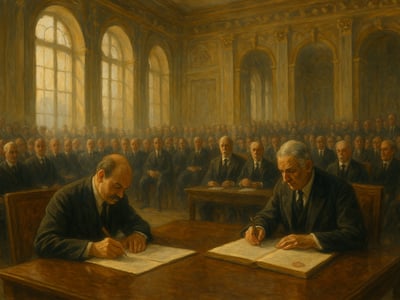
Treaty of Trianon signing at Versailles on 4 June 1920 in the postwar peace settlement.
On June 4, 1920, representatives gathered at the Grand Trianon Palace in Versailles to sign one of the major peace treaties that followed the First World War. The Treaty of Trianon fixed Hungary's internationally recognized frontiers after the collapse of Austria-Hungary and confirmed the transfer of territories from the former Kingdom of Hungary to neighboring states. Among those changes was the incorporation of areas of present-day Slovakia into Czechoslovakia, a state that had emerged from the war and was seeking international recognition and stable borders.
The signing came at the end of a longer diplomatic process rather than as a single dramatic decision made in one room. When Austria-Hungary disintegrated in 1918, its former lands did not simply fall into a settled order. New and expanded states appeared across Central Europe, but their claims had to be translated into internationally accepted legal terms. That work was taken up at the Paris Peace Conference, where military outcomes, political claims, ethnic arguments, strategic concerns, and practical questions of administration all had to be weighed.
Hungary entered those negotiations in a difficult position. It was being asked to accept a postwar settlement that differed sharply from the borders of the prewar Kingdom of Hungary. On January 16, 1920, the Hungarian delegate Albert Apponyi presented Hungary's case before the Peace Conference in Paris. His appearance became one of the best-known moments in the Hungarian response to the proposed settlement. He argued against the scale of the territorial losses and appealed to historical, demographic, and political considerations. But by that stage, the broad direction of the Allied and Associated Powers was already set.
The decisive step came on May 6, 1920, when the Hungarian peace delegation received the final treaty terms. At that point, the remaining question was no longer whether the old kingdom would be restored, but whether Hungary would formally sign an agreement it regarded as unacceptable. Refusal carried risks of its own. Not signing would not reverse the military and political collapse of 1918, and it could prolong diplomatic isolation while leaving the practical enforcement of new borders even more uncertain.
That is what gave the ceremony at Versailles its significance. The treaty was not only a statement of political intent; it was a legal instrument meant to turn a fluid and disputed postwar situation into a recognized international order. On behalf of Hungary, the treaty was signed by Ágost Benárd and Alfréd Drasche-Lázár. Their signatures did not end disagreement over the settlement, but they did mark Hungary's formal entry into the peace framework established by the victorious powers.
For Czechoslovakia, the treaty helped confirm the transfer of territories that included much of present-day Slovakia. In practical terms, that meant the new border arrangement had to be administered on the ground. Governments, local authorities, and later border commissions faced the work of aligning law, taxation, transport, policing, and public administration with the postwar map. A line drawn in a treaty text had consequences for courts, schools, customs posts, and military jurisdiction.
The treaty also mattered because borders were not just lines between states. They affected populations living in the transferred territories, including minorities who now found themselves under a different government than before the war. Questions of language, citizenship, representation, and administration became part of everyday politics in the successor states. These issues were not unique to Hungary or Czechoslovakia, but Trianon became one of the clearest examples of how a peace settlement could reshape both state structures and local lives.
Even so, the signing on June 4 should not be confused with the end of the process. The treaty entered into force later, on July 26, 1921, after ratifications were completed. That interval matters because peace treaties depended not only on ceremony but also on formal legal approval and implementation. Only then did the settlement fully take effect in the international system.
Why it still matters
The Treaty of Trianon remains important because it shows how international diplomacy converted the outcome of war into binding law. The collapse of an empire created new political realities, but those realities still had to be recorded in treaty language, signed by delegates, ratified by states, and enforced by administrative institutions. Trianon is a clear example of that process.
It also continues to matter for the history of Central Europe. The treaty helps explain the territorial framework within which Czechoslovakia governed the lands that included present-day Slovakia during much of the twentieth century. It is part of the broader history of state succession: what happens when one state disappears, several others claim its former territory, and an international conference attempts to define the legal result.
At the same time, the treaty remains sensitive in regional historical memory. Interpretations of its causes and consequences differ across Hungarian, Slovak, Romanian, and other Central European narratives, especially when questions of borders, minorities, and historical justice are involved. For that reason, Trianon is best understood not as a simple verdict on the past, but as a document that formalized a contested postwar settlement whose effects lasted well beyond the signing table at Versailles.
Looking back at June 4, 1920, the lasting significance of the treaty lies in that combination of ceremony and administration. A few signatures in a palace outside Paris helped define borders that states would govern, defend, debate, and remember for generations.
Timeline
- Collapse of Austria-Hungary
- Hungarian case presented at Paris Peace Conference
- Final treaty terms delivered to Hungarian delegation
- Treaty of Trianon signed
- Treaty of Trianon enters into force
What you uncovered
A Border Becomes Law
You didn't just… complete a puzzle; you traced the moment when a postwar settlement was turned into a legal framework that states had to enforce and administer.
Treaties like Trianon did more than announce political outcomes: they translated the collapse of an empire into borders that officials, courts, and commissions had to define in practice. That process shaped how successor states governed territory, populations, and jurisdiction long after the signing room was emptied. Its importance lies not only in the map it drew, but in the institutions required to make that map function.
The Treaty of Trianon entered into force on 1921-07-26, more than a year after it was signed at Versailles.
FAQ
What happened on 4 June 1920 in Versailles?
The Treaty of Trianon was signed on 4 June 1920 at the Grand Trianon Palace in Versailles, France. It was part of the post-First World War peace settlement.
Who signed the Treaty of Trianon for Hungary?
The treaty was signed on behalf of Hungary by Ágost Benárd and Alfréd Drasche-Lázár. Hungarian delegate Albert Apponyi had earlier presented Hungary’s case before the Peace Conference in Paris.
What did the Treaty of Trianon decide about Hungary's borders?
The treaty set Hungary’s internationally recognized frontiers after the war. It also confirmed the transfer of former Kingdom of Hungary territories to neighboring states.
How did the treaty affect present-day Slovakia?
The treaty confirmed the incorporation of areas of present-day Slovakia into Czechoslovakia. It was one of the agreements that defined the new postwar territorial order in Central Europe.
When did the Treaty of Trianon enter into force?
It entered into force on 26 July 1921, after ratifications were completed. That was later than the signing because the treaty had to be formally ratified before it became effective.