
About this story
Secretariat wins the 1973 Belmont Stakes at Belmont Park and completes the U.S. Triple Crown
On June 9, 1973, Secretariat ran in the 105th Belmont Stakes at Belmont Park in Elmont, New York, with a chance to finish what few American racehorses had managed before him. He had already won the Kentucky Derby on May 5 at Churchill Downs in Louisville and the Preakness Stakes on May 19 at Pimlico Race Course in Baltimore. One race remained. It was also the longest of the three, contested over 1 1/2 miles, and for any horse trying to complete the U.S. Triple Crown, it was the final and most demanding test.
That structure gave the Belmont its special weight. The Triple Crown is not a single contest but a sequence of three major races run over five weeks, each with its own conditions, pace, and pressure. By the time a horse reaches Belmont Park with victories in the first two legs, the challenge is no longer just talent. It is also management, stamina, and judgment. A horse can arrive with national attention and still lose the series in the final stretch of the last race.
Secretariat entered that moment as the leading colt of his generation and the standard-bearer for Meadow Stable, owned by Penny Chenery. His trainer, Lucien Laurin, and his jockey, Ron Turcotte, had to weigh a basic but serious question: how much speed should they let him use early? In the Belmont, a fast beginning can create danger later. The distance is longer than the Derby or the Preakness, and a horse that spends too much energy too soon may weaken badly before the finish.
That was the risk on the afternoon of June 9. Secretariat was not merely trying to win another prestigious race. He was trying to hold together three elite performances across different tracks and distances in just over a month. The horse had already shown speed in the Derby and determination in the Preakness. The Belmont would ask whether he could turn those qualities into sustained command over the longest course of the series.
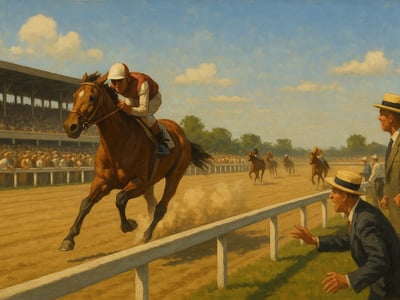
When the field broke from the gate, Turcotte did not restrain Secretariat into a cautious waiting ride. Instead, Secretariat moved forward and established his rhythm near the front. In a race of this length, such a choice invited scrutiny. If the pace proved too strong, the consequences would come late and clearly. Rivals who had conserved more energy could close in the stretch, and the Triple Crown bid would disappear within sight of the finish.
Instead, the opposite happened. Secretariat continued to lengthen his advantage as the race went on. Rather than showing strain in the final stages, he widened the gap. What had begun as a closely watched championship attempt became an exhibition of separation. By the time the field entered the stretch, the question was no longer whether he would win, but by how much.
Official race records list Secretariat's time for the 1 1/2 miles as 2:24. They also list his margin of victory as 31 lengths. Ron Turcotte had ridden him to one of the most measurable outcomes in major American racing: a Triple Crown completed not by a narrow survival in the final leg, but by a performance so far clear of the field that the numbers themselves became part of the story.
Those numbers mattered immediately because they gave the achievement a form beyond memory or impression. Winning the Triple Crown was already rare. Doing it in a final race recorded at 2:24 and by an officially listed margin of 31 lengths made the result easy to compare, quote, and revisit. Sports often preserve their defining moments through statistics as much as through images, and the 1973 Belmont offered both.
The broader context also deepened the significance. Secretariat's victory ended a 25-year gap since the previous U.S. Triple Crown winner. That interval had made the sweep feel difficult to complete, even for outstanding horses. Each spring brought fresh hopes, but the three-race sequence repeatedly proved how hard it was to combine speed, durability, and tactical execution across changing conditions. Secretariat did not remove that difficulty. He demonstrated it by mastering the series from start to finish.
The Belmont also fixed the identities around the horse in the public record. Secretariat was the colt; Turcotte was the rider who guided the final leg; Laurin was the trainer responsible for preparation and race placement; Chenery was the owner whose Meadow Stable became linked permanently with the achievement. In racing, victories belong to a horse on paper, but they are also shared among the people who manage, ride, and sustain the campaign.
Why it still matters
Secretariat's 1973 Belmont Stakes remains a reference point because it joined a championship outcome to a set of official figures that are still easy to understand. The Triple Crown depends on sequence: Kentucky Derby, Preakness Stakes, then Belmont Stakes. Secretariat completed that sequence, and the final leg produced a recorded time of 2:24 and an official margin of 31 lengths. Those facts keep the race central to comparisons whenever another horse approaches the same goal.
The performance also shows how sports memory is built. Multi-event championships often become famous not only because someone wins them, but because the last stage provides a decisive image or unmistakable statistic. In this case, the Belmont turned a successful spring campaign into a lasting benchmark. Coverage of later Triple Crown attempts has repeatedly returned to the same race because it offers a clear standard in both narrative and recordkeeping terms.
Beyond racing fans, the event had consequences for the institutions around the sport. A horse that wins this way increases attention to owners, trainers, breeding discussions, racetracks, and the Triple Crown itself. Secretariat's Belmont did not stand apart from racing's larger system; it helped draw more public focus to that system by making one afternoon at Belmont Park legible even to people who did not follow the sport closely.
More than fifty years later, the race is still remembered not simply as a victory, but as the final proof in a three-part test. Secretariat had arrived at Belmont Park with two major wins already secured. On June 9, 1973, he answered the last question of that campaign in the clearest terms the sport can record: first at the finish, 1 1/2 miles covered in 2:24, and the Triple Crown complete.
Timeline
- Triple Crown gap
- Meadow Stable
- Kentucky Derby
- Preakness Stakes
- Belmont Stakes
What you uncovered
The Shape of a Sweep
You didn't just… complete a puzzle; you traced the final and most demanding stage of a three-race sequence in which pace, distance, and timing all had to hold together on one day.
The Belmont mattered not only because it came last, but because the Triple Crown is built to ask different questions in quick succession. By the time Secretariat reached 1 1/2 miles, the achievement was no longer just about winning another race; it became a measure of how a horse, rider, and stable handled a compressed series with changing conditions. That helps explain why this result still serves as a benchmark in racing memory and comparison.
Secretariat's official winning time of 2:24 for 1 1/2 miles in the 1973 Belmont Stakes remains the race record.
FAQ
What happened at the 1973 Belmont Stakes?
On 1973-06-09, Secretariat won the 105th Belmont Stakes at Belmont Park in Elmont, New York. The victory completed the U.S. Triple Crown after earlier wins in the Kentucky Derby and Preakness Stakes.
Who rode Secretariat in the Belmont Stakes?
Ron Turcotte rode Secretariat in the 1973 Belmont Stakes. He guided the colt to the win at Belmont Park.
Why did the Belmont win complete the Triple Crown?
The Belmont Stakes was the third and final race in Secretariat's Triple Crown series. After winning the Kentucky Derby on 1973-05-05 and the Preakness Stakes on 1973-05-19, the Belmont victory sealed the sweep.
What was Secretariat's Belmont Stakes time and margin?
Official race records list Secretariat's time as 2:24 for 1 1/2 miles. The margin of victory was 31 lengths.
Why is Secretariat's 1973 Belmont still remembered?
The race remains a reference point in horse racing recordkeeping and Triple Crown comparisons. Its official time and 31-length margin made it one of the most notable Belmont results.