
About this story
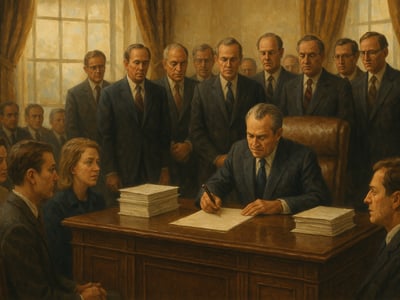
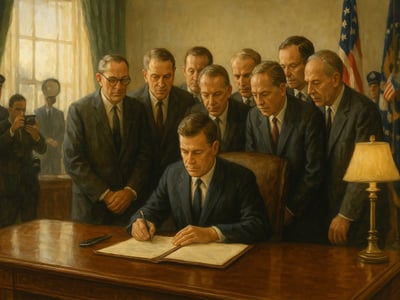
John F. Kennedy and the signing of the Equal Pay Act in Washington, D.C., 1963
On June 10, 1963, President John F. Kennedy signed the Equal Pay Act into law in Washington, D.C., adding a new sex-based pay standard to the federal labor system. The measure did not attempt to remake all of American employment law at once. Instead, it amended the Fair Labor Standards Act of 1938 and addressed one specific problem: employers covered by that law could not pay workers of one sex less than workers of the other sex for equal work in the same establishment, except under certain defined conditions.
That narrow wording reflected both the urgency of the issue and the political limits of the moment. By the early 1960s, wage differences between men and women remained a routine feature of many workplaces. In covered jobs, women often performed work that employers treated as less valuable simply because it was done by women, even when the tasks, effort, and responsibility closely matched those of male employees. Supporters of federal action argued that piecemeal remedies were not enough. If wage discrimination was to be addressed consistently, they said, it had to become part of national labor law.
One of the important advocates for that approach was Esther Peterson, assistant secretary of labor and director of the Women's Bureau during the Kennedy administration. Peterson helped push the issue into federal policy debates and supported legislation that would establish a national rule rather than rely only on scattered state measures or voluntary employer changes. Her work connected labor policy, administrative advocacy, and the broader discussion about the status of women in American public life.
That broader discussion was also taking shape through the Presidential Commission on the Status of Women. In 1963, the commission issued its report, *American Women*, which supported action against wage discrimination. The report did not create law, but it gave official weight to concerns that had often been dismissed as secondary or private matters. It framed unequal pay as a structural issue affecting economic independence, family income, and access to fair employment.
Even with that backing, the path to legislation was not automatic. Lawmakers had to decide whether sex-based wage standards belonged in federal labor law at all. Business opposition and concerns about regulation shaped the debate, as did the limited reach of the existing Fair Labor Standards Act. Because the Equal Pay Act was written as an amendment to that earlier statute, its coverage was tied to the employers and workplaces already falling under that legal framework. In other words, Congress was not creating an entirely new labor code; it was inserting a specific equal-pay rule into an established federal system.
That institutional choice mattered. By working through the Fair Labor Standards Act, Congress used familiar enforcement mechanisms and a known legal structure. At the same time, that choice also meant the law would be narrower than a general ban on all forms of sex discrimination in employment. The statute focused on equal work in the same establishment and allowed specified exceptions, including pay differences based on seniority, merit, systems measuring earnings by quantity or quality of production, or factors other than sex. Supporters saw this as a practical way to secure passage. Critics and later interpreters would note that the law's precision was also a limit.
Congress ultimately approved the Equal Pay Act of 1963, enacted as Public Law 88-38. Kennedy's signature at the White House marked the moment when unequal wages for equal work, at least within the statute's coverage, became a matter of federal labor standards rather than only custom, employer policy, or uneven state action. The law was signed in 1963 but set to take effect one year later, on June 11, 1964, giving employers time to adjust pay practices to the new requirement.
The timing is also notable because the Equal Pay Act came just before another major change in federal law. In 1964, Title VII of the Civil Rights Act would prohibit employment discrimination on several grounds, including sex. But the Equal Pay Act was not replaced by that later legislation. Instead, the two laws developed alongside one another. The Equal Pay Act remained a more targeted rule aimed specifically at wage disparities for equal work, while broader anti-discrimination law addressed a wider range of employment practices.
In that sense, the law signed on June 10, 1963, was both specific and foundational. It did not eliminate wage inequality, and it did not cover every employer or every kind of claim. But it did create a federal legal mechanism for challenging a particular and deeply rooted practice. For many workers, that mattered because wage discrimination was no longer only something to protest politically or negotiate privately. It was something that could be measured against a national standard.
Why it still matters
The Equal Pay Act still matters because it established a durable federal framework for judging pay differences within covered workplaces. Its central idea was clear: if men and women performed equal work in the same establishment, employers could not justify paying one less simply because of sex. That principle gave workers, courts, and regulators a specific legal test rather than a general statement of fairness.
Its placement inside the Fair Labor Standards Act also shaped how equal-pay enforcement developed. Instead of standing alone, the law operated through existing labor-law institutions and procedures. That made the rule easier to integrate into federal administration, but it also tied the statute to defined coverage limits and to a relatively narrow equal-work model.
Later laws and court decisions expanded the legal conversation about workplace discrimination, but they did not erase the significance of this earlier statute. The Equal Pay Act remains an important part of how the United States approached sex-based wage discrimination: not first through a broad philosophical declaration, but through a targeted amendment to labor law. That design explains both the law's practical influence and the continuing debates about what equal pay protections should cover.
More than sixty years after Kennedy signed it, the act is still cited because it turned a common workplace inequity into a federal legal question. Its language, structure, and limits continue to matter for anyone trying to understand how labor rights and sex-equality law developed in the United States.
Timeline
- Fair Labor Standards Act enacted
- Presidential Commission on the Status of Women report issued
- Equal Pay Act signed into law
- Equal Pay Act takes effect
- Civil Rights Act enacted
What you uncovered
A Rule Inside the System
You didn't just… complete a puzzle; you traced the moment when equal pay became a federal labor standard rather than only a demand for reform.
The act mattered not only because it declared a principle, but because it embedded that principle in the Fair Labor Standards Act, where enforcement tools and coverage rules already existed. That gave equal-pay claims a defined legal route, while also limiting them to the boundaries of that older labor framework. Its legacy is partly this tension: progress came through a workable legal mechanism, but one that was narrower than the broader discrimination law that followed.
The law took effect on 1964-06-11, one year after President Kennedy signed it.
FAQ
When was the Equal Pay Act signed into law?
President John F. Kennedy signed the Equal Pay Act of 1963 on 1963-06-10 in Washington, D.C. The law took effect on 1964-06-11.
Who signed the Equal Pay Act of 1963?
President John F. Kennedy signed the Equal Pay Act of 1963. The signing took place in Washington, D.C.
What did the Equal Pay Act of 1963 prohibit?
It barred covered employers from paying employees of one sex less than employees of the other sex for equal work in the same establishment, subject to specified exceptions.
How did the Equal Pay Act change the Fair Labor Standards Act?
The Equal Pay Act was enacted as Pub. L. 88-38 and added sex-based pay provisions to the Fair Labor Standards Act of 1938. That gave equal-pay rules a place inside existing federal labor law.
Why was the Equal Pay Act important in U.S. labor history?
It established a federal legal standard for challenging wage discrimination based on sex. It also became an important part of later debates about workplace equality.