
About this story
On 27 July 1953, military representatives signed the Korean Armistice Agreement at Panmunjom, halting active Korean War fighting after more than three years. The ceasefire fixed a demarcation line but did not produce a final peace treaty.
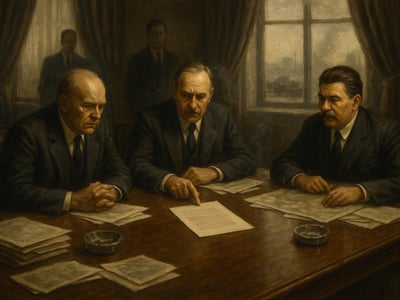
Panmunjom armistice signing that ended active Korean War combat in 1953
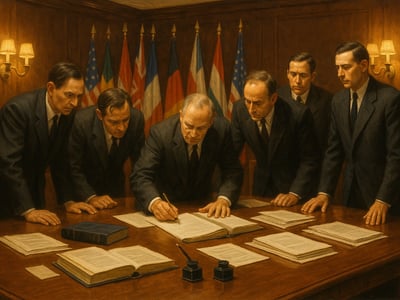
On July 27, 1953, military representatives met at Panmunjom in Korea to sign the Korean Armistice Agreement, bringing active battlefield hostilities in the Korean War to a halt after more than three years. The agreement did not create peace in the full diplomatic sense, but it established the terms under which large-scale fighting would stop. In doing so, it marked one of the most important turning points of the early Cold War.
From invasion to stalemate
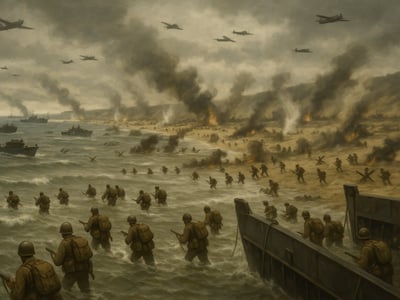
The war had begun in June 1950, when North Korean forces invaded South Korea. What followed quickly widened beyond a civil and regional conflict. United Nations forces intervened under Security Council resolutions, and later Chinese forces entered the war. The fighting became vast, destructive, and mobile, with major advances and reversals before settling into a harsher pattern: a prolonged struggle in which front lines changed little, even as casualties continued.
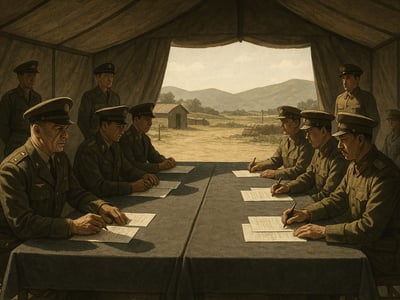
By mid-1951, that battlefield reality had become difficult to ignore. The front had hardened near the area of the 38th parallel, and neither side could secure a decisive breakthrough at acceptable cost. Yet military stalemate did not automatically produce political agreement. Armistice negotiations began at Kaesong on July 10, 1951, but from the start they were slow, technical, and burdened by mistrust. The talks later moved to Panmunjom, where they continued while fighting still went on.
Talking while fighting
This long overlap between negotiation and combat was one of the defining tensions of the armistice process. The parties were discussing how to stop the war while still trying to improve their positions within it. Every hill, trench, and artillery exchange could affect bargaining leverage. Even when a broad outline for a ceasefire seemed possible, difficult issues remained.
Among the hardest of those issues was the fate of prisoners of war. Repatriation was not merely an administrative matter. It raised questions of coercion, allegiance, and individual choice, and it became one of the central obstacles delaying agreement. The dispute showed that an armistice is not only about maps and military lines. It also concerns people whose lives become part of the negotiation itself.
In the end, the commanders accepted a practical but incomplete solution. They agreed to stop active combat without settling the larger political future of the peninsula. That choice carried risk. It meant accepting an armed pause instead of a peace treaty, and it left unresolved the conflict that had brought the war about in the first place. But without such an agreement, the alternative was the immediate possibility of renewed large-scale fighting.
Signing the ceasefire
At Panmunjom on July 27, Lieutenant General William K. Harrison Jr. signed the armistice for the United Nations Command. General Nam Il signed for the Korean People’s Army and the Chinese People’s Volunteers. General Mark W. Clark, commander in chief of the United Nations Command, approved the agreement the same day. The Republic of Korea was not a signatory, an important distinction that still matters in understanding the document’s legal and political place.
A monitored armed pause
The armistice set out the framework for ending battlefield operations. It fixed a Military Demarcation Line and provided for a Demilitarized Zone extending 2 kilometers on each side of that line. It also created supervisory bodies, including the Military Armistice Commission and the Neutral Nations Supervisory Commission, to help oversee implementation. These provisions were not ornamental. They were meant to turn a ceasefire into an organized and monitored system that could hold under pressure.
That system did not erase hostility, but it changed its form. The conflict moved from open war across shifting fronts to a tense armed standoff defined by boundaries, guard posts, patrols, and constant vigilance. The line established by the armistice became a durable military and political reality. Panmunjom itself also became a symbol of that reality: a place associated not with reconciliation alone, but with managed confrontation.
Why it still matters
The Korean Armistice Agreement still shapes the peninsula because it stopped the fighting without producing a final peace treaty. In legal and military terms, the war was not concluded by a comprehensive political settlement. That unresolved status has influenced diplomacy for decades, affecting relations among North Korea, South Korea, the United States, and China.
The demarcation line and the Demilitarized Zone created by the agreement became one of the world’s most heavily fortified borders. What was designed as a buffer also became a long-term structure governing security policy, military planning, and daily life near the border. The institutions created to supervise the armistice have likewise remained part of the story of how a ceasefire can endure even when trust does not.
More broadly, the agreement is an example of a difficult truth in modern conflict: a war can be stopped without being truly settled. Ceasefires can save lives and prevent renewed offensives, yet they may also preserve unresolved political questions for generations. The armistice signed at Panmunjom on July 27, 1953, stands as a clear case of that paradox. It ended active combat, but it left behind a framework of tension that continues to define the Korean peninsula.
Timeline
- North Korean invasion of South Korea
- Armistice talks begin at Kaesong
- Korean Armistice Agreement signed
What you uncovered
A War Paused on Paper
You didn't just… complete a historical puzzle; you traced the moment when a signed document stopped large-scale fighting while leaving the wider conflict unresolved.
The armistice shows that ending combat and ending a war are not always the same thing. Instead of settling the political dispute, it built a framework of lines, zones, and supervisory bodies that managed danger over time. That helps explain why the agreement still matters: it reduced the immediate risk of renewed battlefield war while preserving a tense and unfinished status quo.
The agreement established a Demilitarized Zone extending 2 kilometers on each side of the Military Demarcation Line.
FAQ
What happened on 27 July 1953 in Panmunjom?
On 27 July 1953, the Korean Armistice Agreement was signed at Panmunjom in Korea. It stopped active battlefield hostilities in the Korean War.
Who signed the Korean Armistice Agreement?
Lieutenant General William K. Harrison Jr. signed for the United Nations Command, and General Nam Il signed for the Korean People's Army and the Chinese People's Volunteers. General Mark W. Clark approved the armistice on the same day.
Did the Korean Armistice Agreement end the Korean War?
It ended active fighting, but it did not create a final peace treaty or political settlement. The war remained unresolved after the armistice was signed.
What did the armistice establish on the Korean peninsula?
The agreement fixed a Military Demarcation Line and created a Demilitarized Zone extending 2 kilometers on each side of that line. It also provided for the Military Armistice Commission and the Neutral Nations Supervisory Commission.
Why was Panmunjom chosen for the armistice signing?
The source says negotiations had moved from Kaesong to Panmunjom before the agreement was signed there. It does not give a more specific reason for choosing Panmunjom.