
About this story
Richard and Mildred Loving in connection with the Supreme Court ruling of 12 June 1967
On June 12, 1967, the U.S. Supreme Court announced its unanimous decision in *Loving v. Virginia*, ruling that Virginia's laws against interracial marriage violated the Constitution. The case centered on Richard Loving and Mildred Jeter Loving, a married couple whose private family life had been turned into a criminal matter by state law. What began as a local prosecution in rural Virginia ended as one of the most important constitutional decisions in the history of marriage and equal protection in the United States.
Richard Loving, who was white, and Mildred Jeter Loving, who was of Black and Native American ancestry, grew up in Caroline County, Virginia. In their community, they knew one another long before their marriage became the subject of a legal case. Because Virginia law prohibited marriages between people the state classified as belonging to different races, they traveled to Washington, D.C., where such a marriage was legal. On June 2, 1958, they were married there and then returned home to Virginia.
That decision brought them into direct conflict with Virginia's anti-miscegenation laws, including provisions associated with the state's Racial Integrity Act of 1924. In practice, these laws allowed the state to treat a valid marriage performed elsewhere as a criminal offense once the couple returned to Virginia. The issue was not only whether the state would recognize the marriage. It was whether the state could punish the couple for living together as husband and wife.
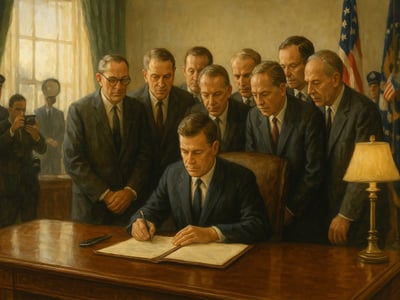
In 1958, local authorities entered the Lovings' home at night and arrested them. Their marriage certificate from Washington, D.C., did not protect them from prosecution in Virginia. On January 6, 1959, the Circuit Court of Caroline County convicted both Richard and Mildred Loving under Virginia's marriage laws. Judge Leon M. Bazile sentenced them to one year in prison, but suspended the sentences on one condition: they had to leave Virginia and could not return together for 25 years.
The condition effectively exiled them from their home state. They moved to Washington, D.C., but the arrangement was deeply disruptive. The case was not only about legal status in the abstract. It was about where a married couple could live, whether they could remain near their families, and whether the state could separate law from ordinary domestic life so completely that marriage itself became evidence of a crime.
Over time, the Lovings decided to challenge the convictions. They were represented by lawyers Bernard S. Cohen and Philip J. Hirschkop, who helped move the case through the courts. Their argument went beyond the details of one county prosecution. It asked whether a state could use racial classifications to restrict a basic civil institution and whether criminal penalties could be imposed on that basis.
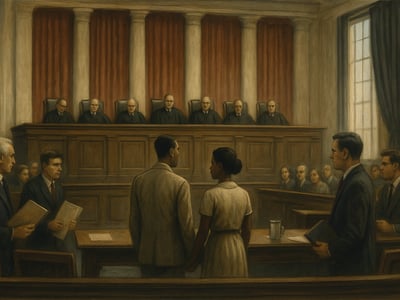
The appeals process moved through Virginia courts and eventually reached the U.S. Supreme Court. Oral arguments were heard on April 10, 1967. By then, Virginia was not alone. More than a dozen states still had laws on the books prohibiting interracial marriage. A ruling in favor of the Lovings would therefore affect not just one couple and one state, but marriage law across a wide section of the country.
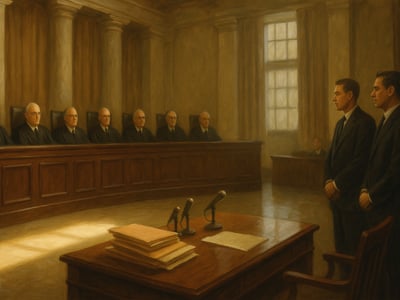
When the Court issued its opinion on June 12, Chief Justice Earl Warren wrote for a unanimous bench. The Court held that Virginia's restrictions violated both the Equal Protection Clause and the Due Process Clause of the Fourteenth Amendment. In clear terms, the justices rejected the idea that marriage could be limited by racial classification in the way Virginia had attempted.
One of the decision's most frequently cited passages described marriage as one of the “basic civil rights of man.” That language helped explain why the Court saw the case as more than a technical dispute over state regulation. States have broad authority over marriage law, but that authority is not unlimited. When a state uses race as the basis for criminal punishment and exclusion from marriage, constitutional protections apply.
The ruling invalidated Virginia's law immediately and also rendered unenforceable similar laws in other states. In that sense, the case demonstrates how a single constitutional challenge can change legal conditions far beyond the place where it began. The Lovings had sought the right to live as a married couple in Virginia. Their case also removed legal barriers affecting many others.
Why it still matters
*Loving v. Virginia* remains central to U.S. legal history because it shows how equal protection limits state power over family life. The decision is often taught as an example of how the law once enforced racial hierarchy not only in public institutions, but also in intimate personal relationships. It is a reminder that criminal statutes were used to police marriage, residence, and identity.
The case also endures as an example of how constitutional litigation can grow from ordinary circumstances. Richard and Mildred Loving were not public officials or national political leaders. Their challenge began with a marriage, a conviction, and the practical burden of being forced away from home. Yet the legal questions raised by their situation reached the highest court and resulted in the invalidation of laws across multiple states.
For that reason, the case is still cited in discussions of civil rights, federal constitutional limits on state law, and the meaning of liberty in personal life. Its importance lies not only in what the Court struck down in 1967, but in how clearly it showed that the regulation of marriage cannot be separated from the constitutional guarantees of equality and due process.
The decision did not erase the long history that made the case possible, but it marked a decisive legal end to one set of discriminatory marriage laws in the United States. In the record of the Court, the names Richard and Mildred Loving remain attached to a judgment that began with one family and changed the law for many more.
Timeline
- Virginia Racial Integrity Act
- Marriage of Richard Loving and Mildred Jeter in Washington, D.C.
- Conviction of Richard Loving and Mildred Loving in Caroline County, Virginia
- U.S. Supreme Court oral argument in Loving v. Virginia
- U.S. Supreme Court decision in Loving v. Virginia
What you uncovered
Marriage and State Power
You didn't just… complete a puzzle; you traced how one couple's private marriage became a public test of whether a state could use racial categories to govern family life.
What makes Loving v. Virginia enduring is not only that it ended specific bans, but that it exposed how deeply law can reach into ordinary life when it turns classification into policy. The case shows that marriage law is never just administrative: it can become a tool for enforcing social boundaries. It also illustrates how a challenge brought by people outside centers of power can force constitutional limits on multiple states at once.
The Lovings' suspended one-year sentences were conditioned on leaving Virginia and not returning there together for 25 years.
FAQ
What did the Supreme Court decide in Loving v. Virginia?
On 12 June 1967, the U.S. Supreme Court unanimously held that Virginia’s laws banning marriage between people classified by the state as belonging to different races violated the U.S. Constitution.
Who were Richard and Mildred Loving?
Richard Loving and Mildred Jeter Loving were the couple at the center of the case. They married in Washington, D.C., on 2 June 1958 and were later convicted in Virginia under that state’s anti-miscegenation laws.
Why did the Lovings challenge Virginia’s law?
Virginia treated their marriage as a criminal offense and barred them from living together in the state as husband and wife. They challenged the convictions after being ordered to leave Virginia and not return together for 25 years.
How did the case reach the Supreme Court?
The Lovings were convicted by the Circuit Court of Caroline County, Virginia, on 6 January 1959, and the case eventually moved through the courts to the U.S. Supreme Court. The Court heard oral argument on 10 April 1967 before issuing its decision on 12 June 1967.