
About this story
On 13 July 1936, Slovenská strela began regular ČSD express service between Bratislava and Prague. Contemporary references for the launch cite a top speed of 130 km/h on the new motor-train service.
Slovenská strela entered regular ČSD service between Bratislava and Prague on 13 July 1936.
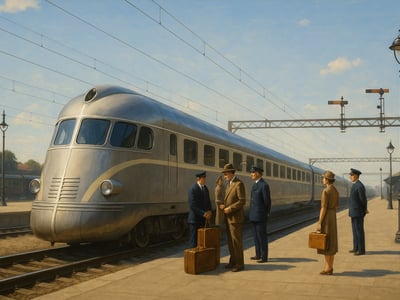
On 13 July 1936, the motor express train *Slovenská strela* entered regular service between Bratislava and Prague in Czechoslovakia. Its debut put a fast, streamlined rail connection onto one of the country’s most important long-distance routes, linking the main urban center of Slovakia with the Czech capital through a scheduled public service. Contemporary references for the launch cited a speed of 130 km/h, making the train an eye-catching example of interwar transport ambition.
The service mattered not only because it was fast, but because it was regular. A railway can stage a demonstration run for publicity, but placing a train into the timetable is a different test. It means operators must trust the equipment, maintenance staff must be ready to keep it working, and railway planners must fit a higher-performance train into the daily rhythm of a larger network. In that sense, the start of *Slovenská strela* was a practical commitment as much as a technical one.
The train operated under the Czechoslovak State Railways, known as ČSD, which was responsible for connecting the major cities of the state. In the interwar years, railways remained central to movement across Czechoslovakia. Roads and motor traffic were developing, and aviation had its own prestige, but rail still carried the weight of regular intercity travel. Faster services therefore had both practical and symbolic value. They promised shorter journey times, but they also suggested a modern, capable state able to organize distance more efficiently.
*Slovenská strela* was built around two motor units, M 290.001 and M 290.002. These units were completed in 1936 by Tatra in Kopřivnice, a company widely associated with engineering innovation in the period. Rather than relying on a conventional locomotive hauling coaches, the service used self-propelled motor trainsets designed for express passenger work. That choice reflected broader European interest in streamlined forms and lighter, faster rail vehicles during the 1930s.
The propulsion system used on the train was associated with Josef Sousedík, an inventor and engineer whose work became linked with the project’s technical identity. For the public, however, what would have been most visible was the train’s appearance and performance: a sleek unit meant to look modern and to move quickly over a prominent route. Speed claims such as 130 km/h helped define its reputation, but those claims only had lasting meaning if the train could perform reliably in actual service.
That reliability was the central challenge. Running quickly over a long corridor between Bratislava and Prague required more than an impressive machine. It depended on the condition of the track, careful scheduling, station handling, maintenance routines, and the ability of staff across the network to support the service day after day. Any weakness—a mechanical problem, a delay in operations, or difficulty maintaining the advertised standard—could have reduced the train from a transport milestone to a short-lived experiment.
Instead, the launch of *Slovenská strela* came to stand for a wider moment in interwar modernization. Czechoslovakia was a state with multiple historic regions, different industrial centers, and long internal distances. Railways helped bind those regions together in practical ways. A fast service between Bratislava and Prague was therefore not just a matter of convenience for travelers. It also expressed the importance of direct connection within a shared national framework.
There was also a cultural dimension to such trains. Interwar Europe attached prestige to movement, design, and engineering efficiency. Streamlined vehicles appeared in rail, automobiles, and aircraft, often carrying meanings beyond their technical function. They suggested progress and discipline, and they turned public transport into a visible statement of what industry and planning could achieve. *Slovenská strela* fit neatly into that world, where timetable speed and industrial design reinforced one another.
At the same time, the train’s story is grounded in specifics rather than myth. It was a named service on a defined route. It used two identified units, M 290.001 and M 290.002. It was built by Tatra in Kopřivnice. Its propulsion system is associated with Josef Sousedík. And its regular service began on a documented date: 13 July 1936. Those details help explain why it remains such a durable subject in transport history. It can be discussed not only as a symbol, but as a concrete railway operation with traceable equipment and institutional context.
Why it still matters
*Slovenská strela* still matters because it shows how railways were used to integrate major cities within a single state network. The line between Bratislava and Prague was more than a map connection; it was part of how distance was managed in everyday public life. Fast scheduled trains made that integration visible.
It also illustrates interwar competition around passenger speed and specialized rolling stock. Across Europe, railways sought ways to improve journey times and present themselves as modern. *Slovenská strela* belongs to that history of experimentation with motor units, streamlined design, and technically ambitious public services.
Finally, its importance survives through preservation and museum interpretation. Historic trains often outlive their original timetable role by becoming objects through which later generations study engineering, design, and public expectations of technology. In that sense, *Slovenská strela* is not just a memory of a fast train from 1936. It is a preserved reference point for understanding how mobility, industry, and national connection were imagined in the interwar period.
Its launch did not transform rail travel by itself, and it did not erase the practical limits of operating a demanding service. But it marked a clear moment when technical ambition, state railway planning, and a major intercity route came together in a single scheduled train. That is why the start of regular service on 13 July 1936 still stands out in the history of transport in Czechoslovakia.
Timeline
- Interwar Czechoslovak rail modernization
- Tatra railcar production in Kopřivnice
- Slovenská strela enters regular service
What you uncovered
Speed as Statecraft
You didn't just… complete a puzzle; you traced a moment when a rail timetable was used to make distance between Bratislava and Prague feel smaller within one state.
Slovenská strela mattered not only because it was fast, but because speed on a published schedule signaled that modern technology could reorganize everyday geography. In the interwar period, that kind of service linked engineering, planning, and political imagination: a train was also a statement about how closely major cities could be connected. That is why preserved rail vehicles still draw interest today—they show how infrastructure can carry symbolic meaning as well as passengers.
Slovenská strela used two motor units, M 290.001 and M 290.002, built by Tatra in Kopřivnice in 1936.
FAQ
What was Slovenská strela, and when did it start service?
Slovenská strela was a motor express train in Czechoslovakia. It began regular service on 13 July 1936.
Which cities did Slovenská strela connect?
It ran on the Bratislava–Prague route. The service linked Bratislava and Prague by rail.
How fast was Slovenská strela reported to be?
Contemporary historical references for the launch cite a top speed of 130 km/h. That figure is tied to the 13 July 1936 start of service.
Who built the Slovenská strela train units?
The train consisted of M 290.001 and M 290.002 motor units built in 1936 by Tatra in Kopřivnice. Its propulsion system used a design associated with Josef Sousedík.