


About this story
1880 census returns for counties in present-day Slovakia under the Kingdom of Hungary
On 15 May 1880, the Kingdom of Hungary carried out the reference day for its population census across the lands of the Hungarian half of Austria-Hungary, including counties that now lie within Slovakia. In the region then often called Upper Hungary, this meant that households in towns, market centers, villages, and rural districts were all meant to be captured as they existed at one fixed administrative moment. The census was not simply a headcount. It gathered information on sex, age, occupation, religion, and mother tongue, creating one of the key statistical records for reconstructing the region’s late 19th-century population.
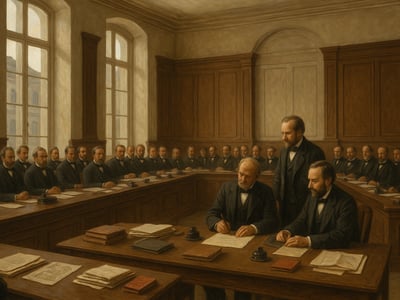
The census took place within the political framework established after the Austro-Hungarian Compromise of 1867, which created the Dual Monarchy and confirmed the Kingdom of Hungary as one half of the imperial structure. Within that system, officials sought more regular and comparable information about the population. Statistical offices wanted data that could be organized by county and summarized in printed tables. For administrators, these returns were tools of governance. For later historians and demographers, they became a detailed, if imperfect, archive of everyday society.
In practical terms, a census day depended on many small acts of recording. Enumerators had to move through multilingual communities and enter answers into standardized forms. That was not always straightforward. In counties associated with places such as Pressburg, Spiš, Šariš, and Zemplén, people might use different languages in different settings: at home, in trade, in school, in church, or when dealing with officials. The category of mother tongue seemed precise on paper, but lived experience did not always fit cleanly into a single box.
Religion, too, was both easily legible to administration and deeply tied to local life. The census returns recorded confessional belonging as part of a broader effort to classify the population into comparable units. Alongside age, sex, and occupation, religion helped produce a picture of social structure. Yet even where categories were clearly defined, the process still depended on what households reported, what enumerators understood, and how local officials interpreted the instructions they had been given.
That combination of official order and local complexity was central to the 1880 census. The reference day of 15 May fixed the population at one administrative instant, but no society stands still in that way for long. Seasonal labor, temporary absence, mobility between countryside and town, and ordinary misunderstandings could all affect how people appeared in the record. Standardization was the goal, but consistency could never be perfect across every county and settlement.
Once collected, local entries were aggregated into county-level results and then into published statistical tables. Those tables reported data for territories that correspond to several areas in present-day Slovakia. In this way, thousands of household-level encounters were transformed into official summaries. A family became part of a village total; village totals became county totals; county totals became part of a wider portrait of the Kingdom of Hungary.
The resulting publications are valuable partly because they allow comparison. Researchers can place the 1880 census alongside earlier and later counts, including the 1869 and 1890 censuses in the Hungarian lands, to trace continuity and change. They can study urbanization, the balance between rural and urban populations, occupational patterns, and the distribution of religious communities. They can also ask how language was recorded and what that reveals about administration, education, migration, and local society.
At the same time, the 1880 census must be read with care. The category recorded in the official returns was mother tongue, not a direct measure of modern nationality in the later political sense. This distinction matters. In Central European history, census data were often reused in later debates about who lived where and in what proportions. But the categories on the forms reflected the state’s statistical framework and the realities of local reporting, not a simple or timeless definition of identity.
That caution does not lessen the census’s importance. On the contrary, it helps explain why it remains such a significant source. The 1880 returns preserve evidence of a multilingual, socially varied region under Habsburg rule. They show an administration trying to convert a complex society into comparable data. They also reveal how much depended on the meeting point between official categories and everyday life.
Why it still matters
The 1880 census still matters because it remains one of the main foundations for studying demographic history in the territory of present-day Slovakia. Historians, demographers, genealogists, and regional researchers continue to use its published returns to track settlement patterns, migration, family structure, occupations, and religious distribution. For many places, it offers one of the clearest statistical snapshots of the late 19th century.
It also matters because its categories continue to shape modern arguments. Language and identity in Central Europe are often discussed through census-era numbers, but those numbers need careful interpretation. The official recording of mother tongue, for example, should not be treated automatically as a direct statement of later national belonging. The 1880 census is therefore useful not only for what it records, but also for what it teaches about the limits of official data.
More broadly, the census shows how states make populations legible. Administrative systems rely on categories, forms, and summaries to understand the people they govern. That process can document real social conditions, but it can also flatten ambiguity. In Upper Hungary in 1880, a multilingual society was entered into tables that seemed exact and comparable. The record that survived is indispensable, but it is not neutral in the sense of being free from the assumptions of its time.
For that reason, the census endures as both evidence and warning: evidence of who was counted and how society was described, and a warning that numbers always come from choices about classification. On 15 May 1880, those choices were made across counties that now lie within Slovakia. The results still help map the region’s past, even as they remind readers to look closely at the categories behind the totals.
Timeline
- Austro-Hungarian Compromise
- Hungarian census reference day
- Hungarian census
What you uncovered
Counting a Multilingual Society
You didn't just…complete a date puzzle; you stepped into a moment when everyday language, religion, and work were being turned into official records across a diverse region.
The 1880 census shows how imperial administration depended on making very different local realities comparable on paper. That process made large-scale analysis possible, but it also pushed fluid identities into fixed categories that later readers can mistake for simple facts. This is why historians treat such returns as valuable evidence and as records shaped by the system that produced them.
Published 1880 census tables in the Kingdom of Hungary reported county-level results for areas corresponding to places such as Pressburg, Spiš, Šariš, and Zemplén.
FAQ
What happened on 15 May 1880 in the Kingdom of Hungary?
15 May 1880 was the official census reference day for the population census in the Kingdom of Hungary. It was used across the Hungarian half of Austria-Hungary.
Which areas in present-day Slovakia were covered by the census?
Published census tables for 1880 included counties corresponding to Pressburg, Spiš, Šariš, and Zemplén. These were territories in Upper Hungary, then part of the Kingdom of Hungary.
What information did the 1880 census record?
The census recorded official statistical categories such as mother tongue, religion, sex, age, and occupation. These data were entered in standardized returns.
Why is the 1880 census still important for historians?
It remains a key statistical source for reconstructing population patterns in the region in the late 19th century. Researchers still use it to study settlement, migration, and social change in what is now Slovakia.