
About this story
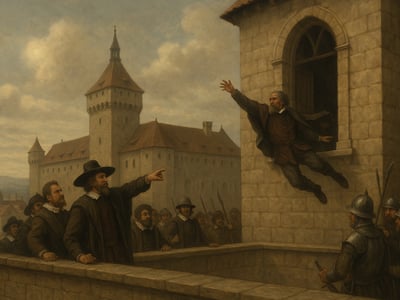
Prague Castle after the 23 May 1618 defenestration that opened the Bohemian Revolt
On 23 May 1618, a confrontation inside Prague Castle turned a political and religious dispute into one of the most famous incidents in early modern European history. That day, a group of Bohemian Protestant nobles entered the castle, seized two imperial governors, Vilém Slavata of Chlum and Jaroslav Bořita of Martinice, along with their secretary Filip Fabricius, and threw all three men from a window. Remarkably, they survived the fall. The act was shocking in itself, but its deeper importance lay in what it set in motion: the Bohemian Revolt within the Habsburg monarchy.
The event did not come out of nowhere. For years, relations had been tense in the Kingdom of Bohemia, one of the lands ruled by the Habsburg dynasty. Bohemian estates, especially Protestant nobles, believed that their religious rights were protected by the Letter of Majesty issued in 1609 by Emperor Rudolf II. That document addressed religious privileges in Bohemia and became a key reference point in later disputes. When conflicts arose over the interpretation and enforcement of those guarantees, arguments about worship quickly became arguments about law, political authority, and the limits of royal power.
In the years before 1618, these tensions sharpened. The closure of Protestant chapels became a particularly contentious issue, because many Protestants saw such actions not as isolated local decisions but as violations of rights they believed had already been confirmed. Opposition then focused not only on specific policies, but also on the officials charged with carrying out Habsburg authority. The central question was whether the Bohemian estates still possessed meaningful political and religious protections, or whether royal government could override them.
That is the background against which the meeting at Prague Castle unfolded. The nobles who gathered there were not making a symbolic protest in a public square. They were confronting imperial representatives at the political center of Bohemia. Matthias Thurn was among the leading figures associated with this rising opposition. By seizing the governors directly, the nobles chose a form of action that made compromise far less likely. Petitioning, delay, and negotiation gave way to a dramatic act of violence intended to reject both the officials themselves and the authority they represented.
Slavata and Martinice were identified as responsible, in the eyes of their opponents, for policies hostile to Protestant interests. Fabricius, the governors' secretary, was taken with them. All three were thrown from the same window. Although later retellings often emphasized the extraordinary fact of their survival, contemporaries understood that the true significance of the moment was political. A boundary had been crossed. The estates had physically attacked royal officers inside the seat of government.
Their survival mattered, but not because it reduced the seriousness of what had happened. If anything, it made the event easier to narrate, remember, and reinterpret. Different confessional traditions later attached different meanings to the escape from death. Yet the central fact remained unchanged: on that day, a dispute over rights and authority became open rebellion.
After the defenestration, the Bohemian estates moved from protest to organized resistance. In 1618 they formed a revolt against Habsburg rule in the Kingdom of Bohemia. What might have remained a limited constitutional struggle instead widened into a larger crisis. Bohemia was not an isolated state; it was part of a composite monarchy tied into broader dynastic and imperial structures. That meant a conflict in Prague could not easily remain a purely local affair.
The pace of escalation was rapid. In 1619, Ferdinand II became Holy Roman Emperor, strengthening the wider dynastic stakes of the conflict. The same year, the Bohemian crown was offered to Frederick V of the Palatinate. That decision turned a revolt within Habsburg lands into a more explicit challenge to Habsburg legitimacy. It also drew in outside powers and widened the political horizon far beyond Bohemia itself.
The military outcome in Bohemia came quickly. At the Battle of White Mountain in 1620, the revolt suffered a decisive defeat. Yet the end of the Bohemian bid for autonomy did not end the broader conflict. Instead, the struggle became part of the much larger Thirty Years' War, a war that involved dynastic ambition, confessional division, territorial interests, and repeated foreign intervention across Central Europe and beyond.
Why it still matters
The Defenestration of Prague is still studied because it shows how fragile political settlements could be in a composite monarchy. The original dispute centered on guarantees that had been written down and publicly recognized. But written privileges meant little if different groups disagreed over who had the right to interpret or enforce them. In that sense, the incident illustrates how constitutional arguments and religious conflict could become inseparable.
It also demonstrates how quickly a court struggle inside one kingdom could spread through larger political systems. Bohemia's crisis was connected to Habsburg rule, to the institutions of the Holy Roman Empire, and to rival interests across Europe. What began with the seizure of three officials in a castle chamber soon became part of a war that reshaped much of the continent.
For historians, the event remains one of the clearest opening moments in the escalation toward the Thirty Years' War. It is memorable because of the image of men thrown from a window, but enduring because that image points to something larger: the breakdown of trust in legal guarantees, the collapse of political compromise, and the speed with which a single act can transform a tense dispute into a wider crisis.
Timeline
- Letter of Majesty
- Bohemian estate government formed
- Defenestration of Prague
- Ferdinand II elected Holy Roman Emperor
- Frederick V accepts the Bohemian crown
- Battle of White Mountain
What you uncovered
When a Window Became a Crisis
You didn't just… place names from a dramatic episode; you traced the moment a confrontation at Prague Castle became the opening signal of a wider revolt.
What made this incident consequential was not only the violence itself, but the political structure around it. A dispute over written religious guarantees, the authority of local estates, and the reach of Habsburg rule turned one act inside a royal residence into a constitutional crisis. Once that happened, the conflict could move beyond Bohemia through dynastic ties and imperial institutions, helping explain why the crisis did not stay local.
The tensions behind the event were tied in part to the Letter of Majesty of 1609, which had recognized important religious privileges in Bohemia.
FAQ
What was the Defenestration of Prague on 23 May 1618?
It was an incident at Prague Castle in Bohemia in which Protestant nobles seized two imperial governors and a secretary and threw them from a window. All three survived, and the event became the opening act of the Bohemian Revolt.
Who was thrown from the window at Prague Castle?
The men thrown from the window were Vilém Slavata of Chlum, Jaroslav Bořita of Martinice, and their secretary Filip Fabricius. The two governors were imperial officials, and Fabricius also survived the fall.
Why did the Defenestration of Prague happen?
It followed tensions over religious rights in Bohemia, especially disputes linked to the Letter of Majesty of 1609 and the enforcement of Habsburg authority. Bohemian Protestant nobles opposed what they saw as violations of their religious guarantees.
How did the event lead to the Bohemian Revolt?
After the Prague incident, the Bohemian estates organized a revolt in 1618 against Habsburg rule in the Kingdom of Bohemia. The crisis then escalated into wider conflict in Central Europe.
How is the Defenestration of Prague connected to the Thirty Years' War?
It is regarded as an important opening crisis in the chain of events that expanded into the Thirty Years' War. The revolt that followed helped turn a local dispute into a broader European conflict.