
About this story
Pittsburgh Agreement linked to Czech and Slovak representatives in Pennsylvania, 1918.
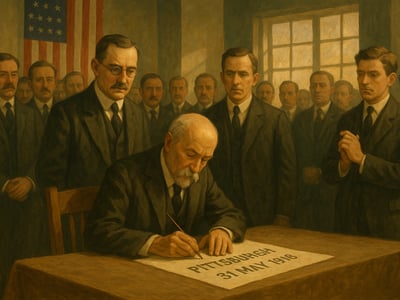
On May 31, 1918, in Pittsburgh, Pennsylvania, Czech and Slovak representatives signed what became known as the Pittsburgh Agreement, a short wartime political text with a long afterlife. The First World War was still underway, Austria-Hungary had not yet collapsed, and the future of Central Europe remained uncertain. In that unsettled moment, émigré leaders in the United States tried to give clearer form to a shared political project: support for a common Czecho-Slovak state.
The agreement belonged to a wider campaign led by exile politicians and community organizations that were working far from the Habsburg lands but closely followed events there. Among the central figures associated with the effort was Tomáš Garrigue Masaryk, whose wartime diplomacy helped connect Czech and Slovak activism abroad to the broader case for independence. The United States mattered because it offered space for organizing, publishing, fundraising, and public advocacy at a time when political action inside the monarchy faced obvious limits.
By the spring of 1918, however, general sympathy for national self-determination was not enough. Czech and Slovak leaders also had to show that they could cooperate with one another and present a plausible program for a future state. That required more than slogans. It meant addressing a practical political question: what kind of arrangement would bind Czechs and Slovaks together if the wartime opportunity for independence actually arrived?
The Pittsburgh Agreement was one answer to that question. It stated support for a common Czecho-Slovak state, turning a coalition of wartime interests into a more public and concrete declaration. At the same time, the text addressed specifically Slovak concerns by referring to Slovak administration, its own assembly, and courts within the proposed state framework. Those phrases were important because they suggested that unity did not have to mean complete uniformity.
That balance was the heart of the document. On one side stood the need for a united political front. A fragmented movement would have been weaker in diplomacy and less convincing to foreign audiences. On the other side stood the need to reassure Slovak supporters that cooperation in a shared state would not erase distinct institutions or local control. The wording therefore tried to keep a wartime alliance together without forcing every constitutional detail into final form.
The setting in Pittsburgh was no accident. Czech and Slovak communities in the United States had built organizations, newspapers, and associations that gave exile politics both an audience and an infrastructure. These communities were not merely distant observers of European events. They were active participants in shaping public arguments about what should follow the war. In that sense, the agreement shows how diasporas could become part of state-building before a state formally existed.
Its timing also mattered. In May 1918, the Habsburg monarchy still stood, and any future settlement remained contingent on military and diplomatic developments. Signing such a document carried political risk. If the coalition broke apart over competing expectations, the case for a joint Czecho-Slovak state could be weakened before the decisive end of the war. The agreement therefore served an immediate purpose: it signaled discipline, cooperation, and common intent at a moment when none of those could be taken for granted.
Later events in 1918 would change the context rapidly. As Austria-Hungary collapsed in the final months of the war, the possibility of an independent Czechoslovakia moved from aspiration toward reality. In that broader sequence, the Pittsburgh Agreement was not the only important text, nor did it by itself determine the constitutional structure of the new state. But it became part of the documentary record of how Czech and Slovak leaders had presented their common cause during the last year of the war.
Its later significance came partly from that very ambiguity. Because the agreement contained both the commitment to common statehood and language about Slovak administration, assembly, and courts, it was open to later interpretation. Some saw it mainly as a wartime political agreement designed to maintain unity under difficult circumstances. Others treated its references to Slovak self-government as evidence of more specific expectations for the future constitutional order. Those debates did not erase the document's original function, but they did give it a second life beyond 1918.
Why it still matters
The Pittsburgh Agreement still matters because it helps explain how states can emerge not only from battlefields and treaties, but also from networks of organizers, newspapers, meetings, and negotiated texts. It is a useful example of diaspora politics operating at a high level: communities outside Europe helped formulate and publicize a project that would soon become tied to the remaking of the map of Central Europe.
It also remains relevant to constitutional history. The document's references to Slovak administration, its own assembly, and courts later became part of debates over what had been promised during the struggle for independence and how those promises should be understood afterward. Historians and political actors have not always agreed on its legal force or its exact place in the making of Czechoslovakia. For that reason, the agreement is often discussed not only as a wartime statement, but as a text whose meaning changed as later generations revisited it.
More broadly, the document shows how short political texts can outlast the immediate circumstances of their drafting. The men who signed in Pittsburgh were trying to hold together a coalition in wartime. Yet the language they chose continued to matter because later readers returned to it with different political questions. That is one reason the agreement remains present in Czech and Slovak historical memory: it sits at the intersection of independence, constitutional design, and the difficulty of turning alliance language into stable institutional reality.
Seen in that light, the Pittsburgh Agreement is best understood neither as a mere symbol nor as a text whose meaning is completely self-evident. It was a practical wartime document written under uncertainty, shaped by the needs of coalition politics, and later drawn into larger arguments about statehood and autonomy. Its importance lies in that combination of immediate purpose and enduring interpretive weight.
Timeline
- Czech and Slovak émigré political organizing in the United States
- Collapse of Austria-Hungary
- Proclamation and early constitutional structure of Czechoslovakia
- Pittsburgh Agreement signed
- Washington Declaration
What you uncovered
Promises in Wartime
You didn't just…complete a historical puzzle; you traced a moment when political allies tried to hold a future state together by putting carefully balanced promises into writing.
The Pittsburgh Agreement matters not only for what it said in 1918, but for how such texts are read after the crisis that produced them has passed. A wartime coalition document can help unify supporters in the moment while leaving key terms open enough to invite later disagreement. That is why the agreement sits at the intersection of diplomacy, constitutional expectation, and historical memory. Its later significance came as much from interpretation as from the words on the page.
The agreement was signed in Pittsburgh, Pennsylvania, on 31 May 1918, during the final year of World War I.
FAQ
What was the Pittsburgh Agreement of 31 May 1918?
It was an agreement signed on 31 May 1918 in Pittsburgh, Pennsylvania, during the final year of World War I. The text expressed support for a common Czecho-Slovak state.
Who was associated with the signing of the Pittsburgh Agreement?
Tomáš Garrigue Masaryk was associated with the agreement and its signing. The text was part of the broader émigré political effort behind it.
What did the Pittsburgh Agreement say about Slovak autonomy?
The agreement referred to Slovak administration, its own assembly, and courts within the proposed state framework. It combined support for common statehood with language addressing Slovak self-government.
Why was the Pittsburgh Agreement signed in the United States?
It was produced in the context of émigré political organizing in the United States. Czech and Slovak representatives signed it there while wartime outcomes were still unresolved.