
About this story
Louis I's accession in 1342 transferred rule over Hungary and Croatia.
On 16 July 1342, after the death of Charles I at Visegrád, his son Louis I became King of Hungary and Croatia. The succession was immediate in dynastic terms, but in medieval politics a ruler's position was never secured by inheritance alone. A new king had to be recognized by the kingdom's leading nobles, accepted by important towns, and then confirmed through coronation. Louis's accession therefore marked both a moment of continuity and a moment of uncertainty in a realm that stretched across several regions, including territories in present-day Slovakia.
Louis inherited more than a title. He took charge of the Kingdom of Hungary at a time when royal authority depended on a network of loyalties, offices, and ceremonial acts. His father, Charles I, had spent much of his reign rebuilding central power after earlier periods of fragmentation and aristocratic competition. That background mattered. Because Charles I had worked to strengthen the crown, Louis did not step into a political vacuum. Even so, the transfer of power after a king's death could still become dangerous if powerful magnates hesitated, if rival interests emerged, or if uncertainty spread through the kingdom's political centers.
Visegrád, where Charles I died, had become one of the important seats of royal government. The court there was not only a household but also a center of administration and decision-making. When Charles died, the immediate task was to turn hereditary right into functioning rule. Louis was the obvious successor: he was the son of Charles I and Elizabeth of Poland, and his claim was clear. But medieval monarchy relied on visible acts of recognition. The royal court had to communicate continuity, preserve order, and ensure that the kingdom understood that authority had passed without interruption.
That mattered across the whole realm, not only near the court. The Kingdom of Hungary included regions that are today parts of several states, and in 1342 towns such as Košice and Trnava lay within it under the new king's authority. For urban communities, the identity of the ruler was not an abstract matter. Royal towns depended on charters, privileges, taxation arrangements, commercial protections, and access to justice. A dynastic transition raised practical questions: would existing rights be respected, would officials remain in place, and would the new reign bring stability? The smooth transfer of authority was therefore important to local life far from the place where the king had died.
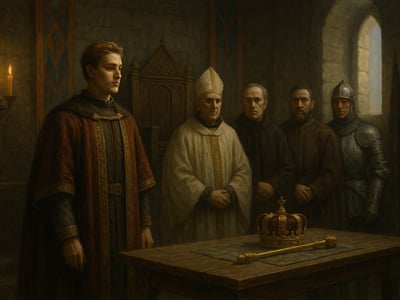
Louis's position was strengthened by the fact that he succeeded on the same day his father died. That immediate succession reflected a basic principle of monarchy: the realm could not be left without a ruler. Yet accession and coronation were not identical. Louis became king on 16 July by succession, but he was crowned at Székesfehérvár on 21 July 1342 with the Holy Crown of Hungary. The distinction was fundamental in medieval political culture. Succession established the claim; coronation gave the claim its full ceremonial and legal form. The days between those events were short, but they reveal how carefully medieval kingship was structured.
Székesfehérvár was the traditional site of Hungarian coronations, and the use of the Holy Crown carried exceptional significance. In the kingdom's legal and symbolic order, proper coronation was part of what made kingship fully valid. This was not empty pageantry. Ritual confirmed hierarchy, continuity, and legitimacy before the elite groups whose cooperation mattered in government. A young ruler such as Louis needed that confirmation. He was not beginning from weakness exactly, but from a position that still required public reinforcement.
In the early phase of his reign, the presence and influence of his mother, Elizabeth of Poland, also formed part of the broader political setting. Medieval courts were family institutions as well as centers of rule, and dynastic connections could help stabilize a succession. Elizabeth linked Louis to the Polish royal house, a connection that would matter later in his career. At the time of his accession, however, the immediate issue was more basic: to maintain the authority Charles I had assembled and to ensure that the machinery of kingship continued to function across Hungary and Croatia.
The event is easy to reduce to a simple line of succession, but it was more than that. Each transfer of the crown tested whether the kingdom's institutions were strong enough to outlast the life of an individual ruler. Could officeholders continue their work? Would towns and regional elites accept commands in the new king's name? Would the symbols of monarchy align with the realities of power? In Louis's case, the answer appears to have been yes. The swift succession and coronation suggest an orderly transition rather than a contested collapse.
That order helped shape the world of Upper Hungary, including areas in present-day Slovakia. Places such as Košice and Trnava remained part of a kingdom whose government was centered elsewhere but whose royal authority had direct local consequences. Trade, law, privileges, and urban development all depended in part on the stability of the crown. A dynastic change at court could therefore affect communities that never saw the king in person.
Why it still matters
Louis I's accession still matters because it shows how medieval states held together across distance. The Kingdom of Hungary was not a single compact region governed in a modern way. It was a composite monarchy, and continuity depended on accepted rules of succession, trusted ceremonies, and cooperation among elites, officials, and towns. The events of July 1342 show those mechanisms in action.
It also matters for the history of present-day Slovakia. In 1342 its territory was not a separate kingdom but part of the Kingdom of Hungary, and the accession of a new ruler affected royal towns there just as it affected other parts of the realm. Understanding Louis's succession helps explain the political framework in which medieval urban life developed in places such as Košice and Trnava.
Finally, the distinction between accession and coronation remains a useful reminder that medieval monarchy was both legal and ceremonial. Louis became king when his father died, but his coronation a few days later gave visible and formal confirmation to that authority. In that gap between inheritance and ritual, one can see how power was made durable in medieval Central Europe. What happened at Visegrád on 16 July 1342 was not merely a family succession. It was a test of whether a kingdom could carry authority from one reign to the next, and in Louis I's case, it did.
Timeline
- Louis I succeeds Charles I
- Coronation at Székesfehérvár
What you uncovered
Rule Before Coronation
You didn't just…place a new king on the timeline; you traced the moment when authority passed across a kingdom that also included towns in present-day Slovakia.
Louis I's accession shows that in a medieval monarchy, rule did not depend on ceremony alone. The death of one ruler could immediately redirect governance, obligations, and political loyalty across several regions at once. His later coronation mattered because it confirmed and formalized that authority within the kingdom's legal order.
Louis I was crowned at Székesfehérvár on 21 July 1342, five days after succeeding his father.
FAQ
What happened on 16 July 1342?
On 16 July 1342, Louis I succeeded his father Charles I and began his reign as King of Hungary and Croatia. Charles I died at Visegrád that same day.
Who was Louis I of Hungary?
Louis I was the son of Charles I of Hungary and Elizabeth of Poland. He became king of Hungary on 16 July 1342.
Why did Louis I become king in 1342?
He became king because he succeeded his father, Charles I, after Charles died on 16 July 1342. The succession passed the throne to Louis I immediately.
How was present-day Slovakia connected to the Kingdom of Hungary in 1342?
In 1342, the Kingdom of Hungary included territory in present-day Slovakia. Towns such as Košice and Trnava were within the kingdom under Louis I's authority.