
About this story
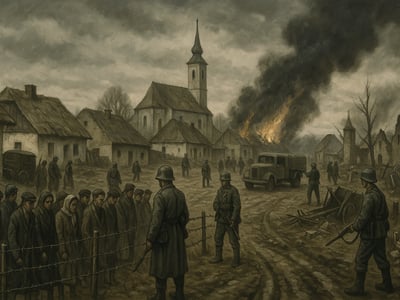
Lidice near Kladno after the German reprisal ordered in June 1942.
On 10 June 1942, German occupation authorities began the destruction of Lidice, a village near Kladno northwest of Prague in the Protectorate of Bohemia and Moravia. The action came as part of the reprisals that followed the assassination of Acting Reich Protector Reinhard Heydrich. What happened there was not a battlefield clash or a spontaneous outbreak of violence. It was a planned operation against a civilian community, carried out through orders, separation of families, shootings, deportations, and the deliberate removal of a place from the map.
The immediate background lay in events a few weeks earlier. On 27 May 1942, Heydrich was attacked in Prague by Czechoslovak agents Jozef Gabčík and Jan Kubiš during Operation Anthropoid. Heydrich was one of the most powerful Nazi officials in occupied Europe, and his position in the Protectorate gave him a central role in German rule there. After the attack, occupation authorities launched an intense crackdown. Investigations, raids, arrests, and intimidation spread quickly as German security organs searched for the attackers and sought to demonstrate control.
When Heydrich died from his injuries, the pressure for retaliation intensified. Nazi policy in occupied territories often used collective punishment as a tool of rule, especially when authorities wanted to make an example of a population. In this case, the reprisal was not limited to pursuing those directly involved in the assassination. It expanded into a public act of terror aimed at civilians. On 9 June 1942, Adolf Hitler and Karl Hermann Frank approved measures that included the destruction of Lidice.
Lidice was then selected for annihilation. German forces entered the village and isolated it, ensuring that no one could leave and outside interference was prevented. The population was separated into groups: men, women, and children. This sequence mattered. It shows how the action was organized in stages, each one turning the village from a living community into a controlled site of punishment.
The men were the first victims of the killings. On 10 June, German forces shot the adult male population of Lidice; standard references commonly cite 173 men killed that day. The shootings were not incidental to the operation. They were one of its central purposes. The village was being used to send a message of collective reprisal, and the execution of the men formed the most immediate and visible part of that message.
For the women, the next stage was deportation. Beginning on 10 June, most Lidice women were sent to Ravensbrück concentration camp. Their removal extended the violence beyond the village itself. The destruction of Lidice did not end with the shootings, because occupation policy treated the community not simply as people to punish but as social bonds to break apart. Husbands, wives, parents, and children were separated under guard, and the village ceased to function as a place where family life could continue.
The fate of the children remains one of the most painful parts of the story and one that requires careful phrasing. They were taken away from their families after the population had been separated. Some were later killed, while others were selected for transfer. What is clear from the historical record is that the children did not remain with their parents and that the occupation authorities treated them as part of the broader reprisal process. The attack on Lidice therefore extended across generations.
The operation also targeted the village as a physical place. After the inhabitants had been removed, German authorities burned and demolished Lidice. Its physical eradication continued over the following period rather than ending on 10 June alone. Buildings were destroyed, and even the cemetery was damaged. This was an effort not only to kill and deport but to erase. The reprisal was meant to eliminate both the people who lived there and the visible setting of their communal life.
That combination of mass violence and destruction explains why Lidice became one of the most recognized symbols of Nazi terror in wartime Czechoslovakia. The village was not chosen because it posed a military threat. It was turned into an example. In occupied Europe, the German regime repeatedly used such examples to show that resistance, or even suspected association with resistance, could bring catastrophic punishment upon civilians.
The destruction of Lidice was also bureaucratic. Decisions were approved at high levels. Security forces carried them out in sequence. Deportation systems, camp administration, and demolition all played a role. This matters because it shows that such crimes were not only acts of rage. They were often administrative processes, in which officials, police units, transport arrangements, and written orders combined to produce irreversible human loss.
Why it still matters
Lidice remains a central case for understanding collective reprisals against civilians under occupation. Historians and memorial institutions return to it because it illustrates how state terror can move from a political crisis to a carefully organized attack on an entire community. The event helps explain how occupation regimes used fear, punishment, and public example to maintain control.
It also continues to shape discussion of war crimes and the bureaucratic character of mass violence. Lidice shows that atrocity does not depend on chaos alone. It can emerge from systems that classify people, separate families, arrange transport, and destroy evidence of ordinary life with administrative precision. That is one reason the village remains present in scholarship, commemoration, and education.
Its remembrance also endures as a warning about indiscriminate punishment. The assassination of Heydrich was a specific political and military act, but the German response in Lidice struck civilians as a community. Remembering that distinction is essential. It clarifies how regimes can exploit moments of crisis to justify actions far beyond any direct pursuit of responsibility.
Today Lidice stands not as the village that German authorities tried to erase, but as a documented historical case and a site of memory. The name survives because the attempt to destroy the place became inseparable from the effort to preserve what happened there in public record and remembrance.
Timeline
- Attack on Reinhard Heydrich
- Reprisal measures approved
- Destruction of Lidice begins
What you uncovered
Erasing a Community
You didn't just…complete a puzzle; you traced how occupation authorities turned retaliation into the destruction of a civilian community and its place on the map.
What happened at Lidice was not only an outburst of vengeance but a structured process carried out through orders, separation, transport, shooting, and demolition. That sequence matters because it shows how state terror can move step by step through institutions and paperwork, making violence appear procedural while widening its reach beyond any alleged target. Lidice is still studied for that reason: it reveals how collective punishment can be organized not only to kill people, but also to erase a community as a social and physical reality.
Standard historical references commonly cite 173 Lidice men shot on 10 June 1942.
FAQ
What happened in Lidice on 10 June 1942?
On 10 June 1942, German occupation forces began the destruction of Lidice in the Protectorate of Bohemia and Moravia. Adult men were shot, most women were deported to Ravensbrück concentration camp, and the village was then burned and demolished.
Why was Lidice targeted after Reinhard Heydrich was attacked?
Lidice was selected as a reprisal after the attack on Reinhard Heydrich in Prague on 27 May 1942. On 9 June 1942, Adolf Hitler and Karl Hermann Frank approved measures that included the village’s destruction.
Where was Lidice located?
Lidice was near Kladno, northwest of Prague, in the Protectorate of Bohemia and Moravia. It was a civilian village, not a military target.
What happened to the women and children from Lidice?
Most Lidice women were deported to Ravensbrück concentration camp beginning on 10 June 1942. The children were separated from their families, with later outcomes that varied.
Was Lidice destroyed in one day?
No. The killings and deportations began on 10 June 1942, but the physical eradication of the village continued over the following period. German authorities also damaged the cemetery during the destruction.