
About this story
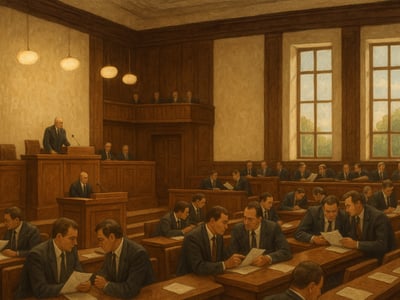
Slovak National Council in Bratislava at the July 1992 sovereignty declaration.
On July 17, 1992, the Slovak National Council in Bratislava adopted the Declaration of Sovereignty of the Slovak Republic, a decisive step in the constitutional crisis that was reshaping Czechoslovakia. The act did not itself create an immediately independent state, but it formally asserted Slovak sovereignty at a moment when the future of the federation was under intense dispute. Coming only weeks after elections had produced sharply different political mandates in the Czech lands and in Slovakia, the declaration changed the tone and stakes of negotiations over whether the common state could be preserved in some new form.
The background to that July vote lay in the parliamentary elections of June 5-6, 1992, held in the Czech and Slovak Federative Republic. In Slovakia, Vladimír Mečiar's Movement for a Democratic Slovakia emerged as the leading force. In the Czech lands, Václav Klaus and the Civic Democratic Party gained the strongest position. Those results mattered not simply because different parties had won, but because they advanced different ideas about the state's future. The basic question was no longer just who would govern; it was what kind of political structure they were meant to govern.
By the summer of 1992, Czechoslovakia faced unresolved constitutional questions that had been present in some form since the fall of communism. How much authority should remain at the federal level? How much should belong to the republics? Could the federation be tightened, loosened into a more confederal arrangement, or would it have to end? These were not abstract legal debates. They affected the distribution of power, the legitimacy of institutions, and the ability of leaders in Prague and Bratislava to claim they were acting in line with their voters' wishes.
Within that setting, Slovak political leaders faced a consequential choice. They could continue bargaining over a revised federal arrangement without taking any formal constitutional step, or they could adopt a declaration that asserted Slovak sovereignty before a final agreement existed. Choosing the second path carried obvious risks. It could strengthen Slovakia's negotiating position, but it could also harden political positions and make a shared solution more difficult. The federation still existed, federal institutions still formally operated, and no final legal settlement had yet been reached.
The declaration adopted in Bratislava signaled that the dispute had moved beyond technical redesign of the federation. It suggested that a central issue was now whether the common state still had enough political consent to endure. In practical terms, the vote told federal leaders and the Czech political leadership that Slovak representatives were no longer discussing only adjustments within the existing system. They were marking a constitutional threshold and insisting that any future arrangement had to take Slovak sovereignty as a starting point.
This distinction is important. A declaration of sovereignty is not the same thing as an immediate declaration of full independence. On July 17, Czechoslovakia did not instantly disappear, and the Slovak Republic did not yet begin operating as a fully separate internationally recognized state. Instead, the declaration formed part of a staged legal and political process. It raised the pressure on all sides to decide whether a new federation was still possible or whether separation would have to be negotiated.
Events moved quickly after that. The federal leadership remained unsettled, and on July 20, 1992, President Václav Havel resigned after failing to secure re-election as federal president during the post-election constitutional crisis. His resignation underscored the depth of the impasse. The crisis was no longer just a disagreement among party leaders; it had reached the highest office of the federation and showed how difficult it had become to maintain a common constitutional framework acceptable to both republics.
During the following weeks, negotiations continued, especially between the leading Czech and Slovak political figures, including Klaus and Mečiar. The question was increasingly not whether major change would occur, but how it would be organized and legalized. The process then advanced on September 1, 1992, when the Slovak National Council adopted the Constitution of the Slovak Republic. That constitution provided another key document in the sequence of state-building steps that were being assembled before the end of the federation.
The final stage came at the end of the year. On December 31, 1992, the Czech and Slovak Federative Republic ceased to exist. The Slovak Republic became an independent state on January 1, 1993. Seen from that endpoint, the declaration of July 17 appears as one of the central formal acts on the road to independence. Yet at the time, its significance lay precisely in its uncertainty: it was a forceful statement made before the final settlement had been secured, when the outcome still depended on political negotiation and constitutional follow-through.
The declaration also illustrates how the end of Czechoslovakia was shaped through institutions rather than sudden collapse. The process involved parliamentary votes, negotiations, resignations, constitutional texts, and agreed legal termination. That does not mean the path was simple or universally welcomed, nor that Czech and Slovak interpretations of 1992 have always matched. But the documentary trail is clear in showing a sequence of official acts through which the common state was brought to an end.
Why it still matters
The events of July 17, 1992, remain important because they show how states can be transformed through formal constitutional language as much as through elections or public rhetoric. A declaration may not by itself complete a change in sovereignty, but it can redefine the framework in which all later negotiations take place. In this case, the Slovak declaration helped structure the transition from dispute within a federation to a negotiated settlement about ending that federation.
The episode also remains relevant for understanding federal systems more broadly. Czechoslovakia in 1992 faced competing electoral mandates, unresolved constitutional design, and leaders who had to decide whether compromise remained realistic. Those problems are not unique to one country or one era. The case offers a closely documented example of how institutional systems respond when shared legitimacy weakens across different parts of a state.
Finally, the declaration matters as part of a late 20th-century European case of peaceful state succession. The end of Czechoslovakia was not without tension, uncertainty, or disagreement, but it proceeded through negotiated legal steps rather than violent conflict. For that reason, the vote in Bratislava on July 17, 1992, is remembered not only as a Slovak political milestone, but also as a key moment in the orderly dissolution of a European federation.
Timeline
- Parliamentary elections in Czechoslovakia begin
- Declaration of Sovereignty adopted
- Václav Havel resigns as president
- Constitution of the Slovak Republic adopted
- Czechoslovakia ceases to exist
- Slovak Republic becomes independent
What you uncovered
A Step Short of Independence
You didn't just… finish a puzzle; you traced a moment when Slovak leaders raised the constitutional stakes without yet declaring immediate full independence.
The July declaration is easiest to understand as a threshold act rather than the final act itself. It asserted sovereignty in the middle of a federal crisis, signaling that the relationship between the Czech and Slovak republics could no longer be treated as a routine constitutional adjustment. That distinction matters because state breakups are often shaped not by one dramatic announcement, but by a sequence of legal and political steps that gradually redefine what kind of common state is still possible.
Just three days after the declaration, on 20 July 1992, Václav Havel resigned as federal president during the unresolved constitutional crisis.
FAQ
What happened on 17 July 1992 in Bratislava?
On 17 July 1992, the Slovak National Council in Bratislava adopted the Declaration of Sovereignty of the Slovak Republic.
Did Slovakia declare full independence on 17 July 1992?
No. The 17 July 1992 act declared sovereignty, not immediate full independence. The Slovak Republic became an independent state on 1 January 1993.
Why was the 1992 sovereignty declaration important?
It took place during negotiations over the future of the Czech and Slovak federation and formally asserted Slovak sovereignty in the constitutional crisis before Czechoslovakia dissolved.
What happened after the July 1992 declaration?
The constitutional crisis continued after the declaration. Václav Havel resigned on 20 July 1992, the Slovak National Council adopted the Constitution of the Slovak Republic on 1 September 1992, and Czechoslovakia ceased to exist on 31 December 1992.