
About this story
Barclays cash machine launched at Enfield, North London, on 27 June 1967
On 27 June 1967, Barclays put a cash-dispensing machine into service at its branch in Enfield, North London, in a small but highly visible experiment in changing how people got access to their own money. For customers used to branch hours, counters, and face-to-face transactions, the idea was simple to explain but significant in practice: cash might now be available without a teller standing on the other side of the exchange.
That mattered because everyday banking still depended heavily on timing. If a branch was closed, access to cash was limited. The ordinary rhythm of withdrawing money followed the bank's schedule rather than the customer's needs. In that setting, a machine that could dispense cash outside conventional counter service was not just a new device. It was a test of whether one of the most basic acts in banking could be shifted from staffed service to self-service.
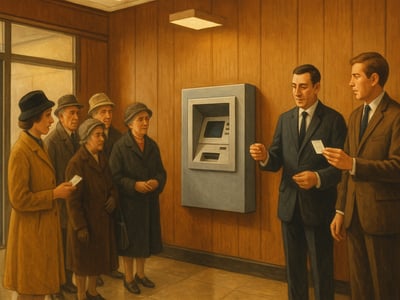
Barclays chose a single branch in Enfield to make that test public. The machine used specially prepared vouchers or tokens rather than the plastic bank cards people would later associate with ATMs. In other words, this was not yet the familiar system of card insertion, PIN entry, and network verification. It was an earlier form of automated cash access, one that solved a practical problem with the tools available at the time.
Later accounts commonly connect the machine's development with John Shepherd-Barron, whose name is regularly linked to the Barclays cash machine system introduced in Enfield. Historical discussions of inventor credit vary, and sources do not always define the technology in exactly the same way. That is one reason descriptions of the Enfield launch often use careful wording such as "early cash machine" or "precursor to the modern ATM." Even so, the event is widely recognized as a milestone in the history of automated banking.
The public opening also had a promotional and demonstrative side. Actor Reg Varney is widely reported to have taken part in the launch, giving the occasion a recognizable public face. That detail helps explain how Barclays presented the machine: not as a quiet back-office technical change, but as something ordinary customers were meant to notice, discuss, and perhaps trust.
Trust was the central issue. A machine could be installed in a wall, but that alone did not mean people would use it confidently. Customers had to believe that an unattended device could perform a task closely associated with security, accuracy, and personal finances. The bank, meanwhile, had to show that the machine would work reliably enough to avoid embarrassment or skepticism. A visible failure on such a basic service could have reinforced the view that cash withdrawal belonged only in the hands of bank staff.
That tension is what makes the Enfield installation historically useful to examine. It was not simply a story of invention in the abstract. It was a practical trial of public behavior. Would customers understand the voucher-based process? Would they treat machine-dispensed cash as legitimate and dependable? Could a bank persuade people that convenience did not have to mean lowered standards of security or service?
The answer, over time, was yes, though not in exactly the same form as the 1967 machine. The Enfield system differed from later ATM models in important ways. Modern automated teller machines came to rely on bank cards, personal identification numbers, and increasingly networked systems that connected machines to accounts and institutions across large areas. Those later developments made self-service cash withdrawal more flexible, more scalable, and more familiar.
Still, the 1967 launch showed that the basic shift was possible. It demonstrated that a bank could place part of a routine transaction into infrastructure rather than keeping it entirely at the counter. Once that principle was established, the question was no longer only whether machine-based cash access could exist. It became how far and how effectively it could spread.
The spread was gradual, shaped by technical improvement and customer acceptance. Voucher-based systems gave way to card and PIN authentication. Single-branch installations became wider networks. What began as a local trial in North London eventually formed part of a larger international pattern, in which access to money became less dependent on the opening hours of a particular branch and more dependent on shared systems operating across cities, regions, and countries.
Why it still matters
The Enfield installation still matters because it captures a turning point in the structure of everyday banking. It marks a move away from the idea that routine financial access must always be mediated by a member of staff. That change now seems ordinary, but in 1967 it still had to be demonstrated in public, one machine and one branch at a time.
It also matters because it sits near the beginning of a larger chain of technical standardization. Later cash machines and ATMs adopted card authentication and PIN-based access, making automated withdrawal faster and more broadly usable. Those systems became part of daily life in many countries, but their acceptance depended on earlier experiments that familiarized customers with the idea of obtaining cash from a machine at all.
Finally, the Enfield launch is a reminder that large infrastructure shifts often begin locally. A single installation in one London borough did not by itself create the global ATM network. But it offered a workable model of self-service banking at the moment when banks were beginning to rethink convenience, labor, and access. That is why the event is still remembered: not because the 1967 machine was identical to the ATMs that followed, but because it helped show the direction banking was taking.
Timeline
- Voucher-based cash dispenser development
- John Shepherd-Barron associated with machine design
- Shift from vouchers to card and PIN authentication
- ATM network expansion
- Debates over early cash machine definitions
- Barclays cash machine launched in Enfield
What you uncovered
Banking Beyond Branch Hours
You didn't just… complete a puzzle; you traced a moment when access to cash began to move from the bank counter to self-service machines.
What makes the Enfield installation significant is not only that it dispensed cash, but that it tested a new idea about where banking could happen. A local response to limited branch hours helped open the way to infrastructure that later became standardized through cards, PINs, and networks. It is also a useful reminder that labels like "first ATM" depend on definition, since the 1967 system differed in important ways from the machines that later became familiar worldwide.
The Enfield machine dispensed a fixed amount of cash using specially prepared vouchers or tokens rather than a bank card.
FAQ
What happened at Barclays in Enfield on 27 June 1967?
Barclays put a cash-dispensing machine into service at its branch in Enfield, North London, on 27 June 1967. It was a public trial of self-service cash access outside a staffed counter.
How did the 1967 Enfield machine work?
It dispensed a fixed sum of cash when a customer used specially prepared vouchers or tokens. It did not use a modern bank card.
Who is linked to the Enfield cash machine launch?
John Shepherd-Barron is commonly associated with the machine’s development in later accounts. Reg Varney is widely reported to have taken part in the public opening.
Why is the Barclays Enfield launch historically important?
It showed that customers could obtain cash from a machine rather than only at a branch counter. Later ATM systems built on this idea with card and PIN authentication.