
About this story
Signing of the UN Charter at Veterans' Memorial Hall, San Francisco, 26 June 1945
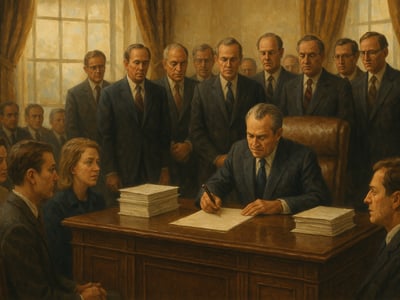
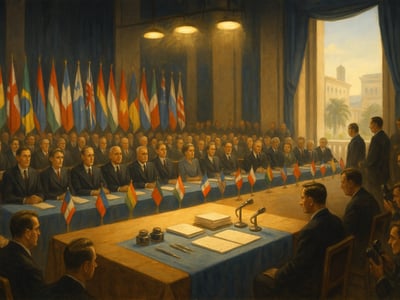
On June 26, 1945, representatives of 50 countries signed the Charter of the United Nations in San Francisco, California, bringing to a close the United Nations Conference on International Organization. The signing at Veterans' Memorial Hall did not yet create a fully operating institution, but it completed the legal text that states had agreed to support after months of negotiation at the end of a global war. The document set out the purposes of the new organization, the rules for membership, and the structure of its principal organs.
The moment came in a world still shaped by World War II. Franklin D. Roosevelt, who had backed plans for a new international organization, had died earlier that year. Germany had surrendered in May 1945, while the war in Asia continued. Governments were trying to design a system that could outlast wartime alliance politics and provide a more regular framework for diplomacy, security discussions, and international cooperation.
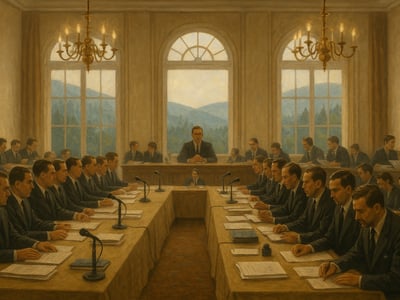
The San Francisco conference had opened on April 25, 1945, at the San Francisco Opera House, with delegates from 50 nations. They did not begin from nothing. Much of the draft structure had already been outlined in earlier proposals, especially those developed at Dumbarton Oaks in 1944. Further agreement on voting arrangements had been shaped by wartime discussions among the major Allied powers, including at Yalta. Even so, turning earlier proposals into a single charter acceptable to dozens of governments remained a difficult task.
That difficulty was built into the conference itself. Large and small states did not approach the text with identical priorities. Some wanted clearer protections for the role of the General Assembly and broader participation in debate. Others focused on the powers of the Security Council, which was intended to carry primary responsibility for international peace and security. Delegates also had to settle language on economic and social cooperation, trusteeship arrangements, and the relationship between the organization and international law.
The final text established the principal organs that still define the United Nations today: the General Assembly, the Security Council, the Economic and Social Council, the International Court of Justice, and the Secretariat. It also described the organization's broad purposes, including maintaining international peace and security and promoting cooperation among states. In that sense, the Charter was both constitutional and diplomatic: it created a framework for institutions while also expressing a set of agreed procedures for how governments would work through them.
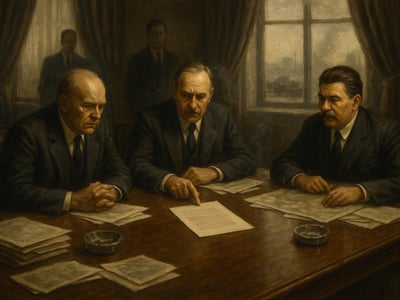
Several leading figures were closely associated with the conference and its conclusion. Edward Stettinius Jr., the U.S. Secretary of State, played a central role as host-country representative. Other prominent participants included Anthony Eden of the United Kingdom, Vyacheslav Molotov of the Soviet Union, and T. V. Soong of China. President Harry S. Truman addressed the closing session on June 26, linking the signing to the wartime sacrifices that had preceded it and to the hope that a new organization might help states manage future conflicts through agreed rules rather than force alone.
Yet the signing itself was not the final legal step. Article 110 of the Charter laid out the conditions under which the document would enter into force. Ratification was required not only from a majority of the signatory states but also specifically from China, France, the Soviet Union, the United Kingdom, and the United States. This meant that the conference could succeed ceremonially in June while the actual creation of the organization still depended on decisions taken afterward within national governments.
That interval between signature and ratification mattered. Signing showed that delegates had reached a common text. Ratification showed that states were prepared to bind themselves formally to it. The distinction is easy to overlook, but it was central to the legal process. The Charter entered into force on October 24, 1945, after the required ratifications had been deposited. Only then did the new framework become operative in the full legal sense envisioned by Article 110.
The choice of San Francisco also gave the event a distinctive setting. Although the conference was international, it took place in an American city at a moment when the United States was emerging as a central postwar power. Veterans' Memorial Hall provided the site for the signature ceremony, while the Opera House had hosted the opening weeks earlier. Those locations became part of the historical memory of the conference: one associated with deliberation, the other with formal completion.
The Charter signed on June 26 was therefore not simply a declaration of good intentions. It was a negotiated legal instrument shaped by wartime experience, power politics, and procedural compromise. Its text reflected both aspiration and limitation: a desire to build a durable international organization, and an acceptance that such an organization would rest on rules that major states were willing to accept.
Why it still matters
The Charter remains the legal foundation of the United Nations and of the principal organs that continue to operate under it. Later resolutions, debates, and institutional practices all depend on this basic framework. When governments invoke the authority of the General Assembly, the role of the Security Council, or the standing of the International Court of Justice, they are working within structures defined in 1945.
The history of the signing also shows that international institutions are created in stages. Negotiation at a conference can produce a text, but domestic approval and ratification are what give that text binding force. In that respect, the Charter illustrates a broader pattern in treaty law and multilateral diplomacy: agreements depend both on international bargaining and on state consent at home.
It also helps explain why the United Nations has often been both influential and constrained. The organization was built to provide a permanent forum and a set of procedures, not to eliminate disagreement among states. The signatures in San Francisco marked the point at which 50 governments accepted that framework. The ratifications that followed turned it from a conference outcome into the governing document of a new international organization.
Timeline
- Dumbarton Oaks proposals
- United Nations conference opens in San Francisco
- UN Charter signed in San Francisco
- UN Charter enters into force
What you uncovered
From Signature to Institution
You didn't just… complete a puzzle; you traced the moment when a negotiated text began its path toward becoming a functioning international institution.
The San Francisco signing closed one phase of diplomacy, but it did not make the United Nations operational on that day. Article 110 made clear that agreement at a conference still had to pass through ratification by key states and a broader majority of signatories. That gap matters because international institutions are built not only on shared language, but on domestic approval and legal commitment.
The Charter entered into force on 24 October 1945, after the required ratifications had been deposited under Article 110.
FAQ
What was signed in San Francisco on 26 June 1945?
Representatives of 50 countries signed the Charter of the United Nations at Veterans' Memorial Hall in San Francisco on 26 June 1945. It was the final text of the new international organization.
Who signed the UN Charter at the San Francisco conference?
Delegates from 50 countries signed the Charter of the United Nations. The conference had opened on 25 April 1945 at the San Francisco Opera House.
When did the UN Charter enter into force?
The Charter entered into force on 24 October 1945. This happened after the required ratifications were deposited under Article 110.
What did the UN Charter set out?
The Charter defined the United Nations' purposes, membership rules, and principal organs. These included the General Assembly, Security Council, Economic and Social Council, International Court of Justice, and Secretariat.