
About this story
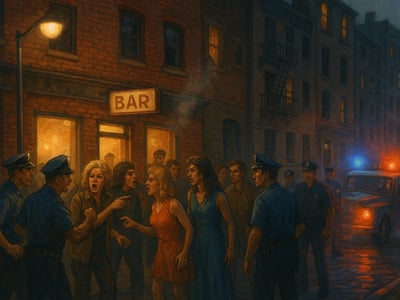
Christopher Street in New York City after the 28 June 1969 Stonewall Inn raid
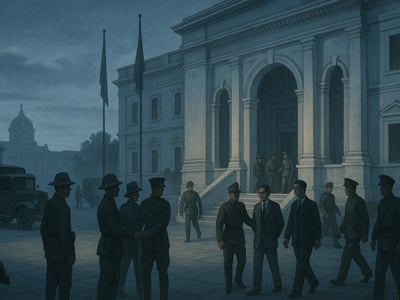
In the early hours of June 28, 1969, a police raid at the Stonewall Inn in Greenwich Village, Manhattan, turned into something far larger than a routine enforcement action. What began inside a bar at 53 Christopher Street quickly spilled into the street outside, where patrons, neighborhood residents, and bystanders gathered, watched, argued, and eventually resisted. The confrontations on Christopher Street that night, and the clashes that followed over subsequent nights, became known as the Stonewall uprising.
To understand why the raid did not end quietly, it helps to place Stonewall in the world of New York City in the late 1960s. Gay bars operated under constant pressure from liquor rules, police surveillance, and the threat of closure. Raids were not unusual. Many establishments that served gay and lesbian patrons existed in a legal gray area or under arrangements that made them especially vulnerable to police action. For customers, a raid could mean public humiliation, arrest, loss of employment, or exposure to family and neighbors. The risk was not abstract. It was built into ordinary social life.
The Stonewall Inn was one of the places where people gathered despite those risks. It drew a mixed crowd, including gay men, lesbians, drag performers, transgender people, homeless youth, and others who often had few public spaces where they could meet freely. Accounts of the night differ on some details, and historians remain careful about assigning a single cause or a single leading figure to the first moments of resistance. But the broad outline is well established: police entered the Stonewall Inn, began removing patrons, and the process did not remain contained.
Deputy Inspector Seymour Pine later identified the operation as a Public Morals Division raid targeting the Stonewall Inn. As officers checked identification, made arrests, and moved people out of the bar, a crowd formed outside. Such crowds could be volatile. They were made up not only of those directly affected but also of passersby, local residents, and people drawn by the sight of patrol wagons and police activity on a summer night in Greenwich Village.
At first, the scene reflected a pattern New Yorkers had seen before. People were taken from the bar. Police attempted to maintain control. But this time, the crowd did not disperse. Instead, the numbers grew, and the mood changed. Witnesses later described jeering, shouted remarks, and mounting anger as arrests continued. The narrow street, the familiar local audience, and the slow rhythm of the removals all seem to have helped turn observation into collective action.
Once that shift happened, the street itself became central to the story. Christopher Street and the surrounding Village blocks gave the crowd room to assemble and regroup while also hemming in the officers near the bar. The confrontation moved beyond a raid and became a struggle over presence: who could remain in public space, who controlled the street, and whether police authority would go unanswered. Clashes developed outside the Stonewall Inn during the night of June 28.
Contemporary reporting helps fix the event in the historical record. Village Voice coverage by Howard Smith documented the crowds and disorder outside the Stonewall Inn that night. Newspaper reporting in the days that followed also showed that the unrest did not end with a single clash. On July 2, 1969, New York newspapers reported another major night of disorder around Christopher Street after the initial raid. That continuation mattered. Stonewall became historically significant not simply because a raid occurred, but because resistance proved sustained and visible.
The names most often associated with Stonewall today include Marsha P. Johnson and Sylvia Rivera, both later prominent in struggles around LGBTQ life and survival in New York. Craig Rodwell, another important figure in the period, would help connect the uprising to organized public commemoration. At the same time, the event’s memory remains contested in some respects. Different participants remembered the sequence of actions differently, and later retellings sometimes compressed a complex crowd into a few symbolic names. Careful history does not erase those figures, but it also avoids pretending that one person alone explains what happened on Christopher Street.
That caution is part of what makes Stonewall historically interesting. It was not a scripted campaign launch, and it was not the first instance of LGBTQ resistance in the United States. Rather, it was a local confrontation that became a wider reference point because many people recognized in it a familiar pattern of policing and a visible refusal to accept it quietly. The uprising connected private risk to public assembly. People who might otherwise have remained isolated found themselves in a crowd that did not immediately give way.
In the months after Stonewall, activists formed new organizations, including the Gay Liberation Front and later the Gay Activists Alliance. These groups did not emerge from nowhere, but Stonewall gave urgency, language, and publicity to organizing that followed. The event became a focal point for newspapers, community discussion, and political action. It also became a place in memory: a street corner and bar address that could stand for a broader change in how activists understood visibility, protest, and coalition.
Why it still matters
Stonewall still matters in part because it offers historians a concrete case for examining policing, public assembly, and civil-rights organizing in an American city. The event shows how a familiar enforcement action could produce a different outcome when a crowd stayed, grew, and treated the street itself as a political space. That makes Stonewall important not only in LGBTQ history but also in the history of urban protest.
Its anniversary also helped establish an enduring form of public commemoration. On June 28, 1970, the Christopher Street Liberation Day march in New York marked the first anniversary of the uprising. That anniversary observance became a model. Over time, annual Pride marches spread to other cities, turning a local event in Greenwich Village into a recurring international practice of remembrance, visibility, and advocacy.
Stonewall also remains central because it is so heavily documented, debated, and revisited. Archives, museums, libraries, and scholars continue to study the raid, the nights of unrest, and the people who were there. That continuing attention reflects both the importance of the event and the care required in telling its story. Some details remain disputed in eyewitness memory, but the central fact is not: on June 28, 1969, at the Stonewall Inn on Christopher Street, a police raid met public resistance and entered history.
Timeline
- Stonewall Inn raid in New York City
- Second night of disorder in Greenwich Village
- Christopher Street Liberation Day march
What you uncovered
When a Raid Became a Turning Point
You didn't just… complete a puzzle; you traced the moment when a police raid did not end at a doorway but spilled into the street and drew a community into public view.
Stonewall is often remembered as a single dramatic event, but its broader significance also lies in how an enforcement action became harder to contain once people stayed, watched, and gathered together in a visible public space. The streets around Christopher Street mattered because they turned a raid inside a bar into a confrontation that unfolded before a growing crowd. That shift helps explain why Stonewall is so often used to study the relationship between policing, public assembly, and organized activism. It also helps explain why its anniversary became a recurring form of commemoration rather than only a memorial to one night.
The first Christopher Street Liberation Day march was held in New York on 1970-06-28, one year after the initial Stonewall raid.
FAQ
What happened at the Stonewall Inn on June 28, 1969?
On 1969-06-28, New York City police raided the Stonewall Inn at 53 Christopher Street in Greenwich Village, Manhattan. Crowds gathered outside, and street confrontations followed during the night.
Where was the Stonewall Inn located?
The Stonewall Inn was located at 53 Christopher Street in Greenwich Village, Manhattan, New York City. The unrest also centered on Christopher Street outside the bar.
Who is linked to the Stonewall uprising?
The brief identifies Seymour Pine, Craig Rodwell, Marsha P. Johnson, and Sylvia Rivera as key figures associated with Stonewall. Their names are often connected with the events and their later public memory.
How did Stonewall lead to an anniversary march?
After the initial raid and the following nights of disorder, the events were remembered publicly as a turning point. On 1970-06-28, the Christopher Street Liberation Day march marked the first anniversary of the Stonewall uprising.