
About this story
On 9 August 1936, Jesse Owens won his fourth gold medal at the Berlin Olympics in the men’s 4×100-meter relay. The victory completed a historic Games performance that challenged Nazi racial ideology on its own stage.
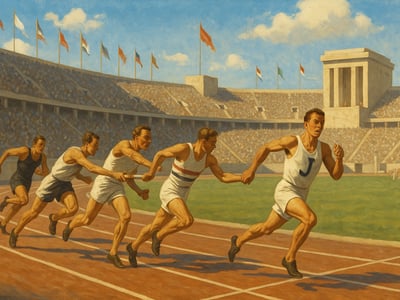
Jesse Owens and the U.S. relay team win the 4×100-meter final in Berlin, 1936.
On August 9, 1936, at the Olympiastadion in Berlin, Jesse Owens ran the anchor leg for the United States men's 4×100-meter relay team and crossed the line for his fourth gold medal of the Olympic Games. The Americans finished in 39.8 seconds, a time recorded in Olympic records as a world record. It was the last of Owens's victories in Berlin, following his wins in the 100 meters, the long jump, and the 200 meters earlier that week.
Berlin’s charged Olympic stage
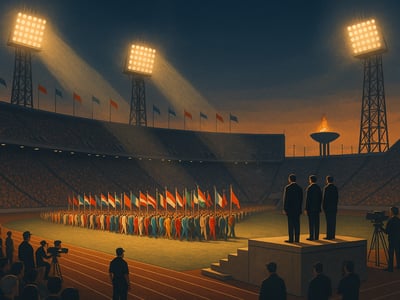
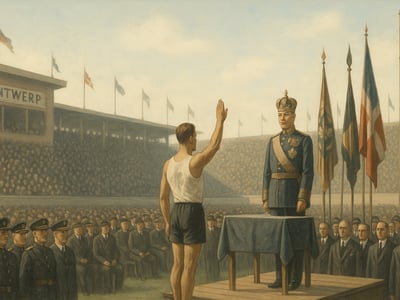
The race took place within one of the most politically charged Olympic settings in modern history. The 1936 Summer Games were staged under the Nazi government, which used the event to present an image of national order and strength to international visitors. Athletes still competed according to the demands of their sports, but their performances unfolded inside a larger framework of ceremony, symbolism, and propaganda. Owens's successes in Berlin would later be remembered not only as athletic achievements, but also as part of that broader historical setting.
By the time of the relay, Owens was already one of the central figures of the Games. He had won the 100 meters on August 3, the long jump on August 4, and the 200 meters on August 5. A fourth event offered the possibility of another title, but a relay added a different kind of pressure. Sprint relays depend not just on speed, but on precise coordination. Baton exchanges must be timed closely, and even a slight error can undo the advantage of the fastest runners.
Three golds already won
The United States entered a final quartet of Foy Draper, Frank Wykoff, Ralph Metcalfe, and Jesse Owens. Before the race, however, there had been a late lineup change. Marty Glickman and Sam Stoller, who had been expected to run, were removed from the team. Owens and Metcalfe took their places in the final lineup. The decision has remained one of the most debated personnel choices of the 1936 Games.
Contemporary accounts and later histories have treated that change with caution and disagreement. Because Glickman and Stoller were Jewish, many observers have seen the decision in the context of antisemitism and the effort to avoid offending the Nazi hosts. Others pointed to competitive reasoning offered by U.S. officials, who said they wanted their strongest available team in the race. The historical record shows clearly that Glickman and Stoller were removed and that Owens and Metcalfe ran instead; the motives behind the change remain a sensitive and contested subject.
Relay lineup controversy
What is not disputed is the task that faced the team once it was on the track. A relay final leaves little room for recovery. Each runner must accelerate, place the baton cleanly into the next hand, and trust that every exchange zone will be judged correctly under Olympic pressure. In Berlin, the American quartet executed the race successfully. Draper opened, Wykoff followed, Metcalfe carried the baton on the third leg, and Owens took the final handoff before bringing the relay home.
The winning time of 39.8 seconds was reported in Olympic records as a world-record performance. Owens, as anchor, became the visible finish of the effort, but the result depended on all four runners and on the quality of their exchanges. That matters in understanding the event. Unlike an individual sprint, the relay compressed personal ambition into a collective performance. Owens's fourth gold was inseparable from the work of Draper, Wykoff, and Metcalfe.
Fourth gold and a contested memory
The result also completed one of the most famous Olympic programs in track and field history. Four gold medals at a single Games placed Owens in an exceptional category of athletic accomplishment. Yet even that summary can flatten the sequence of events. The four victories did not come as a single symbolic gesture; they came through separate competitions across several days, each with its own demands. The relay, because it was the last, helped fix the overall image in public memory.
Much later retellings often simplified Berlin into a single moral tableau, sometimes blurring what is documented and what was added afterward. The race itself is straightforward in the historical record: the final was held on August 9, 1936, at the Olympiastadion; the United States team of Draper, Wykoff, Metcalfe, and Owens won in 39.8 seconds; and that victory gave Owens his fourth gold medal of the Games. Around those facts, interpretation has grown, shaped by the politics of the setting and by the enduring place of Owens in sports history.
Why it still matters
This relay remains important partly because it shows how athletic events can never be entirely separated from their surroundings. The Berlin Olympics were used by the Nazi state as an international display, and performances there were inevitably read through political as well as sporting lenses. Owens's success became part of that history, even though the race itself was decided by the familiar elements of sprinting: speed, preparation, and execution under pressure.
The lineup change before the relay also continues to draw attention because it raises questions about fairness, representation, and institutional decision-making. Since Marty Glickman and Sam Stoller did not run, the episode is still discussed in accounts of discrimination in sport and in debates about how bias can shape selection. Historians and writers approach it carefully because the evidence supports the change itself more clearly than it settles every motive behind it.
Owens's four-gold performance also endures in Olympic recordkeeping and public memory. It is remembered as a major achievement in athletics, but also as an example of how a single athlete can come to symbolize much more than a race result. Later generations have returned to Berlin not only to recount medals and times, but to ask how sport, national image, and historical memory become intertwined.
In that sense, the relay final on August 9 was both a race and a moment that would keep being reinterpreted. The baton made its way once around the track in less than 40 seconds. The questions attached to that run have lasted far longer.
Timeline
What you uncovered
More Than a Fast Finish
You didn't just… rebuild a relay finish; you traced a moment where precise teamwork, selection decisions, and Olympic spectacle converged under unusual political scrutiny.
This race is often remembered through Owens alone, but the relay also points to how team events can carry arguments about institutions as much as performances. In Berlin, athletic success unfolded inside a carefully staged international setting, and the late lineup change ensured that the result would be discussed not only for speed but also for who was chosen to run. That is part of why the event still matters: it sits at the intersection of excellence, representation, and the politics surrounding sport.
Before the relay, Owens had already won gold in the 100 meters, long jump, and 200 meters during the same Berlin Olympics.
FAQ
What happened on 9 August 1936 in Berlin?
On 9 August 1936, the men's 4×100-meter relay final was held at the Olympiastadion in Berlin during the Summer Olympics. The United States won the race in 39.8 seconds, and Jesse Owens ran the anchor leg.
Which athletes ran for the United States in the relay final?
The United States relay team consisted of Foy Draper, Frank Wykoff, Ralph Metcalfe, and Jesse Owens. Owens and Metcalfe were in the final lineup for the race.
How many gold medals did Jesse Owens win in Berlin?
Jesse Owens won four gold medals at the 1936 Berlin Olympics. He had already won the 100 meters, long jump, and 200 meters before the relay victory.
What time did the U.S. relay team record?
The United States won the men's 4×100-meter relay in 39.8 seconds. Olympic records reported that time as a world-record performance for the event on 9 August 1936.
Who was removed from the U.S. relay lineup before the race?
Before the relay final, Marty Glickman and Sam Stoller were removed from the U.S. lineup. Owens and Metcalfe then ran in the final quartet on 9 August 1936.