
About this story
On 26 July 1945, the United States, Great Britain, and China issued the Potsdam Declaration calling on Japan to surrender unconditionally. The short wartime ultimatum framed the final phase of the Pacific War.
The Potsdam Declaration set Allied surrender terms for Japan on 26 July 1945.
On July 26, 1945, as Allied leaders met at Potsdam near Berlin, the United States, Great Britain, and China issued a formal declaration calling on Japan to surrender unconditionally. The statement, now known as the Potsdam Declaration, was brief but consequential. It set out terms for ending the war in the Pacific and warned that if Japan did not accept them, the alternative would be "prompt and utter destruction."
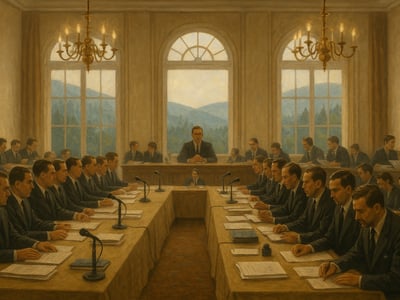
The declaration came at a late stage of World War II, but not at a moment of peace. Fighting in the Pacific was still continuing, and the question facing Allied governments was how to bring Japan's resistance to an end. At Potsdam, where leaders were already discussing the postwar order in Europe and Asia, the war against Japan remained unfinished. The declaration was part diplomatic message and part military pressure, designed to make Allied terms public and unmistakable.
Harry S. Truman, Winston Churchill, and Chiang Kai-shek were the leaders named with the document on its date of issue. Their governments presented it not as a private opening for negotiation, but as a public ultimatum. That choice mattered. By publishing the terms openly, the Allies narrowed the room for ambiguity and made Japan's next move an issue of international attention.
The language of unconditional surrender had already become an established Allied policy during the war. In the case of Japan, the Potsdam Declaration applied that policy directly to the final phase of the Pacific conflict. It called for the end of the authority of those who had led Japan into war, for the occupation of certain Japanese territory, and for the disarmament of Japanese forces. At the same time, it also stated that Japan would not be annihilated as a nation and that, once peaceful and responsible government had been established, occupation forces would withdraw. In this way, the declaration combined severe demands with a limited outline of a postwar future.
One striking feature of the document was what it left unsaid. Its threat of "prompt and utter destruction" was explicit, but the means by which that destruction would come were not described in the text itself. That omission gave the statement an added force. It left Japanese leaders to consider not only the terms being offered, but also the possibility of further military escalation if those terms were refused.
The wider diplomatic picture was also incomplete. Although the declaration was issued during the Potsdam Conference, the Soviet Union was not among its signatories on July 26, 1945. At that moment, it was not yet at war with Japan. This absence was important because Soviet intentions remained a major factor in the final calculations of 1945. For Japan, the international environment was therefore uncertain even as the Allied demand was made plain.
Within Japan, the declaration immediately raised difficult questions. Accepting unconditional surrender carried enormous political weight, especially for a government still engaged in war and facing internal divisions over strategy and terms. Rejecting the declaration, however, meant accepting the risk of continued combat under worsening conditions. The document did not settle those tensions; it sharpened them.
On July 28, Prime Minister Kantarō Suzuki publicly responded in a way widely reported as rejecting or at least withholding acceptance of the declaration. That response did not close the matter diplomatically, but it left the ultimatum unresolved. In practical terms, the war continued, and the warning contained in the declaration remained in effect.
The days that followed would become some of the most consequential of the twentieth century. The declaration did not by itself end the war, nor did it remove the uncertainty surrounding Japan's decision-making. Instead, it became part of the final sequence of pressure, response, and escalation that led to Japan's surrender in August 1945. Historians continue to read it not only for what it demanded, but for how much was concentrated into a short official text: military resolve, alliance politics, and the attempt to shape an ending to a global war through formal language.
Why it still matters
The Potsdam Declaration remains important because it shows how governments use public documents to connect diplomacy and force. It was not simply a statement of opinion or a routine communiqué from a conference. It was a carefully framed wartime demand, issued by major Allied powers, with terms that were meant to be read both by political leaders and by a wider international audience.
It also serves as a reference point in the history of surrender policy. The declaration demonstrates how official wording can narrow choices, define acceptable outcomes, and increase the consequences of delay. Its text is still quoted in histories of World War II because it helps explain how the final phase of the Pacific War unfolded: not as a single decision made in isolation, but as a chain of public and private actions in which language itself carried strategic weight.
Today, the document is studied as part of the closing diplomacy of World War II. It marks a moment when the end of one of history's largest conflicts was being shaped not only on battlefields, but also through a few paragraphs released to the world from a conference near Berlin.
Timeline
- Potsdam Conference begins
- Potsdam Declaration issued
- Japanese government response
- Soviet entry into war against Japan
- Atomic bombing of Hiroshima
- Atomic bombing of Nagasaki
- Japan announces surrender
What you uncovered
Words Under Wartime Pressure
You didn't just… complete a puzzle; you traced a moment when a few lines of official language helped define the closing decisions of the Pacific war.
The Potsdam Declaration shows how diplomatic wording can do more than describe policy: it can compress military threat, alliance coordination, and political signaling into a single text. Because it was issued publicly and tied to unconditional surrender, it limited how easily either side could adjust its position without visible consequences. That helps explain why such documents matter in wartime history not only for what they say, but for how they structure the choices that follow.
The Soviet Union did not sign the declaration on July 26, 1945, because it was not yet at war with Japan at that time.
FAQ
What was the Potsdam Declaration issued on 26 July 1945?
It was a public Allied ultimatum issued by the United States, Great Britain, and China calling on Japan to surrender unconditionally in the Pacific war. The declaration warned that Japan faced "prompt and utter destruction" if it did not accept the terms.
Who issued the Potsdam Declaration?
On 26 July 1945, Harry S. Truman, Winston Churchill, and Chiang Kai-shek issued the declaration. The Soviet Union did not sign it on that date because it was not yet at war with Japan.
Why was the declaration released at Potsdam near Berlin?
It was released while the Potsdam Conference was underway in Potsdam, near Berlin, from 17 July to 2 August 1945. The statement was part of the Allied effort to set out surrender terms while fighting in the Pacific was still continuing.
How did Japan respond to the Potsdam Declaration?
On 28 July 1945, Japanese Prime Minister Kantarō Suzuki publicly responded in a way widely reported as rejecting or withholding acceptance of the declaration. That left the ultimatum unresolved.
Why was the Potsdam Declaration important in World War II?
It became a key document in the final diplomatic and military sequence of World War II. It helped define the Allied demand for unconditional surrender and the pressure on Japan in the war's closing weeks.