
About this story
Original iPhone launch in the United States, June 29, 2007
On June 29, 2007, Apple began selling the first iPhone in the United States, opening sales at 6:00 p.m. local time through its own retail stores and AT&T sales channels. The launch came nearly six months after Steve Jobs had introduced the device at Apple’s Macworld keynote on January 9, 2007, at the Moscone Center in San Francisco. By the time it reached customers, the iPhone had already become one of the most discussed consumer electronics products of the year, not because it was the first mobile phone or the first device to connect to the internet, but because Apple was presenting a different idea of what a phone could be.
The original iPhone combined three functions that were already familiar to many users: a mobile phone, an iPod, and internet access. Apple emphasized that these were not separate gadgets placed side by side, but parts of a single touchscreen device. It featured a 3.5-inch display and was introduced in two versions: a 4 GB model priced at $499 and an 8 GB model priced at $599, both sold with a two-year AT&T contract. In practical terms, this meant the product entered the market as a premium device, tied closely to one carrier in the United States.
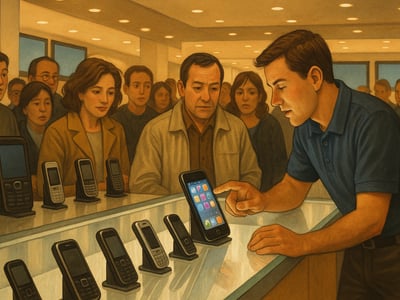
That arrangement showed how much risk was built into the launch. Apple was moving into a market already dominated by established phone makers and by devices built around physical keypads or small hardware keyboards. Many consumers were used to pressing keys for calls, messages, and menus. The iPhone asked them to trust a mostly flat front surface and a software-based interface for tasks that had long depended on buttons. The company was also betting that users would accept a higher price and a carrier restriction in exchange for a different kind of experience.
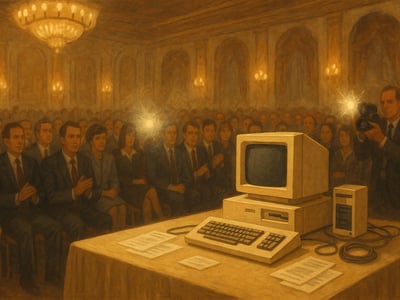
When Steve Jobs unveiled the device in January, he framed it as a combination of products rather than simply another handset. That presentation mattered because it signaled Apple’s intention to define the iPhone less as a telephone and more as a compact computing device for everyday use. The touchscreen was central to that vision. Instead of navigating with a keypad, stylus, or dense menu structure, users interacted directly with icons and content on the display. This was not an entirely new concept in electronics, but Apple was trying to make it simple enough for mass-market use.
The company’s decision was not an obvious one. At the time, several successful mobile devices relied on hardware keyboards, especially for email and messaging. Business users often valued tactile input, and many phones were designed around operator menus, limited web browsing, and tightly controlled software features. Apple’s approach reduced visible controls and placed more responsibility on the screen itself. If customers had found that interface confusing, slow, or unreliable, the device might have been treated as a striking experiment rather than a durable product line.
The first day of sales therefore carried more significance than a routine product release. It was the moment when the idea introduced on stage had to work in ordinary hands. Apple and AT&T were not only selling hardware; they were testing whether consumers would accept a phone organized around touch, media playback, and mobile web use in a single package. The launch also revealed how closely design choices, pricing, and distribution were linked. A device could be innovative, but it still had to fit within retail channels, service contracts, and customer habits.
In its first configuration, the iPhone lineup was relatively simple. Buyers chose between the 4 GB and 8 GB models, both tied to the same carrier relationship and basic concept. That simplicity was itself part of Apple’s broader product strategy. Rather than offering many shapes, keyboard layouts, or feature tiers, the company presented one core design. A few months later, on September 5, 2007, Apple discontinued the 4 GB model, leaving the 8 GB version in the lineup. Even that early adjustment suggested how quickly the company was learning from the market it had entered.
The launch did not by itself create the entire smartphone era, and many of the technologies involved had earlier histories. Mobile internet access, digital music playback, and handheld computing all predated the iPhone. But Apple’s June 2007 release brought those elements together in a form that reached a broad consumer audience and attracted sustained attention. The product’s design, its emphasis on direct touch interaction, and its coordinated sale through Apple and AT&T gave the release a distinct shape.
Why it still matters
The first iPhone’s arrival remains important because it helps explain a larger shift in personal technology. It marked a visible movement away from phones centered on physical keypads and toward touchscreen devices that functioned more like pocket computers. That transition changed expectations about what people would do on a phone: browse the web, view media, manage messages, and later run a growing range of software from a single handheld device.
It also showed how a technology market can be shaped by more than technical specifications alone. Hardware design, software interface, retail presentation, and carrier agreements all influenced how the iPhone reached users. The launch became an example of how companies could package those elements together into a consumer electronics strategy rather than treat them as separate decisions.
The event also points forward to later developments, especially the growth of app-based software distribution after the App Store arrived in 2008. While that came after the original launch, the June 29, 2007 release established the device platform that made such an ecosystem possible. For that reason, the first iPhone’s first day on sale is remembered not only as a successful product debut, but as a clear marker in the history of mobile computing.
Timeline
- iPhone unveiled at Macworld keynote
- iPhone first sale in the United States
- 4 GB iPhone discontinued
- App Store launch
What you uncovered
A New Consumer Tech Model
You didn't just… piece together a product launch; you retraced a moment when phone design, software, and carrier control were bundled into a single consumer experience.
The first iPhone mattered not only because of its features, but because it presented simplicity as a sales strategy. Apple combined hardware, software, and a tightly managed carrier relationship in a way that limited user choice in some areas while making the overall product easier to understand and adopt. That model helped shift expectations for what a phone should do and how digital services could be delivered through one handheld device.
At launch on 2007-06-29, the original iPhone went on sale in the United States at 6:00 p.m. local time in 4 GB and 8 GB versions priced at $499 and $599 with a two-year AT&T contract.
FAQ
When did the first iPhone go on sale?
Apple began selling the first iPhone in the United States on 2007-06-29, starting at 6:00 p.m. local time. Sales were offered through Apple retail stores and AT&T sales channels.
Where was the first iPhone unveiled?
Steve Jobs introduced the iPhone on 2007-01-09 during Apple's Macworld keynote at Moscone Center in San Francisco. That announcement came months before the U.S. sales launch.
What did the original iPhone combine?
The original iPhone combined a mobile phone, iPod functions, and internet access in one device. It used a 3.5-inch display and was sold as a touchscreen product.
How much did the first iPhone cost at launch?
At launch, the original iPhone came in 4 GB and 8 GB models priced at $499 and $599. Those prices required a two-year AT&T contract.