
About this story
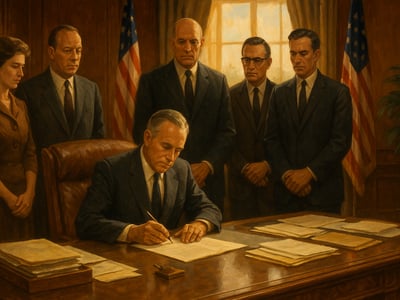
On 29 July 1958, President Dwight D. Eisenhower signed the National Aeronautics and Space Act in Washington, D.C., creating NASA as a civilian federal space agency. The law reorganized U.S. aeronautics and space research in response to the early Cold War space race.
National Aeronautics and Space Act signed in Washington, D.C., on July 29, 1958
On July 29, 1958, President Dwight D. Eisenhower signed the National Aeronautics and Space Act in Washington, D.C., creating the National Aeronautics and Space Administration, or NASA. The law did not launch a rocket or send a person into orbit. Instead, it created a new federal institution meant to organize how the United States would handle aeronautics and space research at a moment of unusual pressure, with the Cold War shaping political decisions and the Soviet Union's recent technological success forcing a rapid reassessment in Washington.
After Sputnik
The immediate background was Sputnik 1, launched by the Soviet Union on October 4, 1957. The satellite was small, but its effect was large. It demonstrated that the Soviet Union could place an object into orbit and, by implication, had powerful rocket technology. In the United States, Sputnik intensified existing concerns about scientific capacity, missile development, education, and national prestige. It also exposed a practical problem: the country had no single civilian agency responsible for coordinating national space activity.
From NACA to a new agency
Before NASA existed, aeronautical research was led largely by the National Advisory Committee for Aeronautics, known as NACA. Founded in 1915, NACA had built a respected record in aviation research, working through laboratories and technical partnerships. But the arrival of the space age raised questions that went beyond aircraft design. Space activities touched military planning, basic science, communications, engineering, procurement, and public diplomacy. A new institutional structure seemed necessary.
That did not mean the path forward was obvious. In 1958, one of the central policy debates concerned whether the United States should place its space effort mainly under military control or establish a civilian agency. This was not a minor administrative question. It concerned how the nation would present its ambitions, how research would be coordinated, and who would set priorities. A military-led system might have aligned more directly with defense objectives, but it also risked narrowing the public and scientific character of the program. A civilian structure offered a different model: one that could still serve national interests while emphasizing research, openness, and broad institutional cooperation.
Choosing a civilian path
Eisenhower favored that civilian approach. Congress, after debate, passed the National Aeronautics and Space Act in 1958. When Eisenhower signed it on July 29, he approved more than a name change. The act reorganized federal responsibilities in a way intended to reduce fragmentation and give the United States a coherent framework for aeronautics and space work. It created NASA as a civilian federal agency at a time when the country was trying to respond quickly without letting the entire field become defined only by military competition.
Building NASA into being
The new agency did not begin from nothing. One of the most important parts of the transition came a little later, when NASA officially began operations on October 1, 1958. On that date, it absorbed NACA, bringing its personnel, laboratories, and research culture into the new organization. This gave NASA an immediate technical foundation. Instead of constructing an institution entirely from scratch, the government built on an existing body of expertise in aeronautics and engineering.
Leadership appointments also helped define the early agency. T. Keith Glennan was sworn in as NASA's first Administrator on August 19, 1958, with Hugh L. Dryden as Deputy Administrator. Glennan brought administrative experience, while Dryden represented continuity with the scientific and research traditions associated with NACA. Together, they stood at the junction between an older era of aviation research and a new era in which federal space activity would be organized at a much larger scale.
This early period involved more than legal paperwork and office reorganization. The challenge was to create a working institution able to bring together laboratories, scientists, engineers, universities, industrial contractors, and policymakers under a common framework. The United States was not simply trying to match a rival's symbolic achievement. It was trying to establish a durable system for research and development in fields that were advancing quickly and requiring large, coordinated investments.
In that sense, NASA's creation was a structural answer to a political and technological problem. Sputnik had exposed urgency, but the response was not limited to a single emergency measure. The National Aeronautics and Space Act created a mechanism for long-term action. It tied scientific research to engineering capacity, federal funding, procurement systems, and public communication. That combination would shape not only later missions but also the everyday machinery of the American space program.
The timing mattered. By the time NASA formally opened on October 1, 1958, early planning was already underway for projects that would soon define the agency's first phase, including human spaceflight efforts that developed into Project Mercury. Those later achievements often receive more public attention than the law that created NASA, but without the institutional decision made in 1958, those programs would have emerged in a different form, and perhaps with less coordination.
Why it still matters
NASA's creation still matters because it established a civilian model for organizing federal space research and exploration. That choice influenced the public identity of the U.S. space program from the start. Rather than being framed only as a military enterprise, American space activity was placed in an agency designed to connect scientific inquiry, technical development, and national policy.
The institutional design also had lasting practical effects. By linking research centers, government management, universities, and private contractors, NASA became a framework for collaboration that extended well beyond one decade of Cold War competition. Its structure helped define how major federal science and engineering programs could operate: with centralized direction, specialized laboratories, outside partnerships, and public visibility.
The act signed in Washington in July 1958 therefore belongs to a larger history than rockets alone. It shows how governments respond when new technologies create both pressure and uncertainty. In NASA's case, the response was to build an institution that could coordinate expertise, set priorities, and present space exploration as a civilian national undertaking. That decision shaped the course of U.S. aeronautics and space activity for decades after the ink on the law had dried.
Timeline
What you uncovered
A Civilian Path to Space
You didn't just… complete a puzzle; you traced the moment the United States chose to organize space research through a civilian agency rather than primarily through the military.
That choice mattered beyond administration. A civilian agency gave the space program a public scientific identity, even as it operated within Cold War pressures. It also created a structure that could connect federal research, universities, industry, and public communication under one institution. That model helped define how large-scale space efforts would be explained, funded, and coordinated for decades.
NASA officially began operations on October 1, 1958, the same day it absorbed the National Advisory Committee for Aeronautics.
FAQ
Why was NASA created in 1958?
NASA was created to give the United States a single civilian agency for aeronautics and space activities. This followed the launch of Sputnik 1 and the growing need to coordinate U.S. space policy.
What did the National Aeronautics and Space Act do?
The National Aeronautics and Space Act was signed into law by President Dwight D. Eisenhower on July 29, 1958. It created the National Aeronautics and Space Administration as a civilian federal agency.
How did Sputnik influence the creation of NASA?
Sputnik 1, launched by the Soviet Union on October 4, 1957, intensified U.S. debate over national space policy. It helped push the United States to reorganize its space efforts under one agency.
When did NASA officially begin operations?
NASA officially began operations on October 1, 1958. On that date, it also absorbed the National Advisory Committee for Aeronautics.