About this story
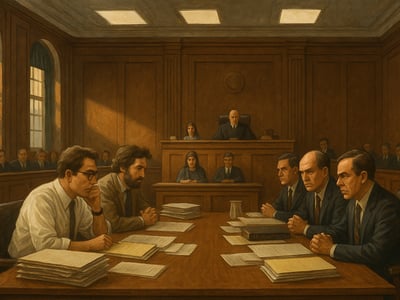
U.S. Supreme Court ruling on Pentagon Papers publication, Washington, D.C., 1971
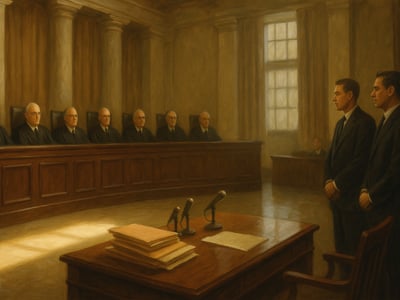
On June 30, 1971, the U.S. Supreme Court issued one of its most cited press-freedom decisions, ruling 6–3 in *New York Times Co. v. United States* against the federal government's effort to stop further publication of the Pentagon Papers. The decision came after an exceptionally fast legal battle in Washington, D.C., and concerned a basic constitutional question with immediate practical consequences: could the government prevent newspapers from printing classified material before publication by claiming harm to national security?
The Pentagon Papers were a classified Department of Defense study on U.S. involvement in Vietnam. Their public importance did not lie in battlefield secrets alone, but in what the documents revealed about years of official decision-making. When *The New York Times* began publishing excerpts on June 13, 1971, the dispute moved quickly beyond a question of newsroom judgment. It became a direct confrontation between executive claims of secrecy and the constitutional protections of a free press.
The government responded within days. On June 15, a federal court issued a temporary restraining order against *The New York Times*, blocking further publication while the case proceeded. That order was crucial because it turned the controversy into a test of prior restraint, the legal term for government action that stops speech or publication before it happens. American courts had generally treated prior restraint with deep suspicion, but there was no guarantee that principle would prevail in so sensitive a case.
The risk for the newspapers was immediate. Editors and publishers had to decide whether to continue pressing the issue under legal threat, and whether publication of classified material could expose them to severe consequences. At the same time, government lawyers argued that continued publication could damage national security and that the courts should act to prevent that harm before more articles appeared.
The conflict widened when *The Washington Post* began publishing related material on June 18, after the injunction against the *Times*. What had begun as a dispute involving one newspaper became a broader institutional test. If the government could halt one major paper and then another, the case would establish a stronger precedent for suppressing reporting in advance, especially where officials invoked secrecy.
The speed of the litigation was remarkable. Lower federal courts handled emergency filings and conflicting arguments in a matter of days. The case reached the Supreme Court so quickly that the justices heard arguments on June 26, 1971, under an unusually compressed schedule. That rapid review reflected the stakes. The Court was not considering a distant academic question; it was being asked to decide, almost in real time, whether publication could continue.
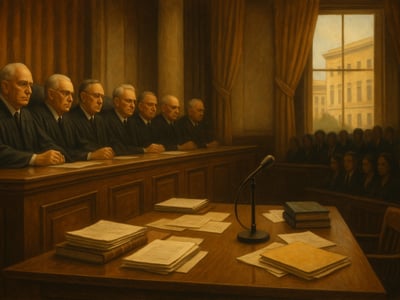
When the justices ruled on June 30, they issued a brief per curiam decision. By a 6–3 vote, the Court rejected the government's effort to maintain the restraints on publication. The brevity of the main ruling was matched by the complexity around it: several justices wrote separate concurring and dissenting opinions, and those opinions did not all rest on identical reasoning. But taken together, the result made one point unmistakable. The government had not met the heavy burden required to justify prior restraint.
Justice Hugo Black, joined in part by Justice William O. Douglas, wrote in especially forceful terms about the First Amendment's protection of the press. Other members of the majority were less absolute in their reasoning, but still concluded that the government had failed to show sufficient grounds for stopping publication in advance. In dissent, Chief Justice Warren E. Burger and Justices John M. Harlan II and Harry A. Blackmun argued in different ways that the Court had moved too quickly or had not shown enough deference to executive claims involving national security.
That divide is important for understanding the case. The Court did not declare that classified information could always be published without legal consequence, nor did it erase the government's ability to protect genuine secrets by all means. Rather, in this instance, with this request for injunctions against newspapers, the justices refused to allow prior restraint on the showing the government had made. The distinction mattered then and still matters now: the ruling addressed the extraordinary act of stopping publication before it occurred.
The decision also illustrated how institutions respond under pressure. News organizations had to weigh public interest against legal exposure. Government officials had to decide whether to seek judicial intervention rather than rely on internal secrecy rules or later prosecution of leakers. The Supreme Court, facing a compressed timetable, had to act without the long deliberative pace often associated with major constitutional rulings.
Why it still matters
The Pentagon Papers case remains a central reference point in American constitutional law because it clarified how difficult it is for the government to suppress publication in advance. In law schools, journalism classrooms, and court arguments, it is regularly used to explain prior restraint and the strong presumption against it.
Its continuing influence also lies in the limits it defined. The case did not settle every dispute involving secrecy, leaks, and national defense, but it shaped how those disputes are framed. Courts, editors, and public officials still return to the 1971 ruling when considering whether a claimed national-security interest is enough to justify blocking publication before the public can see it.
For journalism, the case became a lasting example of how legal protections for the press are tested not in theory but in moments of urgency. For government, it showed that secrecy claims, even when serious, do not automatically outweigh constitutional safeguards. And for the public, it reinforced the idea that debates over war, policy, and official conduct depend in part on whether information can reach citizens before the state succeeds in keeping it from view.
The Supreme Court's ruling on June 30, 1971, did not end arguments over secrecy or the Vietnam War. What it did was set a durable marker: when the government seeks to halt publication before it happens, it faces an exceptionally heavy burden. That principle, stated in the middle of a fast-moving crisis, is why the Pentagon Papers decision continues to be studied far beyond the circumstances that produced it.
Timeline
- The New York Times begins publishing Pentagon Papers excerpts
- Temporary restraining order issued against The New York Times
- The Washington Post begins publishing Pentagon Papers material
- U.S. Supreme Court hears arguments in New York Times Co. v. United States
- U.S. Supreme Court decision in New York Times Co. v. United States
What you uncovered
When Principle Met Deadline
You didn't just… finish a puzzle; you traced a moment when editors, judges, and government officials had to decide in real time whether publication could be stopped before the public could read it.
What made this case especially consequential was not only the subject of secrecy, but the speed. Injunctions, competing newspaper decisions, and rapid Supreme Court review forced an abstract constitutional principle into an urgent operational question for multiple institutions at once. That pressure helps explain why the case still matters: it is often revisited when courts and news organizations confront claims that publication itself must be halted before any public debate can occur.
The Supreme Court heard arguments in the case on 26 June 1971 and issued its decision just four days later.
FAQ
What happened in New York Times Co. v. United States?
On 30 June 1971, the U.S. Supreme Court ruled 6–3 against the federal government’s attempt to stop publication of the Pentagon Papers. The decision rejected the requested prior restraint on The New York Times and The Washington Post.
Why did the government try to stop publication of the Pentagon Papers?
The government argued that the papers contained classified Department of Defense material and that publishing them could cause national-security harm. It asked courts to block further newspaper publication before the material appeared.
What does prior restraint mean in this case?
Prior restraint means a court order that stops publication before it happens. In the Pentagon Papers case, the government sought injunctions to prevent newspapers from printing the material in advance.
How quickly did the Pentagon Papers case reach the Supreme Court?
It moved very quickly. The New York Times began publishing on 13 June 1971, the Supreme Court heard arguments on 26 June 1971, and it issued its decision on 30 June 1971.
Why is the Pentagon Papers case important for press freedom?
The ruling became a major reference point in U.S. constitutional law on prior restraint. It is still used to discuss the limits of government power to block publication.