
About this story
SpaceShipOne's 21 June 2004 Mojave flight with Mike Melvill aboard
On June 21, 2004, a small experimental vehicle rose from the Mojave Desert and entered the history of flight. SpaceShipOne, piloted by Mike Melvill, completed a rocket-powered suborbital mission from Mojave Air and Space Port in California, becoming the first privately funded crewed spacecraft to reach space by one widely used standard. Built by Scaled Composites under the leadership of Burt Rutan and backed by Paul Allen, the mission was brief in duration but large in significance.
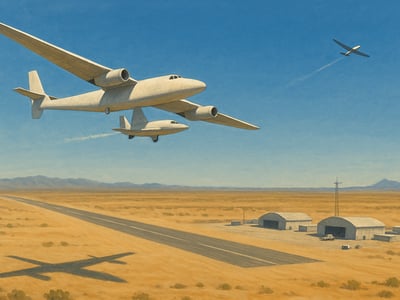
The achievement did not come from a conventional vertical launch pad. Instead, SpaceShipOne began its trip attached beneath White Knight, the carrier aircraft designed to take it high above the desert before release. This air-launch approach was central to the program's logic. By lifting the spacecraft to altitude with an aircraft first, the team could avoid some of the demands of a ground launch and test a different operational model from the large government-run rocket systems most people associated with human spaceflight.
That difference was part of what made the June 2004 flight so closely watched. Human spaceflight had long been dominated by national programs with large budgets, extensive infrastructure, and years of institutional experience. SpaceShipOne represented another path: a privately financed experimental craft, smaller in scale, pursuing a suborbital mission with a pilot aboard. The question was not only whether the hardware would work, but whether a private team could carry out the entire sequence safely and credibly in public view.
The sequence itself left little room for error. White Knight had to carry SpaceShipOne to release altitude in stable conditions. Separation had to be clean. The hybrid rocket motor then had to ignite properly, because a failed ignition would turn the flight into an incomplete demonstration rather than the proof of concept the program needed. Once under power, Melvill had to manage a steep climb toward extreme altitude in a vehicle operating in a thin and unfamiliar part of the atmosphere. After that came descent, transition back toward denser air, and finally a dead-stick landing at Mojave, with no engine available to correct mistakes on approach.
Melvill's role therefore mattered as much as the machine itself. This was not a symbolic passenger flight. He was the test pilot responsible for flying an experimental spacecraft through a full mission profile that combined aircraft procedures, rocket propulsion, and glider recovery. The decision to put a pilot aboard underscored the seriousness of the attempt. An uncrewed demonstration might have proven some engineering points, but a piloted mission made a more direct statement about private crewed spaceflight.
After release from White Knight, SpaceShipOne ignited its rocket motor and climbed rapidly. Contemporary reporting placed the flight near the 100-kilometer threshold that is often used in international discussions of where space begins. That detail became part of the mission's public meaning. In aerospace history, altitude is not always a simple matter, because different organizations and traditions use different boundaries. For that reason, the June 21 flight is often described carefully: it reached space by one widely used definition, and contemporary accounts treated it as a landmark private spaceflight.
For observers on the ground, the mission condensed several ideas into one visible event. It showed that a privately funded program could design, build, launch, and recover a piloted rocket vehicle using a system unlike the state-centered launch architectures that had defined the previous era. It also showed that the accomplishment depended on more than reaching a headline altitude. The flight only became persuasive because SpaceShipOne returned and landed safely, turning a daring ascent into a complete operational success.
That landing mattered. Experimental flight programs can produce impressive numbers on paper, but public confidence often depends on the full arc of a mission. SpaceShipOne came back to Mojave as a glider, completing the end-to-end profile its designers had envisioned. The vehicle's return made the achievement understandable beyond specialist circles: a carrier aircraft had released a spacecraft, a pilot had flown it under rocket power to near the accepted edge of space, and then brought it home without powered landing assistance.
The June 21 mission also stood within a larger 2004 story. Later that year, SpaceShipOne would make the flights associated with winning the Ansari X Prize, a competition intended to encourage reusable crewed spacecraft development. But the June flight came first as a public proof that the concept was not merely theoretical. It gave the team momentum, credibility, and evidence that private capital and experimental design could produce results in a field still widely seen as the domain of governments.
Why it still matters
SpaceShipOne's June 21, 2004 flight remains a reference point because it helped define a new phase in aerospace development. Histories of commercial spaceflight often return to it as an early demonstration that privately financed projects could move from satellites and support technologies into the more visible and difficult realm of human spaceflight.
It also continues to matter as a design example. The mission combined aircraft operations, air launch, rocket ascent, and unpowered glide recovery in a single system. Even when later companies chose different engineering solutions, SpaceShipOne helped broaden the range of serious ideas about how suborbital vehicles might be built and operated.
Finally, the flight is remembered because it showed how incentives outside government agencies could shape technological progress. Private funding played a direct role, and the broader prize environment of the period helped focus attention and effort. For that reason, the mission is not only part of space history but part of the history of how innovation is organized, financed, and demonstrated.
In the Mojave Desert, the vehicle itself was small and the flight short. Yet on that June morning, SpaceShipOne connected decades of experimental aviation with a new commercial ambition. Its path upward and back down did not replace the older model of spaceflight, but it proved that another model could be taken seriously.
Timeline
- SpaceShipOne development program
- White Knight air-launch test program
- SpaceShipOne altitude debate
- Ansari X Prize flight series
- SpaceShipOne piloted suborbital flight
What you uncovered
A Different Route to Space
You didn't just complete a puzzle; you traced the moment a privately funded spacecraft proved that reaching space could follow a very different operational path.
What made this flight distinctive was not only altitude, but the system behind it: carrier aircraft, rocket-powered ascent, and glider return combined into one reusable test approach. That model differed from the vertical launch systems long associated with government programs and suggested that access to suborbital space could be organized around smaller teams, different infrastructure, and staged risk. It also helped frame later discussion about commercial space tourism and experimental aerospace finance.
SpaceShipOne was released from its carrier aircraft, White Knight, before igniting its rocket motor on the 21 June 2004 mission.
FAQ
What happened on SpaceShipOne's 21 June 2004 flight?
On 21 June 2004, Mike Melvill piloted SpaceShipOne on flight 15P from Mojave Air and Space Port in Mojave, California. The vehicle was carried aloft by White Knight, released, ignited its hybrid rocket motor, and returned as a glider to the same airport.
How high did SpaceShipOne fly on 21 June 2004?
Contemporary accounts placed the flight near the 100-kilometer altitude threshold. The exact significance depends on the source and on which definition of space is being used.
Did SpaceShipOne cross the Kármán line that day?
That point is not universally settled. Reports from the time note that the flight was near the 100-kilometer threshold, but whether it is described as crossing the Kármán line depends on the space-definition standard used.
Why is the 21 June 2004 mission important?
It showed that a privately funded crewed spacecraft could complete an air-launch, rocket-powered ascent, and safe glide return. The flight is often cited as a milestone in private and commercial spaceflight.
Who built and funded SpaceShipOne?
SpaceShipOne was developed by Scaled Composites under the leadership of Burt Rutan. The program was backed by private funding from Paul Allen.