
About this story
On 12 August 1981 IBM introduced the Personal Computer 5150 at the Waldorf-Astoria in New York, entering a market smaller microcomputer firms had already opened. Built quickly in Boca Raton with outside components, PC DOS, and expansion in mind, the machine helped define an open platform others could support and imitate.
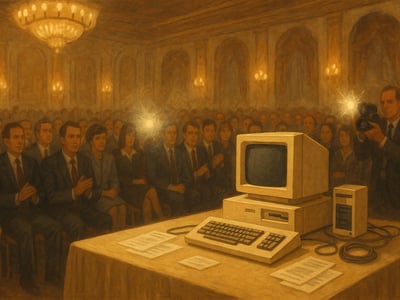
IBM announces the Personal Computer 5150 in New York City, 12 August 1981
On August 12, 1981, IBM introduced the IBM Personal Computer, model 5150, at the Waldorf-Astoria Hotel in New York City. The announcement marked the company’s formal entry into a market that smaller microcomputer firms had already helped define. IBM presented the machine for business and individual users, with launch materials listing a base configuration commonly cited at $1,565, while actual cost depended on selected options and peripherals.
IBM enters a market already in motion
By the time IBM arrived, personal computing was no longer an experiment at the edges of the industry. A growing number of companies had already shown that relatively small computers could be sold to offices, hobbyists, and households. For IBM, that created both pressure and uncertainty. The company was one of the most recognizable names in computing, but its reputation had been built in larger systems and corporate equipment. Entering the personal computer market meant moving into a faster, less settled environment, where a delayed product could easily look outdated.
IBM’s response was unusual by its own standards. Rather than follow a long, fully proprietary development path, the company assigned the project to its Entry Systems Division in Boca Raton, Florida, where the work moved ahead on a compressed schedule. The effort is often associated with leaders including William C. Lowe and project leadership under Don Estridge. Their task was not simply to build a machine, but to get one into the market quickly enough to matter.
Speed, suppliers, and open architecture
That urgency shaped the design. IBM chose to rely on externally sourced components for important parts of the system rather than insist on creating every major element in-house. The IBM Personal Computer 5150 used Intel’s 8088 microprocessor, a decision that fit the broader strategy of speed, availability, and practical engineering. The machine was also built with expansion in mind, allowing additional cards and peripherals to be added. This was a significant choice. It made the computer more flexible for different uses, but it also meant accepting less centralized control than a tightly closed design would have offered.
Software was another part of the same calculation. Hardware alone would not give IBM a convincing debut if customers could not imagine practical work being done on the machine immediately. IBM therefore needed operating-system support and enough outside software interest to make the product credible from the start. PC DOS was supplied for the IBM Personal Computer through IBM’s 1981 operating-system arrangement with Microsoft, an agreement that would later take on broader historical significance than it appeared to have at the moment of launch.
Software, PC DOS, and credibility
Seen from inside IBM, the risk was clear. A company known for reliability and scale was moving quickly in a market that did not wait for slow institutions. If the machine arrived late, lacked software, or seemed less capable than competing products, IBM could fail to win over the very customers it hoped to reach. If the accelerated approach produced a machine that felt unfinished, the IBM name itself could be exposed to embarrassment. The pressure was not only technical; it was reputational.
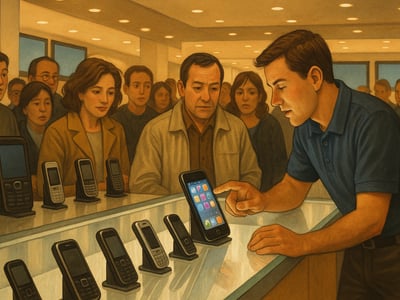
The launch at the Waldorf-Astoria reflected IBM’s attempt to present the new product as both practical and serious. The company was not introducing a laboratory prototype or a niche hobbyist kit. It was presenting a personal computer as a legitimate IBM product category. That mattered in 1981 because many businesses still viewed small computers cautiously. IBM’s presence did not erase the competition, but it changed the conversation. A personal computer was no longer only the domain of younger firms and enthusiast culture; one of the industry’s largest companies had now placed its name behind the idea.
A platform others could build around
The machine itself was modest by later standards, and even in 1981 its usefulness depended heavily on configuration and software. Yet the significance of the 5150 did not rest only on raw specifications. It rested on the combination of timing, branding, architecture, and supplier relationships. IBM managed to arrive in a market already in motion and do so with a product that seemed stable enough for offices while still adaptable enough to grow.
Those choices also had consequences beyond IBM’s original intentions. By using widely sourced components and an expansion-friendly approach, the company helped define a platform that others could study, support, and eventually imitate. The decisions that reduced development time also made it easier for a broader hardware and software ecosystem to form around the machine. Third-party developers could build programs and accessories for a system that looked likely to reach a substantial customer base.
Why it still matters
The IBM PC launch remains important because it was not just the debut of one product. It helped establish a model for how personal computing would spread. IBM showed that a large incumbent could respond to a fast-moving market by sacrificing some degree of internal control in exchange for speed, flexibility, and outside support. That was a notable shift for a company of its size and culture.
Just as important, the architecture and supplier strategy behind the 5150 helped normalize a platform approach to computing. Instead of a single machine standing alone, the IBM PC encouraged a network of operating-system providers, software developers, peripheral makers, and later manufacturers of compatible systems. In the years that followed, IBM-compatible computers became a major force in offices and homes, shaping purchasing decisions, software distribution, and expectations about what a personal computer should be.
The story of the 1981 launch is therefore not simply about IBM entering a new market. It is about a moment when business strategy, engineering compromise, and timing combined to influence the structure of personal computing for years afterward. The IBM Personal Computer 5150 did not create personal computing from nothing, but it helped set terms that much of the industry would continue to follow.
Timeline
What you uncovered
The Power of an Open Design
You didn't just… complete a puzzle; you traced the moment IBM entered personal computing by choosing speed, outside suppliers, and a design others could build around.
What made the IBM PC so consequential was not just that IBM entered the market, but how it did so. By using externally sourced components and an expansion-friendly architecture, IBM made it easier for software makers, peripheral makers, and eventually competitors to work within the same broad model. That helped shift personal computing toward a platform ecosystem, where compatibility could matter as much as the machine itself.
PC DOS for the 1981 IBM Personal Computer was supplied through IBM's operating-system arrangement with Microsoft.
FAQ
What did IBM announce on 12 August 1981?
IBM announced the IBM Personal Computer 5150 at the Waldorf-Astoria Hotel in New York City. The launch marked IBM’s formal entry into the personal computer market for business and individual users.
Which processor did the original IBM PC use?
The IBM Personal Computer 5150 used the Intel 8088 microprocessor. That was part of the machine IBM introduced in 1981.
Who led development of the original IBM Personal Computer?
IBM assigned development of the machine to its Entry Systems Division in Boca Raton, Florida, under project leadership associated with Don Estridge. William C. Lowe is also identified among the key figures linked to the project.
Why was the IBM PC launch significant?
The launch was significant because IBM entered a market already shaped by smaller microcomputer companies. The IBM PC’s design choices helped set patterns that later influenced software and hardware compatibility beyond IBM itself.