
About this story
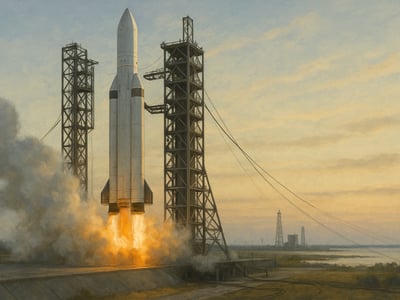
Opportunity launch mission from Cape Canaveral, 7 July 2003
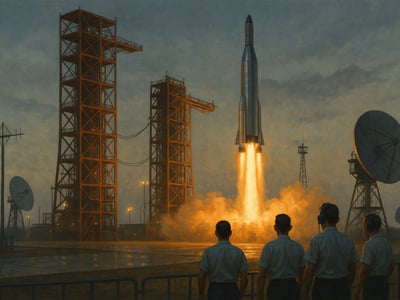
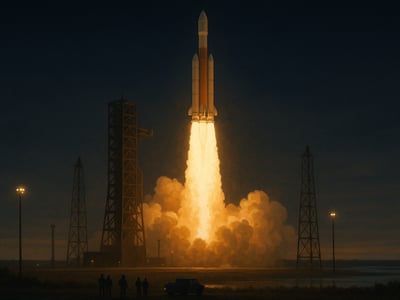
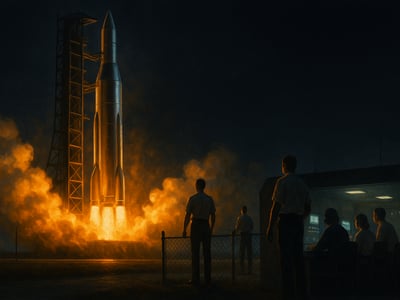
On July 7, 2003, NASA launched the spacecraft that would carry the rover Opportunity toward Mars, sending it into space from Launch Complex 17-B at Cape Canaveral Air Force Station in Florida aboard a Delta II 7925 rocket. At the moment of liftoff, Opportunity was not yet the long-lived explorer later remembered for years of work on the Martian surface. It was a carefully assembled mission package entering the first stage of a difficult chain: launch from Earth, separation into the correct trajectory, months of interplanetary travel, and, much later, a high-risk landing attempt on another planet.
The launch came during the 2003 Earth-to-Mars transfer window, one of the recurring periods when the positions of the two planets make a mission practical. Such windows are limited and exacting. Missing one can mean delaying a mission for many months or longer, so each step in preparation matters. By early July, NASA had already sent the program's first rover, Spirit, on its way after a June 10 launch. Opportunity was the second of the Mars Exploration Rovers to depart that summer, part of a paired mission designed to broaden the scientific return from two landing sites on Mars.
That pairing was important. Sending two rovers did not remove risk; it distributed ambition across two missions with related goals. Each spacecraft still had to survive launch stresses, navigate across space, enter the Martian atmosphere correctly, and reach the surface intact. But using two rovers gave NASA the chance to investigate different regions and compare findings from separate geological settings. It also reflected a practical way of structuring planetary exploration: if one mission encountered trouble, the other might still produce valuable science.
The Mars Exploration Rover mission was managed by the Jet Propulsion Laboratory in Pasadena, California, which had a central role in coordinating the engineering and scientific work behind the effort. Designing a rover mission meant linking many systems into a single sequence. The launch vehicle had to perform reliably. The cruise stage had to guide the spacecraft across millions of kilometers. Flight teams had to track and adjust its path. The entry, descent, and landing system had to work in a short, unforgiving interval at Mars. And once on the surface, the rover had to function as a mobile geology field station operated from another world.
Opportunity's destination was Meridiani Planum, an area selected for its scientific potential. The rover's purpose was geological investigation: to examine rocks and soil, study surface materials, and help scientists better understand the environmental history of Mars. The mission belonged to a period when Mars exploration was increasingly focused on reading the planet's surface as a record of past conditions. Rather than only photographing landscapes from orbit, NASA was trying to place instruments directly on the ground and move them from site to site.
That made the launch more than a transportation event. It was the opening move in a scientific strategy. A successful launch had to place the spacecraft on the right interplanetary course, because small errors early in the journey could create major problems later. In deep-space missions, the handoff between teams is crucial. The rocket's work ends quickly, but the mission continues through navigation, communication, and systems monitoring during cruise. If that chain holds, the spacecraft arrives at Mars with a chance to attempt landing. If it breaks at any point, the mission can end long before any science begins.
The decision to proceed with Opportunity after Spirit's launch also showed the tempo of Mars mission planning. These were not isolated flights improvised one after the other. They were coordinated missions prepared for the same seasonal opportunity, with shared program goals and carefully staged execution. Mission managers and engineers accepted that every phase carried its own uncertainties. Launch vehicles can fail. Spacecraft can miss their intended trajectories. Mars landings are especially hazardous because they require precise timing under conditions that cannot be fully controlled from Earth in real time.
Yet the logic of the mission was strong enough to justify that risk. Mars offered questions that could not be answered from Earth alone, and rover-based exploration promised a closer reading of the planet's geology. Opportunity was built to help carry out that work, using mobility and onboard instruments to investigate evidence preserved in the terrain. Before it became associated with discoveries made on Mars, however, it first had to survive the less visible but equally demanding phase between launch pad and landing site.
That phase began in Florida and extended outward through months of cruise. Opportunity ultimately reached Mars and landed in Meridiani Planum on January 25, 2004, UTC. Looking back, it is easy to connect the launch directly to the rover's later surface operations. But on launch day, none of that outcome was guaranteed. The event marked a transition from preparation to exposure: from a mission built and tested on Earth to one committed to spaceflight, where success depended on many precise systems working in sequence.
Why it still matters
Opportunity's launch remains a useful example of how planetary exploration depends on timing, navigation, and long-duration operations rather than on launch alone. A Mars rover mission begins with astronomy as much as with engineering: Earth and Mars must be in the right relative positions, and the spacecraft must be guided into a narrow practical pathway between the planets. The launch window is brief, but the mission architecture it enables is elaborate.
It also remains a reference point for robotic geological fieldwork. Opportunity was sent not simply to arrive at Mars, but to operate there as a remote investigator of landscape and rock record. That model—using rovers to move, observe, measure, and interpret local terrain—has become one of the defining methods of modern Mars science.
Finally, the mission shows how NASA uses paired spacecraft programs to increase scientific return and manage uncertainty. Spirit and Opportunity were linked by design but sent to different destinations, allowing comparison as well as redundancy at the program level. The launch of Opportunity was therefore both a single event and part of a broader approach to exploring Mars: careful planning on Earth in hopes of extending human knowledge across great distance and over long periods of time.
Timeline
- Mars Exploration Rover launch window
- Spirit launch
- NASA launches Opportunity
- Opportunity landing on Mars
What you uncovered
From Launch Window to Fieldwork
You didn't just… place a launch on the timeline; you traced the opening step in a chain of navigation, engineering, and scientific planning that had to hold together all the way to Mars.
A Mars mission does not become a geology mission only when it lands. That outcome begins with a narrow launch window, then passes through a series of precise handoffs between rocket performance, interplanetary navigation, spacecraft operations, and landing design. Opportunity is a useful reminder that planetary science depends as much on coordination across systems as on the instruments that eventually study the surface.
Opportunity was launched from Launch Complex 17-B at Cape Canaveral Air Force Station as the second of NASA's two Mars Exploration Rovers sent in 2003.
FAQ
When was Opportunity launched toward Mars?
NASA launched Mars Exploration Rover-B, later named Opportunity, on 2003-07-07. It lifted off during the 2003 Earth-to-Mars launch window.
Where did Opportunity launch from?
Opportunity launched from Launch Complex 17-B at Cape Canaveral Air Force Station in Florida, United States.
What rocket launched Opportunity?
Opportunity was launched on a Delta II 7925 rocket. The vehicle carried the spacecraft for NASA's Mars Exploration Rover program.
How was Opportunity connected to Spirit?
Opportunity was the second Mars Exploration Rover launched in 2003, after Spirit. NASA had launched Spirit on 2003-06-10.