

About this story
On 15 September 2008 Lehman Brothers filed for Chapter 11 in New York after a weekend of failed rescue talks, listing about $639 billion in assets. It was then the largest U.S. bankruptcy by assets. The filing shocked funding markets; the next day the Reserve Primary Fund broke the buck.
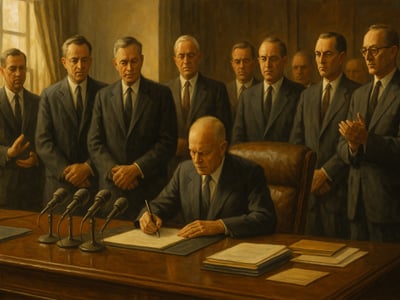
Lehman Brothers after its Chapter 11 filing in New York on September 15, 2008.
On September 15, 2008, Lehman Brothers Holdings Inc. filed for Chapter 11 bankruptcy protection in the United States Bankruptcy Court for the Southern District of New York. The filing came after a tense weekend of negotiations in New York failed to produce a sale or rescue before financial markets reopened. With roughly $639 billion in assets and about $613 billion in liabilities listed in the filing, it was the largest bankruptcy in U.S. history by assets at that time.
A firm that ran out of confidence
The collapse did not begin in a single morning. Lehman had been under pressure for months as losses tied to mortgage-related assets weakened confidence in the firm. During the years before 2008, major financial institutions had increased their exposure to housing-linked securities and related credit markets. When U.S. housing prices fell and mortgage defaults rose, those holdings became harder to value and harder to sell. Firms that depended heavily on borrowing in short-term markets were especially vulnerable, because lenders could quickly refuse to roll over funding.
Lehman Brothers was one of the most exposed institutions in that environment. Once known as a major Wall Street investment bank, it found itself trying to reassure investors, counterparties, and creditors while reporting large losses and shrinking access to funding. In modern finance, a firm does not need to run out of assets in a simple sense to fail. It can fail because confidence disappears faster than assets can be sold, especially when those assets are illiquid or deeply discounted.
A weekend without a buyer
That dynamic shaped the final weekend before the bankruptcy. On September 13 and 14, senior officials and executives gathered at the Federal Reserve Bank of New York in Manhattan. Among the figures involved in the broader crisis response were Treasury Secretary Henry Paulson, Federal Reserve Bank of New York President Timothy F. Geithner, Federal Reserve Chair Ben Bernanke, and leaders from major financial institutions, including Lehman chief executive Richard S. Fuld Jr. The central question was whether a private-sector transaction could be arranged quickly enough to prevent a disorderly failure.
Potential buyers and counterparties were weighing enormous uncertainty. Any acquisition would have required confidence in the value of Lehman's assets and in the funding needed to keep the business operating. But by that stage, the bank's problems were no longer narrowly internal. Market participants were asking what would happen to trading positions, derivatives contracts, short-term lending, and the wider network of institutions connected to Lehman. A solution that seemed possible under calmer conditions became much harder as time ran out.
Chapter 11 and a market shock
The same weekend underscored how quickly the crisis was moving elsewhere. On September 14, Bank of America announced an agreement to acquire Merrill Lynch after negotiations in New York. That deal showed that major institutions were still searching for ways to avoid a similar collapse, but it also made clear that Lehman had not found a comparable outcome in time. By the time markets were preparing to open on Monday, no completed private-sector acquisition had emerged for Lehman Brothers.
The Chapter 11 filing that followed was both a legal step and a market shock. Bankruptcy protection is designed to give a company a framework for dealing with creditors while operations or asset sales are managed under court supervision. But for a firm as large and interconnected as Lehman, the filing raised immediate practical questions far beyond the courtroom. Counterparties had to assess exposures. Investors had to reconsider the safety of short-term instruments. Financial institutions around the world had to judge whether losses and uncertainty would spread through their own balance sheets.
Money-market panic the next day
That uncertainty was not abstract. In the days around the filing, credit and equity markets were already under acute stress, and Lehman's failure intensified it. One especially important consequence appeared on September 16, when the Reserve Primary Fund reported that its net asset value had fallen below $1 per share after exposure to Lehman debt. For money market funds, which were widely treated as stable cash-like holdings, that event was deeply unsettling. It fed concerns about commercial paper, short-term funding, and the ability of businesses and financial firms to borrow routinely.
The bankruptcy therefore became more than the collapse of a single company. It highlighted how much of the financial system depended on confidence, continuous refinancing, and the assumption that key institutions would remain liquid from one day to the next. When those assumptions broke down, the effects spread quickly across markets and across borders. The consequences were not limited to financial professionals. The broader crisis that deepened in 2008 contributed to job losses, housing distress, business strain, and damage to savings and retirement accounts in many places.
Why it still matters
Lehman's bankruptcy remains a central reference point because it exposed the difficulty of managing the failure of a large, interconnected financial firm in real time. Policymakers, regulators, and scholars still study the case when asking how a government should respond when a major institution is near collapse but no buyer is ready and market confidence is evaporating.
It also remains important because it clarified the role of short-term funding markets in the modern financial system. Lehman's troubles were not only about long-term asset values; they were also about whether lenders, counterparties, and investors would continue to provide financing from one day to the next. That lesson shaped later attention to liquidity risk, collateral, and the links between banks, broker-dealers, money market funds, and other parts of the financial system.
After the crisis, the event influenced rulemaking and supervision in the United States and elsewhere. Reforms addressed capital and liquidity standards, resolution planning for large institutions, and oversight aimed at systemic risk. Debates continue about which measures have been most effective, but Lehman's failure remains one of the clearest examples of how quickly stress at one firm can become a wider institutional problem.
What happened on September 15, 2008, is therefore remembered not simply as a bankruptcy filing, but as a moment when legal process, market structure, and public policy collided under extreme pressure. The case still matters because it showed how fragile a highly connected financial system can become when trust, time, and funding all run short at once.
Timeline
- Crisis weekend talks begin at the New York Fed
- Bank of America agrees to acquire Merrill Lynch
- Lehman Brothers files for Chapter 11 in New York
- Reserve Primary Fund breaks the buck
What you uncovered
When Confidence Broke
You didn't just… complete a puzzle; you traced the moment when the failure of one major firm exposed how much the financial system depended on confidence and constant access to short-term funding.
Lehman's collapse is often remembered as a single dramatic failure, but its wider meaning lies in how quickly strain moved through connected markets once trust weakened. Modern finance does not run only on assets and balance sheets; it also relies on lenders, counterparties, and investors continuing to believe that payments will clear and funding will remain available. That is why one bankruptcy filing became a lasting case study in crisis management, contagion, and the limits of ad hoc decision-making over a single weekend.
Lehman's 2008 Chapter 11 filing reported about $639 billion in assets and about $613 billion in liabilities.
FAQ
What happened on 15 September 2008 at Lehman Brothers?
On 15 September 2008, Lehman Brothers Holdings Inc. filed a Chapter 11 petition in the United States Bankruptcy Court for the Southern District of New York. The filing came after efforts to arrange a rescue or sale did not produce an agreement.
How large was the Lehman Brothers bankruptcy filing?
Lehman reported about $639 billion in assets and about $613 billion in liabilities in its 2008 bankruptcy filing. It was the largest bankruptcy filing in U.S. history by assets at that time.
Where were the final negotiations over Lehman Brothers held?
Weekend meetings involving major financial executives and U.S. officials took place in New York at the Federal Reserve Bank of New York before the filing. Those discussions were part of the effort to find a buyer or rescue structure.
What happened in financial markets after Lehman Brothers failed?
The bankruptcy coincided with acute stress across U.S. and global credit and equity markets. On 16 September 2008, the Reserve Primary Fund reported that its net asset value had fallen below $1 per share after exposure to Lehman debt.