
About this story
On 14 September 1959 the Soviet probe Luna 2 struck the Moon after a ~36-hour flight from Baikonur, the first documented human-made contact with another celestial body. Impact was reported near Palus Putredinis, west of Mare Imbrium. The mission, under Sergei Korolev, proved a translunar trajectory could be flown and tracked.
Soviet Luna 2 reached the Moon on 14 September 1959 near Palus Putredinis.
On September 14, 1959, the Soviet spacecraft Luna 2 reached the Moon, becoming the first human-made object known to make physical contact with another celestial body. After launching two days earlier from the Baikonur Cosmodrome in the Kazakh Soviet Socialist Republic, it completed a flight of about 36 hours across roughly 384,000 kilometers of space. Soviet reports placed the impact area near Palus Putredinis, west of Mare Imbrium. By the standards of later spaceflight, Luna 2 was a brief and simple mission. In 1959, it marked a major step into a new kind of environment: one beyond Earth orbit, where navigation, tracking, and communication had to work across a distance never before crossed by a spacecraft on purpose.
A probe aimed at another world
The achievement came at an early and uncertain stage of the space age. Sputnik 1 had orbited Earth less than two years earlier, in October 1957, and the first attempts to send probes toward the Moon had shown how difficult deep-space flight could be. Reaching orbit around Earth was itself a demanding technical problem. Sending a spacecraft onward to the Moon required another level of precision. A small error in timing, engine performance, or guidance could send a probe wide of its target or leave it unable to transmit useful information.
Luna 2 was part of the Soviet Luna program, developed within the broader Soviet space effort under the direction of chief designer Sergei Korolev. Mstislav Keldysh was also an important figure in the scientific leadership behind Soviet space research. The mission used a direct-impact profile: rather than slowing into orbit or attempting a landing, the spacecraft was sent on a trajectory intended to intersect the Moon. That choice reflected both ambition and realism. Engineers did not yet have the means for a controlled soft landing, but a direct hit would still prove that a spacecraft could be launched from Earth and guided successfully to another world.
Launch, tracking, and a sodium cloud
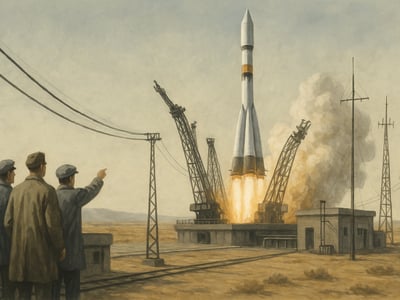
The mission began on September 12, 1959, when Luna 2 lifted off from Baikonur. Once on its way, the spacecraft traveled along a translunar path shaped by launch timing and the gravitational relationship between Earth and Moon. Every part of that process mattered. The launch vehicle had to provide the correct velocity. Tracking stations had to determine whether the probe remained on course. Communications had to function over increasing distance. Unlike an Earth-orbit mission, there was little room to recover from a fundamental error.
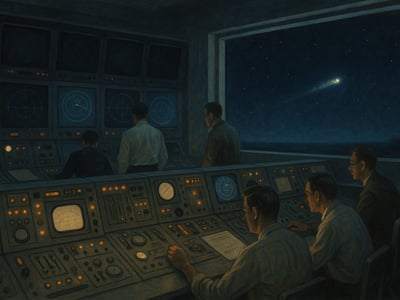
On September 13, Luna 2 released a cloud of sodium gas. This was not a scientific display in the modern sense but a practical aid to observation. The glowing sodium cloud could be tracked optically from Earth, giving observers another way to follow the spacecraft’s path. In an era before routine deep-space navigation, such methods mattered. They helped confirm where the spacecraft had gone and supported the Soviet claim that the mission was proceeding toward the Moon.
Impact near Mare Imbrium
The final stage of the flight was necessarily short on drama in the usual sense, because the mission was designed to end in impact. Yet that ending was exactly the point. On September 14, Soviet sources reported that Luna 2 struck the lunar surface near the region of Palus Putredinis. The probe also carried pennants bearing the coat of arms of the USSR, intended to reach the Moon with it. The gesture was symbolic, but the larger meaning of the mission did not depend on symbolism. The key fact was that the spacecraft had crossed cislunar space and arrived at its target.
That result mattered scientifically and technically even though Luna 2 did not return images and did not survive the encounter. The mission demonstrated that a state-run space program could calculate a translunar trajectory, launch at the required moment, track a fast-moving craft over great distance, and confirm its arrival at the Moon on a specific date. These were foundational capabilities. Without them, later missions involving orbiters, landers, and eventually crewed flight would have remained out of reach.
From a crash to a lunar program
It also mattered politically. In 1959, space exploration unfolded within the Cold War, and spectacular firsts carried international weight. Soviet announcements about Luna 2 were read not only as technical news but as evidence of industrial capacity, scientific organization, and national prestige. The United States was pursuing its own lunar efforts, and both superpowers understood that early space milestones would shape global perceptions. Even so, the significance of Luna 2 outlasted the contest in which it was announced. The mission belongs to the history of space exploration as a whole, not only to Soviet political theater.
Luna 2 was followed quickly by further lunar efforts. Only weeks later, Luna 3 would return historic images of the Moon’s far side, showing that the first impact was not an isolated stunt but part of a fast-moving program of robotic exploration. In that sense, Luna 2 sat at a transition point. It linked the earliest experimental launches of the 1950s to the more capable lunar and planetary missions that would soon follow.
Why it still matters
Luna 2 still matters because it was one of the clearest early demonstrations that spaceflight could extend beyond Earth orbit in a controlled and verifiable way. The mission did not merely go high above Earth; it reached another celestial body on a planned trajectory. That distinction helped define what deep-space exploration would mean in practice.
The mission also helped establish the Moon as the first major destination for robotic exploration. Before astronauts could orbit or land there, engineers had to show that hardware could be sent across the intervening distance reliably enough to reach it at all. Luna 2 provided that proof in its most basic form. Later lunar orbiters, impactors, landers, and sample-return missions all rested on the same fundamental requirement: accurate navigation through deep space.
Finally, Luna 2 remains a useful reminder that scientific and engineering advances are often shaped by institutions, budgets, and political competition. The mission emerged from Cold War conditions, with state support and international rivalry pushing rapid development. Yet its legacy is broader than that setting. The first human-made contact with the Moon opened a path that many countries and agencies would follow, turning a distant point of light into a destination for repeated exploration.
Seen from today, Luna 2 can seem austere: a probe sent to crash, leaving no dramatic landing footage and no surviving machine on the surface. But that simplicity is part of its historical importance. It proved that crossing the space between worlds was possible, and once that had been shown, the range of human-made exploration expanded permanently.
Timeline
- Luna 2 launch from Baikonur
- Sodium gas release for optical tracking
- Luna 2 impacts the Moon near Palus Putredinis
- Luna 3 launch
What you uncovered
A Collision That Proved Control
You didn't just… complete a puzzle; you traced the moment when reaching the Moon became a practical demonstration of human guidance, timing, and control across deep space.
Luna 2 mattered not only because it hit the Moon, but because it showed that an impact could serve as evidence of precision rather than failure. In early spaceflight, simply arriving at the right place on the right date required navigation, tracking, and coordination over distances no state had previously managed. That made the mission a technical proof-of-capability as much as a symbolic first. It also reflects how early robotic exploration was shaped by institutions willing to fund high-risk engineering for scientific and geopolitical reasons.
On 13 September 1959, Luna 2 released a cloud of sodium gas so observers on Earth could help track its path.
FAQ
What happened on 14 September 1959 with Luna 2?
On 14 September 1959, the Soviet spacecraft Luna 2 struck the Moon. It was the first documented human-made object to make physical contact with another celestial body.
Who launched Luna 2?
Luna 2 was launched by the Soviet Union from Baikonur Cosmodrome on 12 September 1959. The Luna program was conducted under the direction of chief designer Sergei Korolev.
Where on the Moon did Luna 2 impact?
Soviet reports placed the impact area near Palus Putredinis, west of Mare Imbrium. The mission ended in that region after reaching the Moon.
How long did Luna 2 take to reach the Moon?
Luna 2 took about 36 hours to reach the Moon. It traveled roughly 384,000 kilometers during the mission.
Why was Luna 2 important in space exploration?
Luna 2 showed that a spacecraft could be guided from Earth to another celestial body and make planned contact. It was an early milestone in robotic lunar exploration and the broader Space Race.