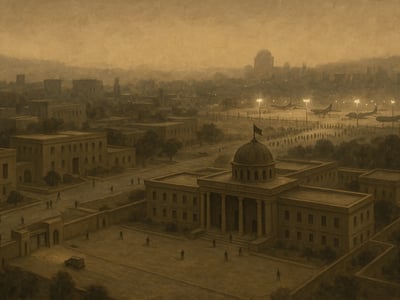

About this story
On 15 August 2021 Taliban forces entered Kabul as Afghanistan’s republican government collapsed and President Ashraf Ghani left the country. After a rapid cascade of provincial losses and a long withdrawal process framed by the 2020 Doha agreement, the capital’s fall turned Hamid Karzai International Airport into the center of an international evacuation crisis.
Taliban fighters in Kabul's presidential palace after the government's collapse
On 15 August 2021, Taliban forces entered Kabul, the capital of Afghanistan, as the government of the Islamic Republic of Afghanistan collapsed and President Ashraf Ghani left the country. What had seemed, only weeks earlier, like a deteriorating military position became in a matter of days a political break at the center of the state. By the end of that day, Kabul was no longer mainly the seat of the outgoing government. It had become the focal point of a hurried transfer of power, a visible leadership vacuum, and an international evacuation crisis centered on Hamid Karzai International Airport.
A capital falls at the end of a cascade
The fall of Kabul did not begin in Kabul itself. It came at the end of a fast-moving Taliban offensive that had already taken multiple provincial capitals in August 2021. As those cities fell in rapid succession, pressure on the capital mounted. The loss of territory mattered not only in military terms but also psychologically and administratively. Provincial control was tied to supply lines, command networks, and the broader sense that the Afghan state could still function. Once those links weakened, events in Kabul were shaped by more than the immediate presence of armed fighters at the city gates.
The background to the final phase included the longer process of international military withdrawal and the February 2020 Doha agreement between the United States and the Taliban. That agreement did not by itself determine the exact form of the August 2021 collapse, but it framed the final period of the war and the political uncertainty around it. As foreign troops drew down and Taliban advances accelerated, the Afghan government faced increasing difficulty holding territory and maintaining confidence among its own forces and officials.
Withdrawal, Doha, and collapsing confidence
By 15 August, leaders in Kabul were confronting narrowing choices. They could try to organize a defense of the capital, seek a negotiated transfer of authority, or leave positions that no longer seemed defensible. Those choices were made under conditions of speed, incomplete information, and fear that any delay could produce wider disorder in a city of millions. One of the major concerns on that day was that prolonged fighting inside Kabul might lead to urban combat, panic, and a breakdown in basic security.
The most consequential sign that the existing order was ending came when Ashraf Ghani left Afghanistan. On the same day, Abdullah Abdullah said in a video message from Kabul that Ghani had departed, confirming publicly what many were already coming to understand: the government had lost its top leadership at the decisive moment. In practical terms, this meant there was no longer a clear chain of civilian authority capable of directing a sustained defense or managing an orderly political transition from the presidential palace.
Leadership vacuum and palace transfer
Taliban representatives said their forces had moved into Kabul amid a reported security vacuum. Their public explanation was that they had entered in response to deteriorating order after the departure of government leadership and security structures. Whatever the mix of military momentum, negotiation, and institutional failure behind the scenes, the result was visible very quickly. Taliban fighters were photographed inside the Arg presidential palace in Kabul after the government's collapse, offering one of the defining images of the day.
At the same time, foreign governments were making urgent decisions of their own. Diplomatic missions had to judge how long they could continue operating in the city and how to protect personnel while events moved by the hour. On 15 August, the U.S. Embassy in Kabul suspended operations at its embassy compound and shifted activity to Hamid Karzai International Airport. That move reflected the airport's growing role as the only major site from which foreign personnel and many civilians might still be evacuated.
Airport as the last exit
The airport soon became the center of a different kind of crisis. Kabul's change of control was not only a story about who held the presidential palace. It was also about access, mobility, and escape. Foreign nationals, embassy staff, and many Afghan civilians converged on Hamid Karzai International Airport in hopes of leaving the country. The city's political collapse was therefore linked directly to logistics: roads to the airport, perimeter security, aircraft movements, and the ability of states to continue emergency operations under extreme pressure.
In that sense, 15 August was both an endpoint and a beginning. It marked the collapse of the republic's governing structure in Kabul, but it also opened a new period in which the Taliban had to present themselves as the authority in the capital while the world watched evacuation efforts unfold. The same day that symbolized a transfer of power also exposed how quickly institutions can fail when territorial losses, leadership departure, and diplomatic withdrawal converge.
Why it still matters
The fall of Kabul remains important because it is studied as a case of how state institutions can collapse much faster than outside observers or even insiders expect. The city did not fall after a long urban siege. Instead, it changed hands after a nationwide chain of territorial losses weakened command structures and political confidence. That sequence has become central to analysis of military withdrawal, government resilience, and the relationship between battlefield momentum and institutional breakdown.
It also continues to shape practical planning. The events at Kabul are closely examined in discussions of embassy security, evacuation systems, and the treatment of civilians fleeing conflict. Hamid Karzai International Airport became a symbol of how modern crises can compress military, diplomatic, and humanitarian problems into a single place within hours. Governments and international organizations still draw lessons from that experience when considering contingency planning for other unstable capitals.
Finally, the day remains a reference point in debates about the limits of international intervention and the risks of negotiated withdrawal arrangements that depend on fragile local institutions. For Afghanistan, it marked a profound political transformation. For the wider world, it became a reminder that the collapse of a government is not always a single military event. It can be the visible final moment in a longer process, when authority disappears faster than plans can adapt.
Timeline
- U.S.–Taliban Doha agreement
- Kabul falls; President Ashraf Ghani leaves Afghanistan
- Evacuation crisis intensifies at Hamid Karzai International Airport
- Taliban interim government announced
What you uncovered
When a Capital Unravels
You didn't just… complete a puzzle; you traced how Kabul became the visible endpoint of a much broader institutional collapse.
What happened in Kabul was not only a battlefield outcome but a systems failure unfolding at speed. Once territorial losses, weakened command, and political uncertainty converged, the capital's transfer of power took shape in hours rather than through a long urban battle. That is one reason the event is still studied in relation to embassy contingency planning, evacuation logistics, and the limits of withdrawal agreements when state institutions are already fragile.
On 15 August 2021, the U.S. Embassy in Kabul suspended operations at its embassy compound and shifted activity to Hamid Karzai International Airport.
FAQ
What happened in Kabul on 15 August 2021?
On 15 August 2021, Taliban forces entered Kabul as the government of the Islamic Republic of Afghanistan collapsed. President Ashraf Ghani left the country the same day.
Why did Taliban forces enter Kabul without a long battle?
The entry came during the final phase of a nationwide Taliban offensive that had already captured multiple provincial capitals. By the time Taliban forces reached Kabul, reports described a security vacuum in the city.
What did Ashraf Ghani say about leaving Afghanistan?
On 15 August 2021, President Ashraf Ghani announced that he had left Afghanistan as Taliban forces entered Kabul. That departure showed that the existing government structure had effectively broken apart.
Why was Hamid Karzai International Airport so important?
After Kabul fell, the U.S. Embassy suspended operations at its Kabul compound and shifted activity to Hamid Karzai International Airport. The airport became the center of evacuation operations for foreign embassies and Afghan civilians.