
About this story
On 9 September 1957 President Dwight D. Eisenhower signed the Civil Rights Act of 1957, the first federal civil rights statute since Reconstruction. The law did not end segregation, but it created a Civil Rights Division in the Justice Department and a Commission on Civil Rights after a bitter Senate fight, including Strom Thurmond’s marathon speech. Voting-rights tools were narrowed in compromise, yet federal enforcement gained a lasting institutional base.
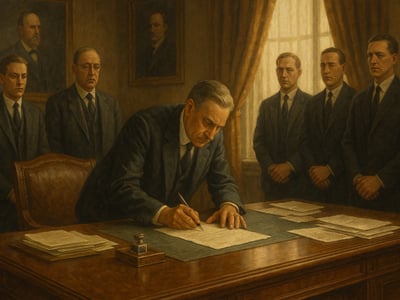
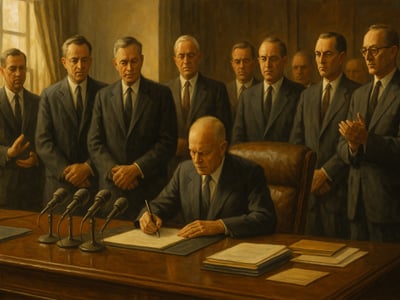
Eisenhower signs the Civil Rights Act of 1957 in Washington, D.C.
On September 9, 1957, President Dwight D. Eisenhower signed the Civil Rights Act of 1957 at the White House in Washington, D.C., turning a contested congressional effort into the first federal civil rights legislation enacted since the Reconstruction era. The law did not end segregation, nor did it settle the central civil rights conflicts of the decade. But it marked a significant moment: after years in which federal civil rights enforcement had been limited and politically difficult, Congress and the executive branch had again placed the national government directly into the question of protecting civil rights, especially voting rights.
A statute after a long federal gap
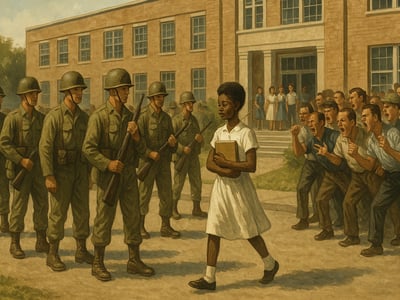
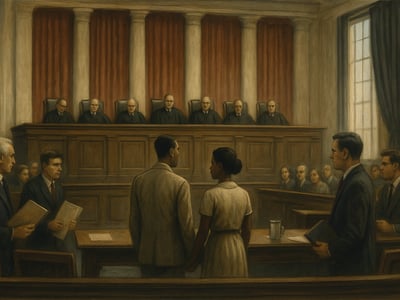
The act emerged in a period when civil rights issues were becoming harder for federal officials to avoid. The Supreme Court's ruling in *Brown v. Board of Education* in 1954 had intensified national debate over segregation and the reach of federal authority. At the same time, Black Americans in many parts of the South continued to face organized barriers to voting, including intimidation, administrative obstruction, and legal tactics designed to keep registration low. Against that background, the Eisenhower administration sent a civil rights legislative program to Congress on June 18, 1957.
The proposal entered a Congress where regional divisions were clear and where southern opposition could delay, weaken, or even stop such a measure. That was the central tension from the start. Supporters wanted a federal response to interference with voting rights and a stronger institutional role for Washington in civil rights enforcement. Opponents, particularly many southern lawmakers, argued against expanding federal involvement and used Senate procedure to resist the bill.
Senate combat and a marathon speech
The Senate became the key arena. Debate over the measure was long and contentious, and amendments became crucial to its final shape. One of the most widely remembered episodes came on August 7, 1957, when Senator Strom Thurmond began a one-man speech against the bill that lasted more than 24 hours. His effort did not stop the legislation, but it symbolized the intensity of the resistance and the willingness of opponents to use every available procedural tool.
As the bill moved forward, its enforcement provisions became a central point of struggle. Civil rights legislation can depend not only on declarations of principle but on how complaints are investigated, who can bring cases, and what courts are allowed to do. In 1957, those details were not secondary. They were where much of the bill's practical strength could be reduced. By the time the Senate passed the measure on August 29, amendments had altered parts of its enforcement design.
Enforcement trimmed by amendment
That outcome helps explain why the act has often been described in two ways at once: as an important breakthrough and as a limited instrument. It was a breakthrough because it succeeded where no comparable federal civil rights law had succeeded for decades. It was limited because the final version reflected compromise, and some of the strongest mechanisms originally sought by supporters did not survive intact. Assessments of the act's effectiveness therefore vary, especially when viewed against the scale of disenfranchisement and segregation that persisted after 1957.
Even so, the statute did more than make a general statement. It created the Civil Rights Division in the U.S. Department of Justice, giving the federal government a permanent institutional base for civil rights litigation and enforcement work. It also established the U.S. Commission on Civil Rights, which was tasked with investigating complaints, gathering facts, and reporting on civil rights conditions. Those two creations mattered because they gave civil rights policy an administrative and investigative structure that could continue beyond a single legislative fight.
Division, Commission, and a path to later acts
The law also added federal procedures intended to address interference with voting rights. In practice, those procedures were narrower and less forceful than many advocates had wanted. But they signaled that voting discrimination was not only a local or state matter; it was a question the federal government could address through law and the courts. In that sense, the act helped define voting rights as a continuing federal responsibility.
The people involved reflected the layered politics of the moment. Eisenhower, though often more cautious in public rhetoric than some activists wanted, chose to send the legislative program to Congress and sign the result. Attorney General Herbert Brownell Jr. had played an important role in pressing for federal civil rights action. In Congress, figures such as Lyndon B. Johnson and Richard Nixon were involved in the legislative environment that shaped the bill's path, while Thurmond became a public face of organized resistance. The final law was therefore not the product of one speech or one office, but of a broader institutional struggle over how much the federal government would do.
Why it still matters
The Civil Rights Act of 1957 still matters partly because of what it built inside the federal government. The Civil Rights Division and the U.S. Commission on Civil Rights became lasting parts of the national civil rights framework. Institutions created in one political moment can shape what becomes possible in later ones, and this law expanded the federal capacity to investigate abuses and bring legal action.
It also remains important as an example of how rights on paper can depend on enforcement design. The act's voting-rights provisions showed that legal protections are affected by court procedures, standards of proof, and the practical ability of federal authorities to act. A law may acknowledge a problem and still struggle to solve it if its mechanisms are weakened during the legislative process.
Finally, the 1957 act belongs to a larger sequence. It did not resolve the major civil rights battles of its era, but it formed part of the legislative path that led to the Civil Rights Act of 1960, the Civil Rights Act of 1964, and the Voting Rights Act of 1965. Seen on its own, it can look modest. Seen in sequence, it marks the reopening of federal civil rights lawmaking after a long gap and an important stage in the modern civil rights movement.
For that reason, September 9, 1957, is best understood neither as a final victory nor as an empty gesture. It was a constrained but consequential federal step, taken in the face of determined opposition, and one that helped define the institutions and legislative momentum of the years that followed.
Timeline
- Brown v. Board of Education ruling intensifies the federal debate
- Eisenhower sends a civil rights program to Congress
- Strom Thurmond begins a 24-hour Senate speech against the bill
- Eisenhower signs the Civil Rights Act of 1957
What you uncovered
Institutions Behind the Breakthrough
You didn't just…complete a puzzle; you traced a moment when civil rights policy became more firmly embedded in federal law and federal institutions.
The Civil Rights Act of 1957 is often remembered as limited, especially after amendments weakened parts of its enforcement design. But its importance also lies in what it built: a stronger federal role through the Justice Department and a permanent commission to document civil rights conditions. In that sense, the law helped shift civil rights from a series of disputes into an area of ongoing national oversight. It also became part of the legislative path that later produced broader federal laws in 1960, 1964, and 1965.
Before Eisenhower signed the bill on September 9, 1957, Senator Strom Thurmond had held the Senate floor for more than 24 hours in opposition to it on August 7.
FAQ
What happened on 9 September 1957?
On 9 September 1957, President Dwight D. Eisenhower signed the Civil Rights Act of 1957 into law at the White House in Washington, D.C.
What did the Civil Rights Act of 1957 establish?
The Act established the Civil Rights Division in the U.S. Department of Justice and the U.S. Commission on Civil Rights. It also added federal procedures intended to address interference with voting rights.
Who opposed the civil rights bill in the Senate?
Senator Strom Thurmond led a one-man speech against the bill on 7 August 1957 that lasted more than 24 hours in the U.S. Senate.
Why is the 1957 act linked to voting rights?
It included federal procedures aimed at addressing interference with voting rights, which is why it is often discussed in that context. Its enforcement provisions were later altered during the legislative process.