
About this story
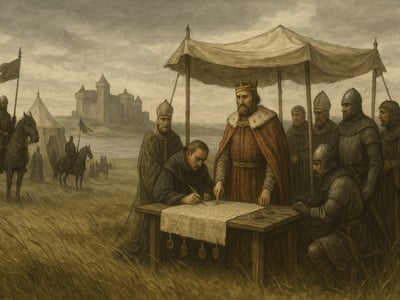
Magna Carta at Runnymede near Windsor, sealed by King John in 1215.
On 15 June 1215, in the meadow of Runnymede near Windsor, King John of England sealed a charter that would become one of the most cited documents in legal history: Magna Carta. The moment came during a severe political crisis, with rebel barons in arms and the king under pressure to answer complaints about royal government, feudal demands, and legal practice. At the time, it was not presented as a timeless declaration for all people. It was a negotiated settlement meant to prevent the immediate collapse of order in John’s kingdom.
The road to Runnymede had been shaped by the troubles of John’s reign. His rule had been marked by military setbacks, including the loss of Normandy, and by the financial demands that followed attempts to recover power and territory. Raising money through feudal payments and other levies increased resentment among important landholders. Disputes also extended beyond taxation. Many critics objected to the way royal justice was administered and to what they saw as arbitrary use of power.
By 1215, opposition had hardened into open revolt. A group of barons organized against the king and pressed for written guarantees. Among the leading figures associated with the crisis were Robert Fitzwalter, a prominent baronial leader, and Stephen Langton, the Archbishop of Canterbury, who played an important role in the negotiations. The meeting at Runnymede was therefore not a ceremonial act of generosity from the crown, but part of a tense bargaining process in the shadow of possible war.
The charter settled there was wide-ranging. Its clauses dealt with feudal payments, inheritance, debts, local administration, and relations between the crown and the church. Its opening confirmed that the English Church was to be free, showing that ecclesiastical liberty was one of the immediate concerns of the settlement. Other provisions tried to regularize how authority was exercised, especially where royal officials could impose burdens or intervene in disputes.
Some clauses later became especially famous, though in 1215 they were only part of a much larger text designed for a specific political world. Clause 39 stated that no free man was to be seized, imprisoned, dispossessed, outlawed, exiled, or otherwise ruined except by the lawful judgment of his equals or by the law of the land. That wording did not create a modern system of equal rights, and it did not apply to everyone in the realm in the way later generations sometimes imagined. Even so, it offered a memorable formula linking punishment and coercion to recognized legal process rather than mere will.
Another striking provision was Clause 61, which established a committee of twenty-five barons to monitor the king’s compliance with the charter. This was a remarkable attempt to build enforcement into the agreement itself. It reflected the depth of distrust between John and his opponents. A promise on parchment was not considered enough; the barons wanted a mechanism to compel observance if the king failed to keep the terms.
That feature also showed how unstable the settlement was. Magna Carta in its 1215 form did not end the conflict for long. John soon appealed to Pope Innocent III, his overlord after John had previously accepted papal lordship. On 24 August 1215, the pope annulled Magna Carta in a papal bull, declaring the charter invalid. Rather than settle the kingdom, the agreement collapsed into renewed fighting, and the First Barons’ War followed.
If the story had ended there, Magna Carta might now be remembered only as a failed peace deal from a troubled reign. Yet documents can outlive the political moment that produced them. After John’s death in 1216, the charter was reissued in revised forms during the reign of his son, Henry III. Reissues in 1216, 1217, and 1225 helped give the text a continuing place in English political and legal life. The versions that later generations knew best were not identical to the charter sealed at Runnymede, but they preserved and reshaped parts of its authority.
Over time, lawyers, parliamentarians, and commentators returned to Magna Carta as a source of language and precedent. Not every clause remained relevant, and not every medieval provision carried forward into later law. But the document acquired a new career as a reference point in arguments about lawful government, taxation, and the limits of sovereign action. Its historical importance rests not only on what happened in June 1215, but also on the repeated reuse and reinterpretation of the text in the centuries that followed.
Why it still matters
Magna Carta still matters because it became a durable reference in the long development of the idea that rulers are not simply above the law. That idea was not fully formed at Runnymede, and the charter was not a modern constitution. It emerged from a feud between a king and a particular political elite, framed in the language of feudal obligations and customary rights. Even so, later generations found in it powerful wording for claims about lawful judgment, due process, and limits on arbitrary rule.
Its significance also lies in its documentary afterlife. The settlement of 1215 failed quickly, but the text did not disappear. Through reissue, legal citation, and selective interpretation, Magna Carta moved far beyond the immediate dispute that created it. This pattern is historically important in itself: negotiated texts can gain meanings that their first drafters did not fully foresee.
Runnymede therefore stands as more than the site of a medieval compromise. It marks a moment when political conflict produced a written statement that could be copied, preserved, argued over, and revived. Magna Carta’s endurance comes from that combination of crisis, text, and memory. The charter sealed by King John was short-lived as a peace settlement, but unusually long-lived as a legal and constitutional reference.
Timeline
- Magna Carta sealed at Runnymede
- Papal annulment of Magna Carta
- First reissue of Magna Carta
- Second reissue of Magna Carta
- Third reissue of Magna Carta
What you uncovered
A Charter Beyond the Crisis
You didn't just… complete a puzzle; you traced the moment when a fragile political compromise began a much longer documentary life.
The 1215 settlement itself was short-lived, and that matters because Magna Carta's importance did not come from immediate success alone. Its endurance came through reissues, later legal use, and selective interpretation by people facing very different political problems. That long afterlife helps explain why a document shaped by a specific baronial crisis could become a wider reference point for limits on power.
Clause 61 of the 1215 Magna Carta created a group of twenty-five barons to oversee whether the king complied with the charter.
FAQ
What happened at Runnymede on 15 June 1215?
On 15 June 1215, King John of England sealed Magna Carta at Runnymede near Windsor. The charter was the result of negotiations with rebel barons during a wider political and military crisis.
Did King John sign Magna Carta or seal it?
King John sealed Magna Carta. The standard historical wording is that he sealed the charter at Runnymede on 15 June 1215.
Which people were central to the Magna Carta settlement?
The central figures named in the brief are King John of England, Stephen Langton, and Robert Fitzwalter. They were involved in the negotiations and crisis surrounding the 1215 settlement.
What did the 1215 Magna Carta say about justice?
Clause 39 said that no free man was to be seized, imprisoned, dispossessed, outlawed, exiled, or ruined except by lawful judgment of his equals or by the law of the land. The charter also included other clauses on church liberties and feudal payments.
Why was the 1215 Magna Carta annulled?
On 24 August 1215, Pope Innocent III annulled Magna Carta after King John appealed to Rome. The original settlement did not last, although the document remained historically important.