
About this story
Spain's marriage law took effect nationwide on 3 July 2005 after Civil Code reform.
On 3 July 2005, a change to Spain's Civil Code came into force that allowed two people of the same sex to marry anywhere in the country with the same legal status as other married couples. The step followed a sequence that had unfolded quickly in Madrid: parliamentary approval, royal sanction, official publication, and then legal effect. What had been debated for months as a question of family law and civil status became, on that date, an enforceable rule across Spain.
The legal change was made through Law 13/2005 of 1 July, a reform specifically modifying the Civil Code regarding the right to marry. In practical terms, it meant that the state-recognized institution of marriage was no longer limited in the code to opposite-sex couples. Because Spain's Civil Code is national in scope, the reform applied across all Spanish jurisdictions once it entered into force. That gave the measure a clarity that is important in legal history: it was not a local experiment or a partial administrative adjustment, but a nationwide change written directly into a foundational body of private law.
The route to that outcome passed through the Cortes Generales, Spain's national parliament. The government of Prime Minister José Luis Rodríguez Zapatero had advanced the reform as part of a broader program of social legislation in the mid-2000s. The proposal, however, did not move forward without dispute. Political parties, religious institutions, and social organizations expressed sharply different views about the definition of marriage, the role of the state, and the pace of legal change. That opposition did not stop the bill, but it shaped the atmosphere in which every procedural step was watched closely.
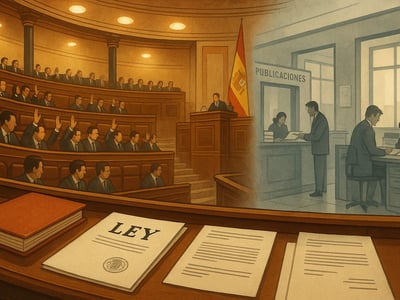
A decisive moment came on 30 June 2005, when the Congreso de los Diputados gave final approval to the bill after overriding a Senate veto. This parliamentary mechanism mattered. It showed that the measure's success depended not only on public argument or executive backing, but also on the internal rules of the legislative process. A bill could be debated, resisted, amended, delayed, or rejected; in this case, supporters had to carry it through the formal stages required for a national law to survive institutional opposition.
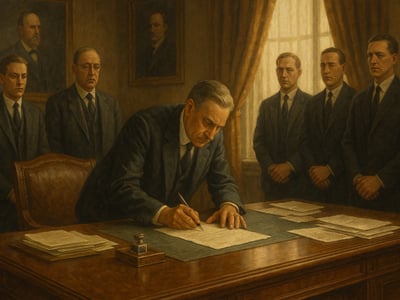
Once Congress completed that final approval, the process moved from legislative decision to legal enactment. The law was sanctioned by King Juan Carlos I, as required for promulgation, and issued as Law 13/2005 on 1 July. It was then published in the *Boletín Oficial del Estado* on 2 July 2005. That publication was not a mere formality. In Spain, as in many legal systems, an approved law becomes operative through official promulgation and publication. The appearance of the text in the state gazette marked the point at which the reform was authoritatively available as law, with a defined date for its entry into force.
By 3 July, the change had legal effect. The abstract language of amendment now had immediate administrative consequences. Civil registries and public officials had to apply the new wording of the Civil Code. Couples who had previously been excluded from marriage under Spanish law could now enter into it under the same statutory framework as other couples. The significance of the date lies partly in that administrative precision: rights in modern states often depend not on a single speech or symbolic ceremony, but on when a published legal text becomes binding.
The story is therefore not only about a social reform, but also about how states transform contested policy into ordinary legal practice. A national parliament voted. A veto was overridden. A monarch sanctioned the measure. An official journal published it. A code was revised. Then clerks, registrars, and local offices had to treat the amended text as governing law. For historians of legislation, that sequence is as important as the public controversy around it, because it shows how institutions convert political decisions into daily legal reality.
Spain's 2005 reform also stood out because it came through legislation rather than through a court judgment alone. In some countries, changes in marriage law have been driven chiefly by constitutional litigation. In Spain, the key event of 3 July 2005 followed a parliamentary route. That did not make the issue less contested, but it placed the center of decision-making in the legislative amendment of the Civil Code. The law's legal language, and the procedure that carried it forward, became central to its meaning.
In the days that followed, the reform quickly moved from the pages of the *Boletín Oficial del Estado* into public life. Marriages began to be performed under the new legal framework, making visible the practical result of the code change. What had recently been a matter of votes, sanctions, and publication was now expressed in marriage registers, certificates, and family-law records.
Why it still matters
The 3 July 2005 reform remains important because it is a clear example of how family law can be altered through national legislation. It demonstrates that major changes in civil status do not happen only in courts or through constitutional interpretation; they can also be written directly into a civil code through parliamentary procedure. For legal history, that makes Spain's case a useful reference point.
It also remains relevant because marriage is not only a cultural institution but a legal one. Access to it affects civil status, public recognition, and the way the state records family relationships. By amending the Civil Code itself, Spain made the reform part of the ordinary structure of private law rather than a temporary exception or separate category.
Finally, the episode is a reminder that law takes effect through process. Debate alone does not create enforceable rights. Votes, promulgation, publication, and implementation do. Spain's same-sex marriage law is still studied not only because of what it changed, but because it shows, in a compact and well-documented sequence, how a modern state turns a disputed reform into binding law.
Timeline
- Congress approves marriage bill
- Law published in official gazette
- Spain same-sex marriage law takes effect
What you uncovered
When Law Becomes Reality
You didn't just… complete a puzzle; you traced the moment a change in legal wording became a new civil status recognized across Spain.
One of the most revealing parts of this story is how quickly a public argument turned into enforceable law once the formal steps were completed. A vote in parliament mattered, but so did sanction, official publication, and amendment of the Civil Code. It shows that rights debates do not become durable through rhetoric alone; they take effect through institutions that translate policy into daily administrative reality.
The Congreso de los Diputados gave final approval to the bill on 30 June 2005 by overriding a Senate veto.
FAQ
When did same-sex marriage become legal in Spain?
It took legal effect in Spain on 3 July 2005.
What law legalized same-sex marriage in Spain?
Law 13/2005 of 1 July modified the Spanish Civil Code regarding the right to marry.
Who sanctioned Spain's marriage reform?
The law was sanctioned by King Juan Carlos I before publication.
How did Spain's Congress handle the Senate veto?
On 30 June 2005, the Congreso de los Diputados in Madrid gave final approval after overriding a Senate veto.