
About this story
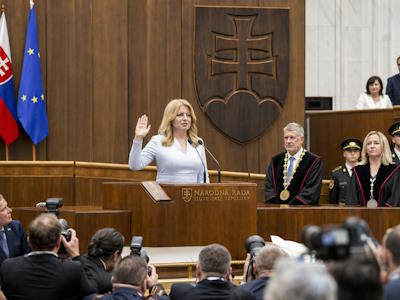
Zuzana Čaputová takes the presidential oath in Bratislava on 15 June 2019.
On 15 June 2019, Zuzana Čaputová was inaugurated as President of Slovakia in Bratislava, formally beginning her five-year term after her victory in the spring presidential election. The ceremony marked the constitutional moment when an election result became a legal transfer of office: before the National Council of the Slovak Republic, she took the required oath and succeeded Andrej Kiska as head of state.
That distinction mattered. Čaputová had already won the second round of the presidential election on 30 March 2019, defeating Maroš Šefčovič. Politically, the outcome was clear by then. Constitutionally, however, the presidency did not change hands on election night. Slovakia's system required a later and public act of inauguration tied to the scheduled end of the incumbent president's term. Between those two dates, the country was in a transition period: the next president was known, but the current president still held the office.
This gap between victory and assumption of office is easy to overlook in modern democracies, where election results often dominate public attention. Yet the legal order depends not only on who wins but also on how power is transferred. In Slovakia, the inauguration before parliament was the point at which presidential authority passed in a valid and visible way. The ceremony in Bratislava was therefore not merely symbolic. It was the constitutional bridge between campaign, result, and governing office.
Čaputová became Slovakia's fifth president since the country became independent in 1993. Her inauguration also drew notice because she was the first woman to hold the office. That fact gave the event significance beyond procedure, but the ceremony itself remained rooted in institutional continuity. The handover from Andrej Kiska followed the established constitutional framework, underscoring that even a historic first entered office through the same legal process that defined the presidency itself.
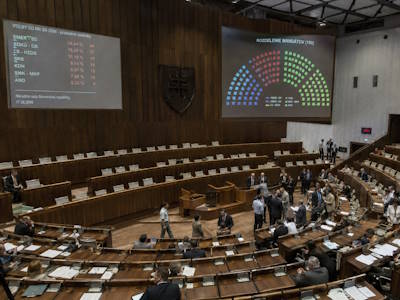
The setting reinforced that message. Official records center on the ceremonial session of the National Council of the Slovak Republic in Bratislava, where the oath was taken. The capital had long been the focal point of state ceremonies, and the inauguration placed parliament at the center of the transfer. Although the presidential residence, Grassalkovich Palace, is closely associated with the office, the decisive act was the oath before the legislature. That arrangement highlighted the formal relationship between the presidency and the constitutional institutions of the republic.
For any incoming president, the oath is more than a ritual sentence recited for tradition's sake. It is the legal threshold of office. Without it, the transfer would remain incomplete. The inauguration of 15 June 2019 therefore resolved a practical question as well as a ceremonial one: at what exact moment does the new president begin to exercise the powers of the office? In Slovakia's case, the answer lay in the scheduled end of the previous term and the successful completion of the constitutional ceremony.
The transition from Kiska to Čaputová was orderly, and that orderliness was part of the event's importance. Democratic systems rely not only on competition in elections but also on predictable succession. The weeks between late March and mid-June showed that the public may know who will be president while the state still awaits the formal handover. On 15 June, that waiting period ended. The office passed from one president to the next without procedural ambiguity.
Čaputová's rise to the presidency also fit into a broader pattern in post-1989 Central Europe, where the forms of democratic government have been tested and consolidated over time. In that context, inauguration ceremonies can appear routine, yet routine itself is often a sign of institutional strength. The more predictable and accepted the process, the less likely a transition is to produce uncertainty about who lawfully holds authority.
Her inauguration was thus both a national milestone and a demonstration of constitutional method. It joined electoral legitimacy to legal procedure, public ceremony to institutional continuity, and personal achievement to the office's formal duties. The event was notable not because it changed the constitutional rules, but because it showed those rules functioning as intended.
Why it still matters
Čaputová's inauguration remains important because it illustrates a basic principle of constitutional government: elections identify a winner, but legal procedures complete the transfer of power. That distinction helps explain why inauguration dates, oaths, and parliamentary roles matter even after a result appears settled.
The event also forms part of the historical record of women's representation in European head-of-state offices. Čaputová's assumption of office as Slovakia's first female president was not simply a biographical detail. It marked a visible change in who could occupy the country's highest constitutional post, while still showing that such a breakthrough occurred within established democratic rules.
Finally, the ceremony offers a useful reminder that state institutions depend on timing, form, and continuity. A peaceful transfer from Andrej Kiska to Zuzana Čaputová did not happen automatically when votes were counted. It happened when the constitutional process reached its appointed moment in Bratislava on 15 June 2019. That is one reason inaugurations, though often ceremonial in appearance, remain central to how democracies make authority lawful.
Timeline
- Slovak presidential election first round
- Slovak presidential election runoff
- Inauguration of Zuzana Čaputová as President of Slovakia
What you uncovered
When Power Becomes Official
You didn't just… complete a puzzle; you traced the moment when a known election outcome became a legally recognized presidency through oath and procedure.
In constitutional systems, winning a vote and holding office are not the same thing. Čaputová's inauguration showed how formal steps, fixed timing, and public procedure turn political choice into lawful authority. That distinction helps institutions manage transitions predictably, even when the election itself is already settled. It also places her presidency within a longer post-1993 Slovak record of how democratic offices are defined by rules as much as by results.
Čaputová took office on 15 June 2019 after defeating Maroš Šefčovič in the presidential runoff on 30 March 2019.
FAQ
What happened on 15 June 2019 in Slovakia?
On 15 June 2019, Zuzana Čaputová was inaugurated as President of Slovakia in Bratislava. She took the presidential oath before the National Council of the Slovak Republic and began a five-year term.
Where was Zuzana Čaputová sworn in as president?
She was sworn in before the National Council of the Slovak Republic in Bratislava. The official records of the inauguration center on that ceremony in the capital.
Who did Zuzana Čaputová succeed as President of Slovakia?
She succeeded Andrej Kiska. His term ended on 15 June 2019, when Čaputová assumed office.
Why was Čaputová's inauguration historically notable?
It made her Slovakia's fifth president and the country's first female president. The inauguration marked the formal start of her presidency after the 2019 election.