

About today's story
USS Indianapolis after its July 1945 sinking in the Philippine Sea
On 30 July 1945, shortly after midnight, the U.S. Navy heavy cruiser USS *Indianapolis* was torpedoed in the Philippine Sea and sank within minutes. The attack came in the final weeks of the Pacific War, at a moment when military operations were still intense even as Japan's defeat was drawing closer. About 1,196 men were aboard. Only 316 would be recovered alive after several days in the water.
The ship had just completed a mission that would later give the sinking an added place in World War II history. On 26 July 1945, *Indianapolis* delivered components and enriched uranium connected to the atomic bomb project to Tinian in the Mariana Islands. Tinian had become a major base for the U.S. air campaign, and the delivery was part of the logistical chain behind one of the war's most consequential operations. After that assignment, the cruiser went to Guam and departed again on 28 July, bound for Leyte in the Philippines.
In ordinary terms, this was a wartime transit through waters where danger had not disappeared. American naval power was dominant by mid-1945, but Japanese submarines could still strike. Questions that later became central to the story were already built into the voyage: how ships were routed, when escorts were assigned, and how captains balanced speed, caution, and procedure at sea. The *Indianapolis* was traveling without escort, and one of the issues later examined was whether it should have been zigzagging, a maneuver intended to make a ship less predictable to a submarine commander.
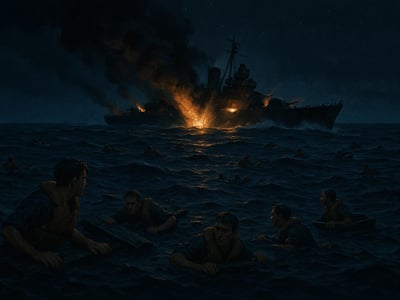
The submarine that found the cruiser was the Japanese I-58, commanded by Mochitsura Hashimoto. Just after midnight, Hashimoto's boat attacked. Torpedoes hit *Indianapolis*, inflicting fatal damage. Captain Charles B. McVay III gave the order to abandon ship, but there was little time to organize a prolonged evacuation. The cruiser sank in about 12 minutes.
That short span of time shaped everything that followed. Some men went down with the ship; others entered the sea with life jackets or clung to rafts and floating debris. Because the sinking happened in open ocean and because wartime communications and tracking systems did not immediately produce an effective alarm, hundreds of survivors were left scattered across a wide area. The loss was not promptly recognized in a way that triggered a rapid rescue.
The days that followed became one of the most studied survival episodes in naval history. The men in the water faced exposure, dehydration, injury, and exhaustion. Supplies were limited or absent. Discipline and mutual aid mattered, but so did simple chance: who had found a raft, who had been injured in the explosion, who was in a stronger or weaker group when daylight came. Later retellings often emphasized the ordeal in highly dramatic terms, but the central fact is plain enough without embellishment: a large number of sailors survived the sinking itself only to remain stranded for days far from immediate help.
The delay was connected to multiple wartime failures rather than a single simple cause. In the late Pacific War, ships and shore commands were handling vast amounts of movement and reporting. A missed arrival, incomplete communication, and the secrecy surrounding parts of *Indianapolis*'s recent mission all formed part of the background. The result was that no quick, coordinated rescue operation reached the survivors in the immediate aftermath of the sinking.
Relief came only on 2 August 1945, when a U.S. Navy patrol aircraft sighted men in the water. That sighting led to a broader rescue effort. Ships and aircraft converged on the area, and sailors were finally brought aboard. Of the roughly 1,196 men who had been on *Indianapolis*, 316 were recovered alive.
For the Navy, the disaster did not end with the rescue. Attention turned to responsibility. McVay, the ship's commanding officer, was later court-martialed, and the question of his decisions—especially over zigzagging—became the most public element of that process. Yet the case never sat comfortably as a straightforward matter of individual blame. Survivors, historians, and naval officers later argued over the fairness of the judgment, pointing to broader systemic problems in routing, escort policy, and reporting. Over time, McVay's case was reassessed, and it came to be seen less as a simple example of command failure than as a difficult wartime episode shaped by incomplete information and institutional shortcomings.
The sinking also occupies an unusual place in the chronology of 1945. It linked a conventional naval loss to the hidden logistical world of the atomic bomb program. Only days after the survivors were found, the bomb delivered through that larger chain of preparation would be used against Hiroshima, followed by Nagasaki. In that sense, the voyage of *Indianapolis* sat at the intersection of two different histories of the war's end: the visible dangers of naval combat and the secret movement of materials tied to a new kind of weapon.
Why it still matters
The loss of USS *Indianapolis* remains important because it is still used to study how military systems work under pressure. Naval historians return to it when examining routing decisions, the allocation of escorts, and the procedures for recognizing when a ship is overdue. The disaster showed that even late in a war, when one side appears to hold overwhelming advantage, administrative gaps and routine assumptions can have grave consequences.
It also continues to matter because of its connection to Tinian. The sinking is not only a story of a ship struck at sea; it is also part of the larger logistical history behind the atomic bomb program. That connection gives the event a broader historical frame, linking the fate of one cruiser and its crew to the final strategic decisions of World War II.
Finally, the later review of McVay's treatment has kept the episode alive in discussions of military accountability. The case is often cited when considering how responsibility should be assigned after disaster, especially when individual decisions are inseparable from larger institutional failures. For that reason, USS *Indianapolis* is remembered not just as a wartime tragedy, but as a continuing reference point in how armed forces judge risk, error, and command.
Timeline
- 1945-07-30 — USS Indianapolis torpedoed in the Philippine Sea
- 1945-07-26 — Delivery completed at Tinian
- 1945-07-28 — Departure from Guam
- 1945-08-02 — Survivors sighted by patrol aircraft
FAQ
What happened to USS Indianapolis on 30 July 1945?
Shortly after midnight on 30 July 1945, USS Indianapolis was torpedoed by the Japanese submarine I-58 in the Philippine Sea. The cruiser sank in about 12 minutes after being fatally damaged.
What mission had USS Indianapolis just completed?
On 26 July 1945, USS Indianapolis completed delivery of atomic bomb components to Tinian in the Mariana Islands. It then departed Guam on 28 July 1945 for Leyte in the Philippines.
How many men survived the sinking of USS Indianapolis?
About 316 men were recovered alive. Roughly 1,196 men had been aboard the ship.
Why did the rescue of USS Indianapolis survivors take so long?
The survivors were not spotted until 2 August 1945, several days after the sinking. The brief and secretive wartime transit, along with delays in detection and reporting, contributed to the late rescue.
Secrecy and Silence at Sea
You didn't just… piece together a naval disaster; you traced how a ship carrying out one of the war's most secret assignments could vanish into a reporting gap almost as soon as its mission ended.
The striking contrast in this story is not only between attack and survival, but between two military systems moving at very different speeds. One part of the war effort delivered sensitive cargo quickly and with tight secrecy, while another failed to register the ship's loss in time to speed rescue. That tension still matters because historians use the sinking to study how organizations manage risk when secrecy, logistics, and accountability overlap.
USS Indianapolis sank in about 12 minutes after being torpedoed by the Japanese submarine I-58 shortly after midnight on 30 July 1945.