

About this story
On 20 June 1837, Queen Victoria acceded to the British throne after the death of William IV. Her accession began a long reign that reshaped Britain’s political and cultural identity.
Queen Victoria's accession was formally recognized in London in June 1837.
On 20 June 1837, Princess Alexandrina Victoria became queen of the United Kingdom after King William IV died at Windsor Castle. She was 18 years old, and the transfer of the crown, though governed by established rules, had to be handled at once. In the space of hours, a young woman who had lived under close supervision at Kensington Palace became the sovereign of the United Kingdom of Great Britain and Ireland.
The immediate business of succession was both personal and constitutional. Early that morning, Archbishop William Howley and Lord Conyngham went to Kensington Palace to inform Victoria that her uncle was dead and that she was now queen. The moment has often been remembered for its intimacy: a teenager, awakened with grave news, learning that her life had changed irreversibly. But it was also part of a carefully ordered constitutional process. The monarchy could not pause. The death of one sovereign meant the instant accession of another.
That principle helped prevent uncertainty. Even before any public ceremony, proclamation, or council meeting, Victoria had already succeeded by law. Yet the new reign still had to be formally acknowledged and presented to the political nation and the wider public. Ministers, royal officials, and senior church figures moved quickly to ensure that the transition was clear, lawful, and visible.
Victoria's accession came after a childhood shaped by unusual scrutiny. At Kensington Palace she had been raised within what later became known as the Kensington System, a regime of supervision designed in part to manage access to the possible heir to the throne. By 1837 she was no stranger to the idea that she might become queen, but the timing still depended on the health and survival of William IV. His death at the age of 71 brought that waiting period to an abrupt end.
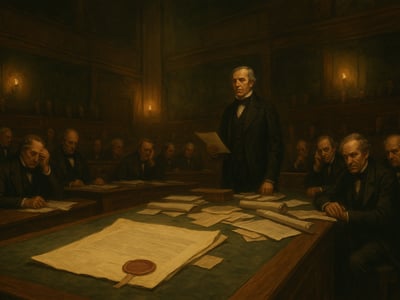
The following day, 21 June, the Accession Council met at St James's Palace. There the machinery of monarchy and government became fully public. The council formally recognized the new sovereign, and Victoria made the required declaration concerning the security of the Church of Scotland. Such acts can appear ceremonial from a distance, but they were central to how the British state expressed continuity. A hereditary monarchy depended not only on bloodline but also on recognized procedure, official witness, and public proclamation.
This was especially important because the crown sat within a constitutional system in which ministers, Parliament, churches, courts, and the public all had a stake in orderly succession. A disputed accession could unsettle far more than the royal household. By the 19th century, Britain had long experience in using legal and ceremonial forms to reduce that risk. Victoria's accession is a clear example of how quickly those forms could be put into action.
Her early reign also began in close association with Prime Minister Lord Melbourne, an experienced politician who became an important adviser during her first years on the throne. Victoria was young, and much public attention focused on her age, conduct, and capacity to fulfill a role that was at once symbolic and political. She had inherited not arbitrary personal power, but the office of monarch within a parliamentary system that expected regularity, restraint, and collaboration with ministers.
One of the most important consequences of William IV's death was not in London but in the constitutional map of Europe. The British crown did not carry with it the crown of Hanover. Since 1714, the two had been linked through the Hanoverian dynasty, but they were governed by different inheritance rules. Hanover followed Salic law, which barred succession through the female line. As a result, Victoria became queen of the United Kingdom, but not ruler of Hanover. That crown passed instead to Ernest Augustus, Duke of Cumberland.
The split mattered because it ended more than a century of personal union between Britain and Hanover. One death thus produced two lawful but different outcomes. In Britain, Victoria's accession opened a new reign. In Hanover, a different dynastic principle determined a different successor. The contrast shows how monarchy in 19th-century Europe was shaped not by one universal rule, but by distinct legal traditions operating across different states.
Victoria would not be crowned until 1838, so accession and coronation should not be confused. She became queen the moment William IV died; the later coronation was a separate ceremonial confirmation of a status she already held. That distinction, familiar in constitutional practice, reveals how the monarchy balanced legal immediacy with ritual display.
Why it still matters
Victoria's accession remains a useful point of reference because it shows that hereditary monarchy was never only a matter of family descent. It also relied on procedure: notification, council, declaration, proclamation, and acceptance within a broader constitutional order. The events of 20 and 21 June 1837 demonstrate how states used formality to secure continuity at moments of vulnerability.
It also matters because the separation of the British and Hanoverian crowns illustrates the practical force of succession law. A single dynastic event could produce different outcomes in different realms, depending on local rules. That helps explain how 19th-century Europe was held together, and divided, by legal traditions as much as by family connection.
Finally, Victoria's accession marks the beginning of a reign that later gave its name to an era associated with industrial expansion, parliamentary development, cultural change, and imperial administration. Those later histories were complex and uneven across Britain and the many places affected by British power. But the starting point was this tightly managed constitutional transition in June 1837, when an 18-year-old woman at Kensington Palace became queen and a new reign began.
Timeline
- Hanoverian succession passes to Ernest Augustus
- William IV dies at Windsor Castle
- Victoria is informed of her accession at Kensington Palace
- Accession Council meets at St James's Palace
What you uncovered
Two Crowns, Two Rules
You didn't just… complete a puzzle; you traced how Victoria's accession depended on immediate procedure and different succession laws acting at the same moment.
Victoria's accession is often remembered as the beginning of an era, but it also reveals how monarchy worked as a legal system rather than a single family story. The same death transferred the British crown to Victoria while sending Hanover to another heir because the two states followed different inheritance rules. That split is a useful reminder that 19th-century political unions could rest on arrangements that looked stable until succession exposed their limits.
Because Hanover followed Salic law, its crown passed in 1837 to Ernest Augustus, Duke of Cumberland, instead of Victoria.
FAQ
When did Queen Victoria become queen of the United Kingdom?
Victoria succeeded to the throne on 20 June 1837, after King William IV died at Windsor Castle. She was 18 years old when she became queen.
Where was Victoria when she was told she had become queen?
Archbishop William Howley and Lord Conyngham went to Kensington Palace in London to inform Victoria that she was now queen. The accession was then formally recognized in London.
Why did Victoria not inherit the crown of Hanover?
Hanover followed Salic law, so the Hanoverian crown did not pass to Victoria. It went instead to Ernest Augustus, Duke of Cumberland.
What happened at the Accession Council in 1837?
The Accession Council met at St James's Palace on 21 June 1837. There, the new queen made the required declaration concerning the security of the Church of Scotland.