
About this story
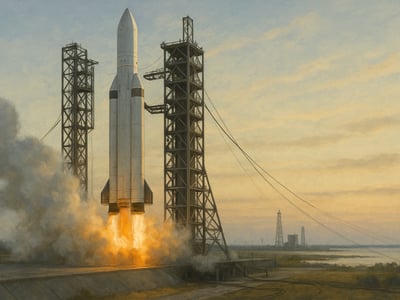
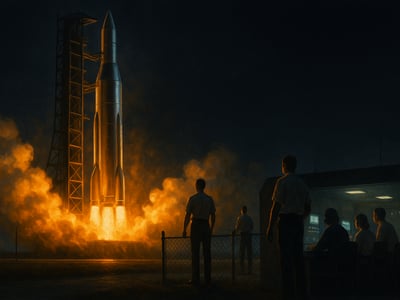
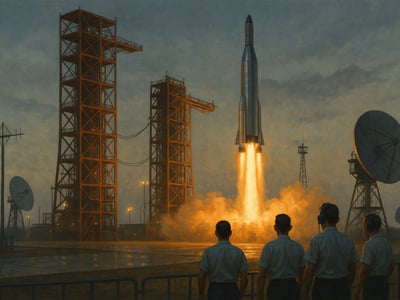
Mariner 5 after its 1967 launch from Cape Kennedy on a Venus flyby mission
On June 14, 1967, NASA launched Mariner 5 from Cape Kennedy Air Force Station in Florida, sending the uncrewed spacecraft toward Venus on an Atlas-Agena D rocket. The mission belonged to the Mariner program, a series of early American planetary probes designed to test whether instruments, tracking systems, and launch vehicles could do useful science far from Earth. Mariner 5 was not meant to orbit Venus or land there. Its task was narrower and, in some ways, more demanding: survive the trip, arrive on the correct path, and collect as much information as possible during a single fast flyby.
That kind of mission left little margin for error. A flyby offered only one close approach, and the geometry had to be right months in advance. If the launch missed the needed interplanetary trajectory, or if the spacecraft lost power, orientation, or contact on the way, there would be no second chance. The scientific return depended on a chain of separate systems working together: the launch vehicle had to perform accurately, navigators had to track and refine the trajectory, and the spacecraft's instruments had to remain healthy until the brief encounter at Venus.
The mission took shape within a larger period of rapid planetary exploration in the 1960s. Venus had become a major target because it was one of Earth's nearest planetary neighbors and because so much about it remained uncertain. Seen from Earth, the planet was hidden under a permanent global cloud cover. That made direct optical observation difficult and left basic questions open about its lower atmosphere, pressure, temperature, and surface conditions. Earlier missions, including Mariner 2, had already shown that Venus was not a temperate world beneath the clouds. But many details still had to be refined, and every successful pass added badly needed measurements.
Mariner 5 relied on methods that now seem standard in planetary science but were still being proven in practice. Jet Propulsion Laboratory in Pasadena managed the mission for NASA, while ground stations tracked the probe across millions of kilometers. For months after launch, the work was less dramatic than liftoff but just as important. Engineers and controllers had to monitor the spacecraft's condition, confirm its course, and ensure that observations would occur at the right time. Because the encounter would happen at high speed, even small errors in timing could reduce the value of the data.
The spacecraft's design reflected this focused purpose. It carried instruments meant to examine the environment around Venus and to support radio science measurements during the encounter. In such experiments, the spacecraft's radio signal itself became part of the scientific toolset. As Mariner 5 passed behind or near Venus from Earth's point of view, changes in the radio signal could be measured and analyzed. Those changes helped scientists derive information about the planet's atmosphere, including how it affected radio waves passing through or near it.
This approach mattered because Venus did not easily yield its secrets to ordinary viewing. A short flyby could still produce valuable results if the observations were carefully planned. Mariner 5 was an example of how early planetary missions often turned limited opportunities into meaningful science. The spacecraft did not need to stay for months in orbit to contribute. It only needed to arrive precisely, transmit reliably, and let scientists interpret the measurements correctly.
That moment came on October 19, 1967, when Mariner 5 flew past Venus and returned mission data during the encounter. The close pass was brief, but it was the central purpose of everything that had happened since launch. Radio science observations during the flyby were used to derive information about the atmosphere, helping researchers improve their picture of the planet's physical environment. The mission added to a growing body of evidence that Venus was a world with a dense atmosphere and conditions very different from those on Earth.
The achievement was not simply that the spacecraft reached Venus. It was that launch operations, interplanetary navigation, communications, and scientific planning all held together long enough to make the flyby productive. In the early space age, every one of those steps was still being tested under real mission conditions. Mariner 5 therefore represented both a scientific investigation and a demonstration of operational capability. It showed that NASA and JPL could execute a mission in which success depended on precision over months, followed by a few critical hours of observation.
Why it still matters
Mariner 5 remains important because it illustrates how much planetary science can be done without landing on a planet or entering orbit around it. Flyby missions extended human knowledge by treating trajectory, timing, and radio communication as parts of the experiment itself. In the case of Venus, this helped researchers study an atmosphere that was otherwise difficult to probe directly.
The mission also belongs to the early development of comparative planetology, the effort to understand planets by measuring and comparing their atmospheres, surfaces, and environments. Data from Venus missions such as Mariner 5 helped scientists refine models of how planetary atmospheres behave under very different conditions. That broader habit of comparison became central to later studies of Mars, the outer planets, and eventually exoplanets.
Just as importantly, Mariner 5 shows how early space exploration depended on coordination rather than on any single dramatic breakthrough. The spacecraft, the Atlas-Agena D launch vehicle, the tracking network, and the mission team all had to function as one system. Looking back, the mission marks a stage when planetary exploration was becoming more than a technical gamble. It was turning into a repeatable scientific practice.
Mariner 5 did not resolve every question about Venus, and it was never intended to. Its value lay in what a well-executed flyby could accomplish. By converting one brief pass on October 19, 1967 into usable measurements, the mission helped establish a method that would shape many later encounters across the solar system.
Timeline
- Mariner 5 launch
- Mariner 5 Venus flyby
What you uncovered
Science in a Single Pass
You didn't just…complete a space puzzle; you retraced a mission in which one carefully timed encounter had to carry nearly all the scientific value.
Mariner 5 is a reminder that early planetary science often depended less on long presence than on precise measurement at the right moment. A flyby offered only minutes of close observation, but radio tracking and occultation could still extract meaningful information about Venus's atmosphere. That approach helped establish a broader lesson of space exploration: useful knowledge can come from indirect methods when direct access is limited.
Mariner 5 flew past Venus on 1967-10-19 after launching on an Atlas-Agena D rocket from Cape Kennedy Air Force Station.
FAQ
What was the Mariner 5 mission?
Mariner 5 was a NASA uncrewed spacecraft sent toward Venus as part of the Mariner program. It was designed to make a close flyby and return scientific data during a brief encounter.
When and where was Mariner 5 launched?
Mariner 5 was launched on 1967-06-14 from Cape Kennedy Air Force Station in Florida, United States. NASA used an Atlas-Agena D launch vehicle for the mission.
What did Mariner 5 learn about Venus?
During its 1967-10-19 flyby, Mariner 5 returned mission data from Venus. Radio science observations were used to derive information about the planet's atmosphere.
Who managed the Mariner 5 mission for NASA?
Jet Propulsion Laboratory in Pasadena, California, managed the Mariner 5 mission for NASA. It handled the mission operations during the 1967 Venus flight.