
About this story
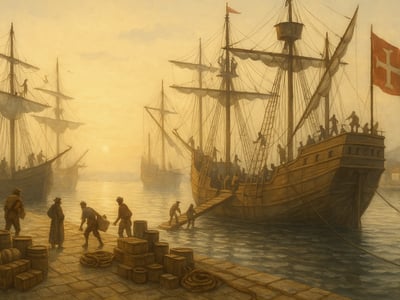
On 3 August 1492, Christopher Columbus left Palos de la Frontera with the Santa María, Pinta, and Niña under Castilian sponsorship. The westward voyage aimed at Asia but opened a lasting Atlantic crossing that reshaped exploration and empire.
Departure from Palos de la Frontera on Columbus's 1492 Atlantic expedition.
Video puzzle
On August 3, 1492, Christopher Columbus departed from Palos de la Frontera in the Crown of Castile with three ships—the *Santa María*, the *Pinta*, and the *Niña*—beginning the voyage that would become his first crossing of the Atlantic under Castilian sponsorship. At the moment of departure, the expedition was framed as a westward attempt to reach Asia by sea. Its later consequences would be far larger and far more contested than the immediate objective suggested.
Royal terms and the Capitulations of Santa Fe
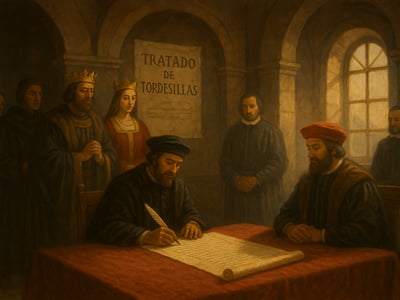
The voyage did not begin as an improvised act of seamanship. Earlier in 1492, the terms of Columbus's venture had been formalized in the Capitulations of Santa Fe, an agreement issued after negotiations with Isabella I of Castile and Ferdinand II of Aragon, often referred to together as the Catholic Monarchs. That agreement set out the titles, privileges, and rewards Columbus would receive if the expedition succeeded. In other words, the departure from Palos was not simply the launch of three ships; it was the activation of a royal project shaped by administration, finance, and expectations of profit and authority.
Even with royal backing, the practical problem remained severe. No proven westward route from Castile to Asia existed. Columbus believed such a voyage was possible and workable, but the central assumptions behind it—especially the distance involved—could not be verified before leaving port. Once the ships committed themselves to the ocean crossing, there would be little room to correct a major miscalculation. The risks were immediate and concrete: navigational uncertainty, damage to the vessels, failures in supply, and the possibility that the crews might lose confidence if the voyage stretched on without results.
The expedition also depended on experienced mariners beyond Columbus himself. Martín Alonso Pinzón, one of the most important figures in the voyage, commanded the *Pinta*. His brother Vicente Yáñez Pinzón was likewise part of the expedition, and Juan de la Cosa sailed aboard the *Santa María*. Their presence reminds us that this was not the work of a single individual, however prominent Columbus later became in the record. It was a coordinated maritime undertaking relying on ships, crews, local sailing knowledge, and the willingness of multiple participants to accept a highly uncertain mission.
Ships, pilots, and the departure from Palos
Palos de la Frontera was therefore more than a dot on a map. It was the point where a negotiated royal venture became a lived reality for those who boarded the ships. The departure marked the transition from paper agreements and court decisions to the hazards of open water. That movement—from legal authorization to practical navigation—is part of what makes August 3 such a significant date in the history of exploration.
The first stage of the journey did not send the fleet directly into the deep Atlantic. After leaving Palos, the ships proceeded to the Canary Islands in August 1492. This stop was a necessary part of the voyage rather than a detour from it. The Canary Islands offered a place to prepare for the much longer westward crossing: a chance to address problems, resupply, and make the final adjustments before committing to the ocean route Columbus intended to follow. Only from there did the expedition set out across the Atlantic.
The Canaries and the Atlantic gamble
Seen from the vantage point of departure, the voyage was suspended between calculation and uncertainty. Columbus had a route in mind and political backing to pursue it, yet neither he nor his sponsors could know in advance what the expedition would actually find, how long the crossing would take, or whether it would return with anything that could justify the investment. The terms of the venture suggested confidence, but confidence was not the same thing as proof.
That tension helps explain why the departure from Palos still draws attention. It represents a moment when maritime ambition, royal policy, and imperfect geographical knowledge converged. The expedition was not launched into a blank space in the minds of its organizers; it was launched into a world they believed they understood well enough to navigate. But their understanding was incomplete, and the consequences of acting on it were immense.
Landfall and what the departure came to mean
In October 1492, the westward crossing led to landfall in the Caribbean, and Columbus's return to Iberia in 1493 helped secure support for further expeditions. Those later developments transformed the meaning of the departure from Palos. What began as an effort to find a maritime route to Asia became part of a much broader history of Spanish expansion in the Caribbean and, over time, the creation of colonial institutions and transoceanic networks.
Any account of the voyage today has to hold two things together. First, the event of August 3, 1492, can be described clearly and specifically: three ships left Palos under an agreement made earlier that year, stopped in the Canary Islands, and then continued westward across the Atlantic. Second, the voyage cannot be separated from the longer history to which it became connected—one that included conquest, forced labor, and the dispossession of Indigenous peoples. For that reason, the date is remembered differently in different places and traditions.
Why it still matters
The departure from Palos remains important because it sits at the intersection of navigation, state power, and empire. It illustrates how maritime exploration in the late 15th century depended not only on ships and pilots but also on contracts, royal authorization, and systems for claiming authority over distant places. The voyage is therefore a key reference point in the history of Atlantic expansion.
It also matters because the institutions surrounding the voyage proved as consequential as the sailing itself. The agreement that backed Columbus, the recording of the expedition, and the rapid organization of later voyages all show how states could turn uncertain exploration into durable structures of administration and control. In that sense, August 3, 1492, was not just a departure date. It was an early stage in a larger process that reshaped trade, politics, and relations among continents.
At the same time, the event continues to matter because it forces historians and the public to consider how such moments should be narrated. For some traditions, the voyage has long stood as a milestone in navigation and exploration. For others, especially in light of Indigenous histories, it is inseparable from colonization and violence. Remembering the departure from Palos responsibly means acknowledging both the documented event itself and the far-reaching consequences that followed from it.
Timeline
- Capitulations of Santa Fe issued
- Fleet stops in the Canary Islands
- Departure from Palos de la Frontera
- Atlantic landfall
- Return to Iberia
What you uncovered
A Voyage and Its Machinery
You didn't just… complete a puzzle about three ships leaving Palos; you traced the opening move in a larger system of state-backed oceanic expansion.
The voyage's stated aim was to find a westward route to Asia, but its larger significance lies in the structures that made it possible and gave it meaning afterward. Royal agreements, command hierarchies, and written records turned a risky expedition into an enterprise legible to a crown and usable by empire. That is one reason the departure still matters: it sits at the intersection of navigation, administration, and later colonial power, not only at the level of an individual voyager.
Before the Atlantic crossing, the fleet stopped in the Canary Islands in August 1492.
FAQ
What happened on August 3, 1492, in Columbus's voyage?
On 1492-08-03, Christopher Columbus departed from Palos de la Frontera on his first Atlantic voyage with three ships: the Santa María, the Pinta, and the Niña. The expedition set out under the terms formalized in the Capitulations of Santa Fe earlier that year.
Where did Columbus sail from in 1492?
He sailed from Palos de la Frontera in the Crown of Castile. The fleet left there before stopping in the Canary Islands later in August 1492.
What were the three ships in Columbus's 1492 expedition?
The three ships were the Santa María, the Pinta, and the Niña. Martín Alonso Pinzón commanded the Pinta, and Juan de la Cosa was aboard the Santa María.
What was the Capitulations of Santa Fe?
The Capitulations of Santa Fe were the terms issued in April 1492 that set the conditions under which the Catholic Monarchs backed Columbus's voyage. They formalized royal support for the expedition.
Why did the fleet stop in the Canary Islands?
The fleet stopped in the Canary Islands in August 1492 before beginning the westward Atlantic crossing. The stop came before the ships continued on their voyage toward Asia.