
About this story
On 3 August 1968, Communist leaders meeting in Bratislava signed the Bratislava Declaration during the Prague Spring crisis. The statement affirmed socialist unity after talks at Čierna nad Tisou, yet Warsaw Pact forces invaded Czechoslovakia less than three weeks later.
Bratislava meeting of Communist party leaders, 3 August 1968
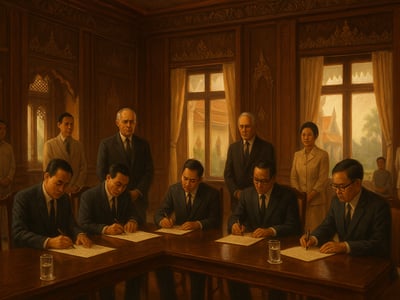
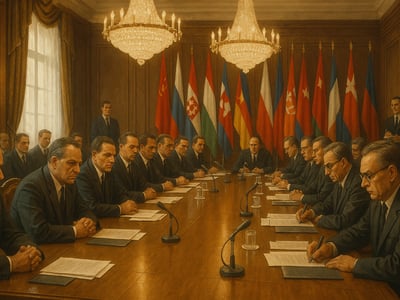
On August 3, 1968, Bratislava became the setting for a high-level Communist party meeting that tried to stabilize one of the most serious internal disputes the Eastern Bloc had faced in years. Leaders and senior representatives from the Soviet Union, Czechoslovakia, Poland, Hungary, Bulgaria, and East Germany gathered there and signed what became known as the Bratislava Declaration. The document affirmed socialist principles and party solidarity, but it emerged from a crisis that had already exposed deep disagreement over the direction of Czechoslovakia under the Prague Spring.
Prague Spring reforms under pressure
Earlier in 1968, the Czechoslovak leadership under Alexander Dubček had introduced reforms that loosened censorship, encouraged wider public discussion, and suggested a different way of organizing political life inside a one-party socialist state. These changes drew attention far beyond Czechoslovakia. To many people inside the country, they represented a chance to make the system more open and responsive. To several allied governments, especially the Soviet leadership under Leonid Brezhnev, they raised a different question: how far could one member of the bloc depart from established political control without affecting the rest?
That question shaped the tense diplomacy of late July and early August. From July 29 to August 1, Soviet and Czechoslovak leaders met at Čierna nad Tisou, on the Czechoslovak-Soviet border. Those talks were an attempt to narrow the dispute through direct negotiation. The basic problem was not only policy language, but trust. The Soviet side and several allied parties were worried about press freedom, weakening party discipline, and the possibility that reform might move faster than the Communist leadership could contain. The Czechoslovak side, for its part, tried to defend its reform course while avoiding a complete break with its allies.
From Čierna nad Tisou to Bratislava
The Bratislava meeting followed immediately after those border negotiations. It brought together figures including Dubček and Brezhnev, as well as Władysław Gomułka, János Kádár, Todor Zhivkov, Walter Ulbricht, and Czechoslovak president Ludvík Svoboda among the senior participants in the broader discussions. The choice of Bratislava mattered symbolically as well as practically. It placed the next stage of the crisis inside Czechoslovakia itself, on Slovak territory, and gave the appearance that disagreement within the bloc could still be handled through party consultation and a shared public statement.
The Bratislava Declaration was the visible result. In formal terms, it was a joint statement of commitment to socialism, Marxism-Leninism, and cooperation among Communist parties. It presented unity. At the surface level, that was important. A common text meant the talks had not collapsed in public, and it allowed all sides to claim that the crisis remained within political control. In moments of Cold War tension, wording mattered. A declaration could signal reassurance, discipline, or warning all at once.
A declaration of unity on paper
Yet the document also has to be understood in the context of the arguments surrounding it. Czechoslovakia's reform movement had already become a test case for the wider bloc. If reforms continued to expand public debate and reduce traditional controls, allied leaders feared that similar pressures might spread elsewhere. In that sense, Bratislava was not a routine summit. It was an effort to define the acceptable limits of change within a system built on alliance commitments and party authority.
This is why the declaration has often been seen less as a final settlement than as a brief diplomatic pause. The leaders assembled in Bratislava did produce a common statement, but the underlying disagreement had not disappeared. The document did not remove doubts among Soviet and allied decision-makers about Czechoslovakia's trajectory, and it did not end hopes within Czechoslovakia that reform might continue. The same words that seemed to preserve unity could also be read as setting conditions.
Invasion and the meeting’s meaning
Less than three weeks later, on August 20-21, 1968, Warsaw Pact forces led by the Soviet Union entered Czechoslovakia. That intervention transformed the meaning of the Bratislava meeting. What had appeared on August 3 as a negotiated statement among allied parties came to be viewed in retrospect as part of the final phase before military action. Historians differ in emphasis when discussing exactly how much the declaration changed calculations, but the chronology is clear: Čierna nad Tisou came first, Bratislava followed, and invasion came later in the same month.
Because of that sequence, the Bratislava Declaration occupies an unusual place in the history of the Prague Spring. It was neither the beginning of the reforms nor the act that ended them by force. Instead, it stands in the narrow space between negotiation and intervention. It shows leaders still using the language of party solidarity and consultation even as the room for independent political development inside the bloc was shrinking.
Why it still matters
The Bratislava meeting remains important because it helps explain how power worked inside the Soviet bloc. Formal declarations, summit meetings, and public statements were not separate from hard power; they were part of the same system. The episode shows that domestic reform in one member state could quickly become an international question once allied governments judged it to affect the cohesion of the bloc.
It also matters as a case study in Cold War diplomacy. The declaration illustrates how leaders used negotiated texts to manage disagreement, display unity, and set political expectations, even when consensus was fragile. For historians, it is a useful reference point between the talks at Čierna nad Tisou and the invasion later in August, because it captures a moment when negotiation had not yet fully given way to coercion.
Finally, the event links Bratislava directly to a central episode in the history of Communist Europe. The city was not simply a backdrop. On that day, it hosted a meeting that connected Slovak territory to one of the defining crises of 1968, when the limits of reform within the Warsaw Pact order were being tested in full view of the world.
Timeline
- Prague Spring reforms begin
- Čierna nad Tisou negotiations begin
- Bratislava Declaration signed
- Warsaw Pact invasion of Czechoslovakia
What you uncovered
Diplomacy Under Pressure
You didn't just…complete a date puzzle; you traced a moment when party leaders tried to manage a deep political conflict through a common text.
The Bratislava Declaration can be read as a document of containment rather than resolution. It followed hard bargaining at Čierna nad Tisou and briefly suggested that shared language about socialist unity might hold the bloc together despite open disagreement over reform. Its short lifespan shows how summit statements in the Cold War could serve both as instruments of negotiation and as markers of how narrow the room for independent change had become.
Warsaw Pact forces led by the Soviet Union entered Czechoslovakia on 20–21 August 1968, less than three weeks after the Bratislava meeting.
FAQ
What happened on 3 August 1968 in Bratislava?
On 3 August 1968, Communist party representatives from the USSR, Czechoslovakia, Poland, Hungary, Bulgaria, and the German Democratic Republic met in Bratislava and signed the Bratislava Declaration. The meeting took place during the Prague Spring crisis.
Who was present at the Bratislava meeting?
Among the leaders present were Alexander Dubček and Leonid Brezhnev. Representatives from the USSR, Czechoslovakia, Poland, Hungary, Bulgaria, and the German Democratic Republic also took part.
How was the Bratislava Declaration connected to the Prague Spring?
It followed negotiations over the Prague Spring reforms and came during disputes about press freedom, party control, and political change in Czechoslovakia. The declaration affirmed socialist principles and party solidarity within the Eastern Bloc.
How soon after Bratislava did Warsaw Pact forces enter Czechoslovakia?
Warsaw Pact forces led by the Soviet Union entered Czechoslovakia on 20–21 August 1968. That was less than three weeks after the Bratislava meeting.