

About this story
On 2 August 1934, after President Paul von Hindenburg died, Adolf Hitler merged Germany’s presidential and chancellor offices as Führer und Reichskanzler. The move concentrated head-of-state and head-of-government powers in one person.
Hitler assumed the title Führer und Reichskanzler in Berlin on 2 August 1934.
On August 2, 1934, the day President Paul von Hindenburg died at Neudeck in East Prussia, Adolf Hitler assumed a new position at the top of the German state. By combining the offices of president and chancellor, he adopted the title *Führer und Reichskanzler* and brought the formal powers of head of state and head of government into his own hands. The step was presented as a legal transfer of authority, but it also marked a decisive stage in the concentration of power within Nazi Germany.
A succession prepared in advance
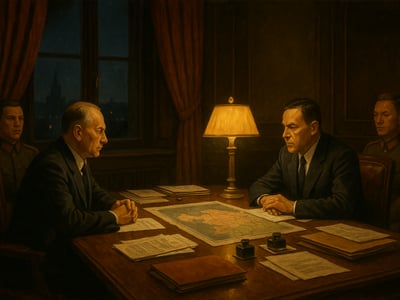
The change did not begin on the day of Hindenburg’s death. It had been prepared in advance. On August 1, 1934, the German cabinet approved the Law Concerning the Head of State of the German Reich. The law stated that, once the presidency became vacant, its powers would be merged with those of the chancellor. That meant there would be no separate presidential succession and no new election for the office that had existed under the Weimar constitution. The timing shows that the Nazi leadership was ready to act as soon as Hindenburg died.
A year of constitutional erosion
This moment came after more than a year of rapid constitutional erosion. Hitler had been appointed chancellor in January 1933, formally within the existing political system. Soon afterward, the Reichstag Fire Decree suspended key civil liberties, and the Enabling Act gave Hitler’s government the power to legislate without normal parliamentary constraints. These measures did not abolish every institution of the German state at once, but they sharply reduced the checks that might have limited executive power.
Even so, Hindenburg still mattered. As president, he remained a distinct constitutional authority and a symbolic figure for conservatives, nationalists, and the armed forces. He had appointed Hitler as chancellor, yet his office still stood apart from Hitler’s own. As long as Hindenburg lived, there remained at least a formal division at the summit of the state. By 1934, however, Hindenburg’s health had declined, and the question of succession had become urgent.
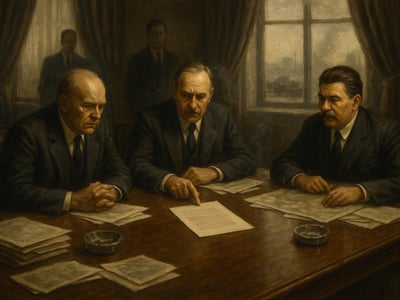
The weeks before his death were also important for another reason. In late June 1934, during the purge known as the Night of the Long Knives, Hitler moved against perceived rivals and opponents within and beyond the Nazi movement. The operation helped reassure parts of the army leadership, which had been wary of the SA and its ambitions. That mattered because acceptance by the Reichswehr was essential. If the armed forces had resisted the transfer of authority after Hindenburg’s death, the merger of offices could have faced a serious obstacle.
Army oath and succession
Instead, the transition was reinforced immediately. On August 2, Defense Minister Werner von Blomberg ordered members of the Reichswehr to swear a personal oath of loyalty to Adolf Hitler. This was not merely an administrative detail. In earlier forms, military loyalty had been directed to the constitution or to the state. Now it was centered on one man. The oath helped bind the armed forces to Hitler personally at a moment when the constitutional order was being reshaped.
The legal language used by the regime suggested continuity and order. The government did not present the change as a revolution. It described it as a lawful merger of powers made necessary by the vacancy in the presidency. But this legal form concealed a deeper transformation. A constitutional office with its own authority disappeared, and the remaining institutional barriers between party leadership, government leadership, and headship of state became much weaker.
Berlin was the political center where the law was formalized and where the machinery of the Nazi state translated a death into a transfer of power. Neudeck, where Hindenburg died, was geographically distant but politically decisive. The president’s death triggered a plan already put in place. In practical terms, the offices were merged at once. In symbolic terms, the old field marshal’s death removed one of the last prominent figures not wholly created by the Nazi regime.
Plebiscite endorsement
The regime then sought public endorsement. On August 19, 1934, a national plebiscite was held to approve the merger of the presidential and chancellor offices. The vote came after the fact, not before it, and took place in a political environment already shaped by repression, censorship, and one-party dominance. Even so, the plebiscite served an important function for the regime: it offered a claim of popular ratification alongside legal decree and military obedience.
Seen step by step, the consolidation of power in August 1934 rested on several connected mechanisms. First came prior legal preparation through cabinet action. Then came the immediate assumption of combined powers when Hindenburg died. Next came military alignment through the personal oath. Finally came plebiscitary approval, intended to give the new arrangement a public mandate. None of these elements alone explains the change; together, they show how dictatorship can be strengthened through institutions as well as coercion.
Why it still matters
This event remains important because it demonstrates how constitutional structures can be dismantled through formally legal measures. The merger of the presidency and chancellorship did not look like the destruction of a state from the outside. It was written into law, announced by officials, and later endorsed in a national vote. Yet the effect was to remove a meaningful separation at the top of government and to concentrate authority in a single ruler.
It also stands as a clear example of how the loyalty of the military can be redirected from impersonal institutions to an individual leader. Blomberg’s order on August 2 helped reshape the relationship between armed force and state power. When an army is tied personally to one ruler rather than to a constitution, the balance of political authority changes sharply.
For historians and the public alike, August 1934 is therefore a case study in the institutional consolidation of one-party dictatorship. It shows that authoritarian power is not built only by dramatic violence or mass spectacle. It can also be secured through decrees, succession rules, administrative timing, and the compliance of established elites. Hindenburg’s death did not create Nazi rule, but it removed a remaining constitutional distinction and allowed Hitler to stand at the apex of the German state without an equal office beside him.
Timeline
- Hitler becomes chancellor
- Enabling Act adopted
- Night of the Long Knives
- Hitler assumes combined state offices
- Plebiscite on office merger
What you uncovered
Power Bound Into One Office
You didn't just… complete a puzzle; you traced the moment when separate parts of the German state were drawn under one ruler's authority.
This change was not only about a new title. The office merger, the army's personal oath, and the later plebiscite each strengthened power in a different way: one through law, one through obedience, and one through public endorsement. Together, they show how dictatorship can be consolidated through institutions that appear distinct but begin to reinforce one another.
On 1934-08-02, Defense Minister Werner von Blomberg ordered the Reichswehr to swear a personal oath of loyalty to Adolf Hitler rather than to the constitution or the state.
FAQ
What changed when Hitler became Führer on 2 August 1934?
After Paul von Hindenburg died, Adolf Hitler combined the offices of president and chancellor in Germany. He adopted the title Führer und Reichskanzler, giving him control of both the head of state and head of government functions under the Nazi state.
How did Hindenburg's death affect the German presidency?
The German presidency became vacant when Paul von Hindenburg died on 1934-08-02 at Neudeck in East Prussia. The vacancy triggered the law that transferred the head of state role into Hitler's hands.
What was the Law Concerning the Head of State of the German Reich?
It was a law approved by the German cabinet on 1934-08-01 to take effect when Hindenburg died. The law merged the offices of president and chancellor.
Why was the Reichswehr oath to Hitler significant?
On 1934-08-02, Defense Minister Werner von Blomberg ordered members of the Reichswehr to swear a personal oath of loyalty to Adolf Hitler. It showed how military loyalty was being redirected from state institutions toward Hitler personally.