

About this story
On 24 November 1974, Donald Johanson and Tom Gray found the first bones of a partial skeleton at Hadar, in Ethiopia’s Afar region. Catalogued as AL 288-1 and nicknamed Lucy, the remains came from one individual who lived about 3.2 million years ago. In 1978 Johanson, Tim White, and Yves Coppens described Australopithecus afarensis. The bones showed upright walking; they did not prove a direct line to living humans.
Lucy’s first remains were found at Hadar, Ethiopia, on 24 November 1974; further excavation followed.
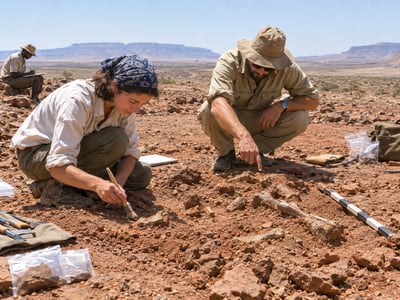
On November 24, 1974, Donald Johanson was surveying at Hadar in Ethiopia’s Afar region with Tom Gray when he noticed a fragment of an ulna, one of the bones of the forearm. Examining the surrounding ground, the two researchers recognized more fossil remains, including portions of a skull, femur, ribs, and pelvis. These were the first finds from the ancient skeleton that became known as Lucy.
Bones that belonged together
The discovery brought a particular kind of opportunity. An isolated fossil can preserve valuable evidence, but several bones belonging to one individual allow researchers to investigate how different parts of a body worked together. At Hadar, the scattered fragments offered a connection between the anatomy of a single early hominin and the broader history of human evolution.
Recognizing that connection depended first on careful observation. A fragment exposed on the ground does not arrive with its identity or significance attached. Researchers must distinguish fossil bone from the surrounding material, identify its anatomical features, and examine whether nearby pieces might belong to the same individual. Johanson and Gray’s inspection of the discovery area turned an initial observation into evidence of a much more substantial find.
A catalogue number, then a nickname
The skeleton was not recovered in a single day. During the weeks that followed, the expedition collected approximately 40 percent of it. Catalogued as AL 288-1, the remains came from the site designated Afar Locality 288. The familiar nickname Lucy would make the discovery widely recognizable, but the catalogue number linked it to a specific place and a scientific record.
Even with much of the skeleton missing, this was an unusually informative collection of remains. Different bones could be studied in relation to one another rather than compared only across separate individuals. A pelvis and parts of the lower limbs, for example, could contribute evidence about posture and movement. Other preserved elements helped researchers assess body proportions and compare Lucy with other fossil hominins.
Upright walking before a larger brain
Lucy lived about 3.2 million years ago. Establishing that age required a different line of investigation from identifying the bones. Fossils are understood within their geological setting: the sedimentary layers in which they occur and the dated deposits that help establish a sequence through time. Geological dating and anatomical study therefore answered complementary questions—when this individual lived, and what the surviving skeleton could reveal about its body.
One of Lucy’s most important contributions concerned walking upright. Features of the pelvis and lower limbs provided evidence of habitual movement on two legs. Combined with other fossils, that evidence helped establish that bipedalism developed well before the large brains characteristic of later humans. Human evolution did not involve every familiar feature appearing together as a single package.
A species name, not a finished lineage
Assigning the remains to a species also required comparison and analysis beyond the discovery itself. In 1978, Donald Johanson, Tim White, and Yves Coppens formally described *Australopithecus afarensis*, the species to which Lucy is assigned. The description placed the Hadar material within a broader anatomical argument about how these early hominins should be classified.
That classification does not make Lucy a proven direct ancestor of living humans. Fossils document individuals and populations within an evolutionary history whose branching relationships must be evaluated through comparison. Lucy provides important evidence about an early hominin species, not a complete family tree contained in one skeleton.
Why it still matters
Lucy remains significant because associated bones let researchers ask questions that isolated fragments cannot answer as readily. When several anatomical features belong to one individual, their relationship is direct rather than inferred from separate specimens. That makes the skeleton a continuing point of comparison for studies of early hominin anatomy, variation, and movement.
The discovery also illustrates how many forms of evidence support a scientific interpretation. Field documentation preserves the context of a find. Geology helps establish its age. Anatomical comparison identifies similarities and differences. Museum curation protects the original material so that it can be examined again as methods and questions change. No single stage substitutes for all the others.
Ethiopia is central to this history, not simply the setting for a discovery by visiting researchers. Lucy belongs to the country’s scientific and cultural heritage, and the original remains are cared for at the National Museum of Ethiopia in Addis Ababa. Their preservation connects research into the distant past with the continuing responsibility to safeguard the evidence on which that research depends.
The interval between the first exposed fragment and the formal species description is part of the story’s meaning. Discovery opened a line of inquiry; collection, documentation, and comparison gave it substance. Lucy’s enduring value lies not in providing a final answer to human origins, but in preserving an unusually connected set of evidence with which researchers can keep testing their explanations.
Timeline
- Lucy found at Hadar
- Field recovery of AL 288-1 continues
- Australopithecus afarensis is described
What you uncovered
Between Fragments and Reconstruction
You didn't just complete a puzzle—you explored the challenge of piecing together evidence from Lucy's fossilized remains in Ethiopia.
Finding an exposed fragment, recovering associated remains, and reconstructing missing anatomy are distinct stages of scientific work. Lucy's approximately 40 percent represents skeletal material recovered over weeks, not a complete skeleton uncovered on the first day. The broader lesson is that reconstruction must distinguish preserved evidence from inferred anatomy, drawing on careful field records and anatomical comparisons.
Donald Johanson, Tim White, and Yves Coppens formally described Australopithecus afarensis, the species to which Lucy is assigned, in 1978.
FAQ
What was discovered on 24 November 1974 at Hadar?
On 24 November 1974, Donald Johanson and Tom Gray found the first remains of the hominin skeleton later nicknamed Lucy at Hadar in Ethiopia's Afar region. The initial find was a fragment of a hominin ulna, not a complete skeleton.
Who found Lucy, and where was the fossil found?
Donald Johanson and Tom Gray made the discovery at Hadar, in Ethiopia's Afar region. The site is also known as Afar Locality 288, the Lucy discovery site.
How much of Lucy's skeleton was recovered after the discovery?
In the weeks after the discovery, Johanson's expedition recovered approximately 40 percent of the skeleton catalogued as AL 288-1. The remains were collected from the surrounding area and assembled from multiple fossil fragments.
Why is Lucy important to human origins research?
Lucy is important because her associated skeletal remains gave researchers a rare chance to compare several parts of one early hominin individual. Her fossils helped support scientific study of early hominin anatomy, including evidence related to bipedal walking.