
About this story
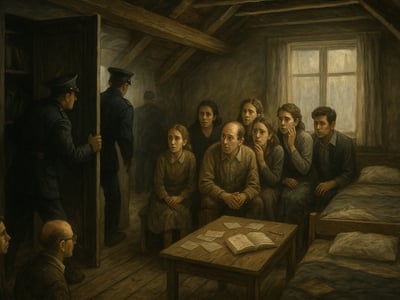
On 4 August 1944, German and Dutch police raided the Secret Annex at Prinsengracht 263 in Amsterdam and arrested Anne Frank and seven other Jews in hiding. The raid ended more than two years of concealment and led to deportation; only Otto Frank survived the camps.
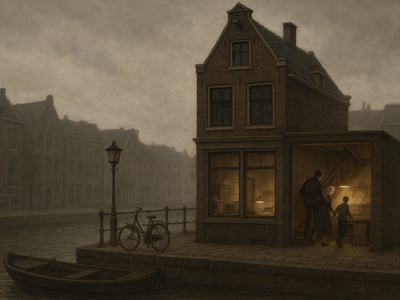
Prinsengracht 263 in Amsterdam, where Anne Frank and seven others were arrested in 1944
On August 4, 1944, German and Dutch police entered the concealed rooms behind the Opekta premises at Prinsengracht 263 in Amsterdam and found Anne Frank and seven other Jews who had been in hiding there for more than two years. Their discovery ended one of the best documented hiding stories of the German occupation of the Netherlands, a story preserved in Anne Frank’s diary but rooted in the daily realities of anti-Jewish persecution, forced concealment, and constant risk.
Life inside the Secret Annex
By the time of the raid, the hiding place later known as the Secret Annex had become a carefully managed world of its own. The Frank family had gone into hiding on July 6, 1942, after anti-Jewish measures in the occupied Netherlands narrowed Jewish life more and more severely. Jews in Amsterdam faced registration, exclusion, restrictions on movement, and the growing threat of deportation. Going into hiding was not a single act of escape but the beginning of a long effort to remain invisible in a city under occupation.
The Annex was located in the rear building of the property at Prinsengracht 263, behind the business premises below. Over time, eight people lived there in concealment: Otto, Edith, Margot, and Anne Frank; Hermann, Auguste, and Peter van Pels; and Fritz Pfeffer. Their survival depended on helpers outside the hidden rooms, including Miep Gies and Johannes Kleiman among others connected to the office and warehouse. These helpers obtained food, passed along news, managed practical needs, and helped maintain the secrecy on which everyone’s lives depended.
The diary written in hiding
Life in hiding was shaped by limits that were both ordinary and severe. The people in the Annex had to keep quiet during business hours so that workers in the building below would not hear movement. Windows and routines had to be managed carefully. Food was rationed. Personal tensions could not be escaped because the group lived in close quarters for months that turned into years. Every routine, from using water to moving from one room to another, had to be adjusted to avoid detection.
Anne Frank had begun writing in a diary after receiving a notebook on June 12, 1942, her thirteenth birthday. What she wrote during the months in hiding later gave readers an unusually intimate record of life under persecution: not just the fear of arrest, but the rhythms of waiting, study, argument, hope, boredom, and uncertainty. Yet on August 4, 1944, the private world described in those pages was interrupted by the arrival of police in the building.
The raid of 4 August 1944
The raid itself has been the subject of extensive historical attention, not least because of Anne Frank’s later fame. What is firmly established is that the concealed rooms were searched, the eight people in hiding were arrested, and people present at the site, including helpers, were also detained. Historical research has examined how the hiding place came to the attention of authorities, but interpretations have differed, and the question of betrayal has remained debated. For that reason, careful accounts stay close to what can be documented rather than presenting certainty where the evidence is incomplete.
The immediate result, however, is not in doubt. The hiding place was broken open, those inside were taken away, and the network that had sustained them was exposed in an instant. A single search accomplished what more than two years of caution had tried to prevent. The central tension of hiding under occupation was always that success depended on secrecy every day, while failure could come all at once.
Deportation and the diary’s postwar path
After the arrest, the eight people from the Annex were drawn into the larger system of detention and deportation that governed Jewish persecution in occupied Europe. They were sent first through the Dutch transit camp at Westerbork and then deported onward to Auschwitz. Otto Frank was later confirmed as the only one of the eight to survive the camps. Anne Frank died after her deportation, and the diary she had left behind became one of the most widely read personal testimonies of the Holocaust.
Miep Gies preserved Anne’s papers after the raid. After the war, when it became clear that Anne had not survived and Otto Frank had returned, the writings were given to him. Their publication helped transform the story of one hidden group in Amsterdam into a global point of entry for understanding Nazi persecution. The diary did not replace the broader history of the Holocaust, but it gave that history a human scale that many readers could approach.
Why it still matters
The arrest at Prinsengracht 263 remains important because it links a familiar personal story to the wider structures of occupation and persecution. Anne Frank is often remembered first as a young writer, but the raid on the Annex shows how hiding places, helper networks, police action, registration systems, and deportation routes were all connected. The event was not isolated from the machinery of anti-Jewish policy; it was one small but revealing part of it.
It also continues to matter because the documentation around Anne Frank’s life and death has shaped Holocaust education across museums, archives, and classrooms. Her diary offers a first-person record of confinement and fear, while the history of the arrest places that record inside the administrative and physical systems that made such hiding necessary. Together, they help explain how persecution was carried out not only through ideology and violence, but also through offices, records, searches, arrests, and transport.
Remembering August 4, 1944, therefore means more than marking the end of the Secret Annex as a refuge. It means recognizing how fragile concealment was under occupation, how much depended on the courage of helpers, and how quickly a hidden domestic space could be absorbed into the larger history of deportation and loss.
Timeline
- German occupation of the Netherlands begins
- Move into the Secret Annex
- Raid on the Secret Annex
- Postwar publication of Anne Frank’s diary
What you uncovered
A Hidden Room, A Larger System
You didn't just…place together a famous story; you traced the moment when a private refuge was pulled into the occupation's system of detection, arrest, and deportation.
The Secret Annex is often remembered as an intimate space of daily routine, fear, and writing, but its end also shows how persecution worked through ordinary administrative structures. Hiding could delay capture, yet it remained vulnerable to registries, policing, workplace oversight, and detention networks that linked a single address to a much larger system. That is part of why Anne Frank's story still matters in classrooms and museums: it connects one voice to the institutions that surrounded and constrained it.
Otto Frank was later confirmed as the only one of the eight people from the Secret Annex to survive the camps.
FAQ
What happened at the Secret Annex on 4 August 1944?
On 4 August 1944, the Secret Annex at Prinsengracht 263 was raided by German and Dutch police. Anne Frank and the seven other people in hiding were arrested.
Who was hiding in the Secret Annex when it was raided?
The eight people in hiding were Anne Frank, Otto Frank, Edith Frank, Margot Frank, Hermann van Pels, Auguste van Pels, Peter van Pels, and Fritz Pfeffer.
Where was Anne Frank's hiding place in Amsterdam?
Her hiding place was the Secret Annex at Prinsengracht 263 in Amsterdam, behind the Opekta premises. It was concealed in the rear building during the German occupation of the Netherlands.
How long had Anne Frank and the others been in hiding before the raid?
They had been in hiding for more than two years before the raid on 4 August 1944. The Frank family went into hiding on 6 July 1942.
What happened to the people in the Annex after the arrest?
They were taken into custody after the raid. After the war, Otto Frank was confirmed as the only one of the eight people from the Annex to survive the camps.