
About this story
On 12 October 1492, Christopher Columbus’s expedition reached an island in the Lucayan archipelago after a westbound Atlantic crossing sponsored by Ferdinand II and Isabella I. He recorded the landfall as San Salvador. The landing followed the Capitulations of Santa Fe and weeks at sea, and it opened sustained Spanish routes across the Atlantic.
Columbus's 1492 Caribbean landfall, recorded as San Salvador in the Lucayan archipelago
On October 12, 1492, Christopher Columbus's expedition reached land in the Caribbean after a westward Atlantic crossing made under the sponsorship of Ferdinand II of Aragon and Isabella I of Castile. In his record of the voyage, Columbus described the landing on an island he named San Salvador. The exact modern identification of that island remains disputed, but historians place the landfall within the Lucayan archipelago in the Bahamas.
A contract before the ocean
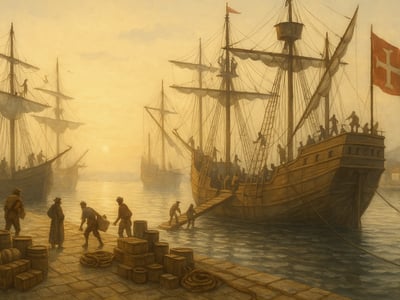
The moment is often treated as a simple point of arrival, but for the people aboard the ships it came at the end of a long stretch of uncertainty. The expedition had left Palos de la Frontera on August 3, 1492, with three vessels: the Santa María, the Pinta, and the Niña. After stopping in the Canary Islands, the fleet departed La Gomera on September 6 for the open Atlantic. From there, the voyage moved into waters that no European expedition had previously crossed on this exact westbound route with a confirmed destination ahead.
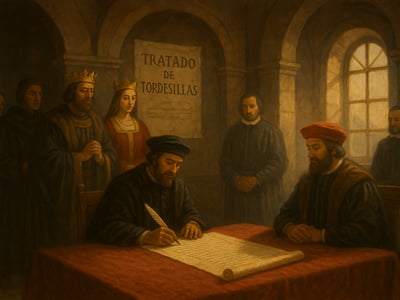
Columbus did not begin this venture alone or suddenly. Earlier in 1492, on April 17, the Capitulations of Santa Fe set out the terms under which he would sail for the Crown of Castile. These agreements defined titles, privileges, and shares of wealth he would receive if the voyage succeeded. They show that the expedition was not merely exploratory in a loose sense. It had already been framed in legal and administrative terms by the monarchy that backed it.
At sea, however, formal agreements on land could not remove immediate practical problems. The ships carried finite supplies, and the crews had to continue day after day without clear proof that land lay ahead. Columbus was pursuing a westward route based on geographic assumptions that were contested and incomplete. Whatever confidence he projected, the expedition depended on keeping enough discipline and trust to avoid turning back before any island was sighted.
Weeks without a coastline
The stop in the Canary Islands had been important for repairs and preparation, but once the ships left La Gomera, the crossing became a test of endurance and judgment. Wind patterns helped carry the fleet westward, yet favorable sailing conditions also created a new concern: if the winds pushed them steadily onward, could they make the return? That question mattered to sailors whose experience had been formed in known sea lanes and coastal routes, not in a prolonged crossing toward an unseen objective.
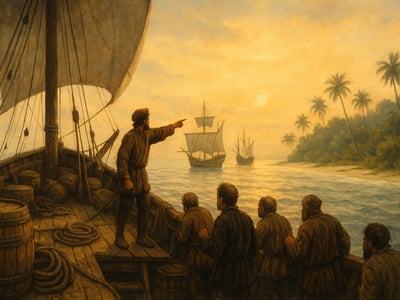
By October, the strain of the voyage had sharpened the importance of every sign. Floating vegetation, birds, and other indications of nearby land took on outsize meaning. Then, on October 12, Rodrigo de Triana, sailing on the Pinta, reported sighting land. Columbus recorded the landing that followed and named the island San Salvador. His account identifies the people encountered that day as inhabitants of islands in the Lucayan archipelago.
A reported shore, already inhabited
That distinction matters. The landing was not on an empty shore waiting to enter history. It was a meeting, however unevenly recorded, in a region already inhabited by Indigenous communities with their own societies, movements, and relationships across the islands. Most surviving written descriptions come from the expedition itself, especially from Columbus's perspective, so the event is documented through records created by the newcomers rather than by the islanders they encountered.
Even the place name most commonly associated with the landing carries layers of uncertainty. Columbus used the name San Salvador, but modern scholars have debated which present-day island corresponds to that record. Several candidates in the Bahamas have been proposed over time. The dispute does not change the broad fact of landfall in the Lucayan archipelago, but it does remind us that precise reconstruction depends on fragmentary evidence, navigational estimates, and later interpretation.
San Salvador, and what the landing set in motion
For Columbus and his backers, the immediate significance of the landing lay in what it seemed to confirm: that the westward voyage had reached islands across the ocean and opened the possibility of further claims, contacts, and expeditions. Columbus believed he had reached islands connected to Asia, not a previously unknown continent to Europeans. That misunderstanding shaped his descriptions and remained part of the language of the voyage itself.
The consequences that followed were much larger than the shipboard objective of finding land. What began as a risky crossing under royal contract became one of the key starting points for sustained Spanish activity in the Caribbean and, more broadly, for regular transatlantic connections between Europe and the Americas.
Why it still matters
The 1492 landfall remains historically important because it became part of the legal and administrative foundation for Spanish imperial expansion in the Atlantic world. The agreements made before the voyage and the records produced after it helped transform a single expedition into a continuing system of royal claims, governance, and maritime movement.
It also marks a major stage in the formation of sustained transatlantic routes. After this voyage, Atlantic crossings were no longer isolated possibilities. They became recurring links between ports, states, and empires. Those routes carried people, goods, information, and institutions in both directions, and they reshaped political geography far beyond the Caribbean.
The event is equally central to the study of demographic, ecological, and economic exchange between Afro-Eurasia and the Americas. Plants, animals, diseases, and labor systems moved across the ocean with profound effects. Historians often study the landing not as an endpoint but as an early moment in a vast process that transformed populations and environments on both sides of the Atlantic.
At the same time, the date remains sensitive because later colonial expansion brought conquest, dispossession, forced labor, and catastrophic demographic loss for Indigenous peoples. For that reason, careful historical writing distinguishes the documented landfall of October 12, 1492, from celebratory interpretations attached to it in later centuries. The event is significant not because it was simple, but because so much of the modern Atlantic world developed from what followed.
Timeline
- Capitulations of Santa Fe issued
- Columbus departs Palos de la Frontera
- Expedition departs La Gomera
- Columbus expedition reaches land in the Caribbean
What you uncovered
From Landfall to Empire
You didn't just… place a famous voyage on the timeline; you traced the moment when a shipboard success became a turning point in how states, routes, and peoples were drawn into lasting Atlantic contact.
For the crew, the immediate goal was simply to find land before uncertainty, distance, and supplies ran out. But once the landing was recorded, it could be turned into something larger: a claim, a route, and an administrative precedent for later imperial expansion. That gap between what happened on the ships and what institutions later built from it is part of why this date remains so historically significant. It also helps explain why historians study 1492 not only as a voyage, but as the beginning of sustained exchanges that reshaped populations, environments, and economies across the Atlantic.
According to the voyage record, Rodrigo de Triana on the Pinta reported sighting land on 1492-10-12 before Columbus recorded the landing on an island he named San Salvador.
FAQ
What happened on 12 October 1492?
On 12 October 1492, Christopher Columbus's expedition reached land in the Caribbean after crossing the Atlantic. Columbus recorded the landing on an island he named San Salvador.
Who first sighted land on Columbus's voyage?
Rodrigo de Triana, sailing on the Pinta, reported sighting land. Columbus then recorded the landing.
Where did Columbus land in 1492?
Columbus identified the landing site as an island he named San Salvador in the Lucayan archipelago. The exact modern location is still disputed, with candidates in the Bahamas.
What route did Columbus take before reaching land?
The voyage departed from Palos de la Frontera on 3 August 1492 with the Santa María, Pinta, and Niña. It left La Gomera in the Canary Islands on 6 September before continuing across the Atlantic.