
About this story
On 5 November 1605, officers found a cache of gunpowder under the House of Lords and arrested Guy Fawkes. The search followed a warning letter to Baron Monteagle. The plot, led by Robert Catesby, had aimed to blow up King James I and Parliament at the state opening. The attack did not happen.
Guy Fawkes and the foiled Gunpowder Plot at Westminster, 5 November 1605
On 5 November 1605, officials in London discovered a large cache of gunpowder hidden beneath the Palace of Westminster and arrested Guy Fawkes, the man found guarding it. The find stopped a plan to destroy the House of Lords at the State Opening of Parliament, an event expected to bring together King James I and much of England’s political leadership in one place. What later became one of the best-known episodes in British history began, at that moment, as a search prompted by a warning that might easily have been ignored.
A plot wider than one name
The conspiracy is usually remembered through the name of Guy Fawkes, but he was part of a wider group led by Robert Catesby. The plot emerged from the political and religious tensions of early Stuart England. James VI of Scotland had become James I of England in 1603, and some English Catholics had hoped that the new monarch would ease the penal laws and restrictions that shaped their lives. Those expectations were not met in the way some had wished. In that atmosphere, a small group of conspirators turned toward violent action.
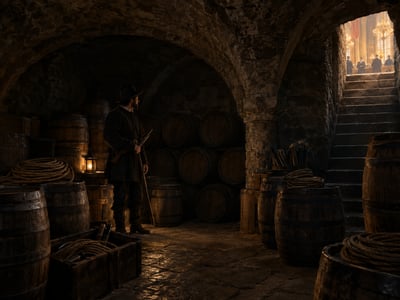
Their aim was not limited to the killing of a single official. The plan was to blow up the House of Lords during the royal opening of Parliament, destroying the king, lords, bishops, and leading officers of state at once. To do that, the conspirators needed to secure access to a place close enough to the chamber, move explosive material there without attracting notice, and wait for the appointed day. According to the evidence later uncovered, 36 barrels of gunpowder were concealed in an undercroft beneath the Lords.
For weeks, the plot remained hidden. Then, on 26 October 1605, William Parker, 4th Baron Monteagle, received an anonymous letter warning him to stay away from Parliament. The message was vague in some respects but clear in its central point: Parliament would be in danger, and absence would be wise. Monteagle passed the letter on, and it was reviewed by senior officials. Robert Cecil, Earl of Salisbury, was among those involved in assessing its meaning, and the warning was ultimately reported to the king.
A letter that changed the opening
The letter did not immediately reveal every detail of the conspiracy, but it changed the way the coming parliamentary opening was viewed. A ceremony that might have been treated as routine became the focus of heightened concern. James I is often credited in contemporary accounts with taking the threat seriously and interpreting the warning as pointing to an attempt involving explosives. Whether by intuition, experience, or caution, the authorities chose not to dismiss the message.
Searches of the Westminster precincts followed. On the night of 4-5 November, Sir Thomas Knyvet conducted a search of areas around the House of Lords. In the early hours, he found Fawkes in a cellar under the Lords. Fawkes was carrying matches and slow-burning fuses, practical items for someone preparing to ignite gunpowder rather than merely standing watch. A further inspection uncovered the hidden barrels.
Fawkes in the cellar
That discovery transformed suspicion into certainty. What had been a troubling anonymous warning was now a prevented attack. The planned opening of Parliament on 5 November 1605 did not become the scene of a mass killing. Instead, the government had in custody a key participant and physical evidence of the conspiracy itself.
The immediate next steps were urgent. Fawkes was arrested and questioned. At first he gave his name as John Johnson, presenting himself as a servant. The government, however, quickly understood that he was linked to something much larger. In the days that followed, the search widened to identify and capture the rest of the conspirators. Some died resisting arrest; others were taken, tried in January 1606, and executed under the penalties then attached to treason.
From arrest to an annual remembrance
The failed plot also had consequences beyond the courtroom. It reinforced official suspicion toward Catholics at a time when confessional identity was already politically charged. The state treated the event not only as a criminal conspiracy but as a threat to the entire political order. In 1606, Parliament passed the Observance of 5th November Act, establishing an annual day of thanksgiving. Over time, remembrance of the event entered public ritual, though the forms and meanings of that remembrance have changed across centuries.
The story has endured partly because of its stark structure: a hidden plan, a warning letter, a midnight search, and a narrow prevention. Yet its survival in memory also reflects how the English and later British state interpreted it. The discovery at Westminster was presented as both a security success and a providential escape, linking political authority, public ceremony, and collective remembrance.
Why it still matters
The Gunpowder Plot remains important because it shows how states respond when a threat is detected before violence occurs. The authorities did not uncover the conspiracy by chance alone. A warning moved through aristocratic, court, and government channels; it was evaluated; then officials acted by ordering searches at a highly sensitive political site. In that sense, the episode is an early and influential example of preventive security around a legislature, a head of state, and a ceremonial gathering.
It also continues to serve as a reference point for the interpretation of anonymous warnings and conspiracies. The Monteagle letter was ambiguous enough to raise doubts, but serious enough to demand attention. The decision to investigate rather than wait proved decisive. That pattern—receiving uncertain intelligence, judging credibility, and acting before the intended event—remains familiar in later security practice.
Finally, the plot still matters because failed political violence can shape public memory as strongly as successful acts. In Britain, 5 November became an annual date of remembrance, showing how an averted attack can be woven into civic ritual and national storytelling. The meaning of that remembrance has never been entirely fixed, but the events at Westminster in 1605 continue to illustrate how danger, government response, and memory can become closely linked in public life.
Timeline
- James I accedes to the English throne
- Monteagle receives the warning letter
- Search of the House of Lords cellars
- Gunpowder Plot discovered under Westminster
- Plotters tried and executed
What you uncovered
A Warning Becomes Policy
You didn't just… identify a failed conspiracy; you traced the moment when a hidden threat was turned into a state response before it reached Parliament.
What stands out is not only the plot itself, but the path from private warning to official action. The Monteagle letter passed through elite networks, was weighed by advisers, and helped justify a search before any attack occurred. That sequence still feels familiar: states often rely on fragmentary signals, then decide whether to treat them as noise, panic, or credible danger. The Gunpowder Plot endures partly because it shows how prevention becomes part of political power and public memory.
Authorities reported finding 36 barrels of gunpowder hidden in the Westminster undercroft on 5 November 1605.
FAQ
What was the Gunpowder Plot of 1605?
It was a conspiracy to blow up the House of Lords during the State Opening of Parliament on 5 November 1605. The aim was to kill King James I and members of the political leadership.
Why was Guy Fawkes in the cellar under Parliament?
Guy Fawkes was guarding the explosives that had been stored beneath the Palace of Westminster. He was found in a cellar under the House of Lords in the early hours of 5 November 1605.
How was the Gunpowder Plot discovered?
William Parker, 4th Baron Monteagle, received an anonymous warning letter on 26 October 1605, and the message was reported to King James I. Sir Thomas Knyvet then searched the Palace of Westminster on the night of 4-5 November 1605 and found Guy Fawkes with the gunpowder.
What did authorities find at Westminster on 5 November 1605?
They discovered 36 barrels of gunpowder concealed in the undercroft at Westminster. Guy Fawkes was arrested there with matches and slow-burning fuses.