

About this story
On 16 September 1992 the UK suspended sterling’s ERM membership after a day of intervention and emergency rate rises, an event known as Black Wednesday. Prime Minister John Major and Chancellor Norman Lamont failed to hold the Deutsche Mark band. The 15 percent rate was not put into effect.
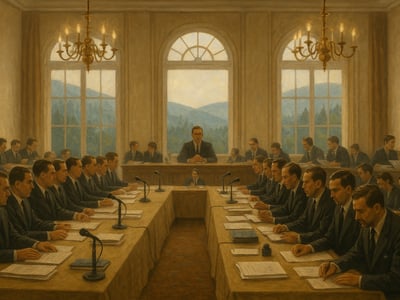
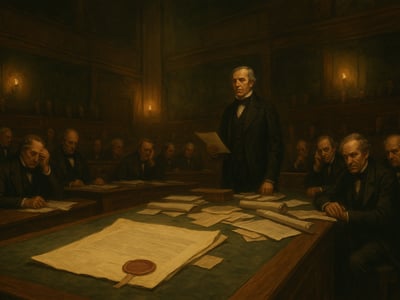
Sterling is suspended from the ERM after emergency action in London, 16 September 1992
On 16 September 1992, the United Kingdom suspended sterling’s participation in the European Exchange Rate Mechanism, ending a dramatic day of market pressure, emergency announcements, and official intervention. The event quickly became known as Black Wednesday. At its center was a simple but difficult commitment: the government had promised to keep sterling trading within an agreed band against other European currencies, especially the Deutsche Mark, but by that September many investors doubted that pledge could still be maintained.
A currency band under strain
The ERM was designed to reduce exchange-rate instability among participating European currencies. When Britain joined on 8 October 1990, it accepted a central rate for sterling against the Deutsche Mark and agreed to keep the currency within specified limits. In principle, this system was meant to encourage stability and support broader European monetary cooperation. In practice, it required national governments and central banks to defend their currencies when market pressure pushed them toward the edge of the band.
By 1992, that defense had become much harder. European currencies were under strain, and Germany’s economic position after reunification had helped keep German interest rates high. For the United Kingdom, this created a difficult mismatch. British economic conditions did not necessarily favor the same level of tight monetary policy, yet membership in the ERM tied sterling to a framework in which confidence had to be sustained against the Deutsche Mark. If markets concluded that sterling was overvalued or that the government lacked the will to maintain the exchange rate, they had every incentive to sell.
That pressure came to a head in London on 16 September. The Bank of England intervened in foreign-exchange markets, using reserves to buy sterling in an attempt to support its price. At the same time, ministers faced a public test of resolve. John Major was prime minister, and Norman Lamont, the chancellor, became the public face of the government’s response as events unfolded.
Intervention and emergency rates
During the day, Lamont announced that UK interest rates would rise from 10 percent to 12 percent. The logic was clear enough: higher interest rates could make holding sterling more attractive and show that the government was serious about defending the currency. But the announcement did not settle markets. Selling pressure continued, and confidence remained weak.
Later that same day, the government announced a further rise to 15 percent. Even by the standards of a crisis, this was a striking signal. It suggested that ministers were willing to impose a very sharp tightening of policy in order to preserve the exchange-rate commitment. Yet the announcement also revealed the scale of the problem. If such extraordinary steps were necessary merely to hold the line for a few more hours, many participants could reasonably conclude that the policy was nearing its limit.
Markets refuse the pledge
This is one reason Black Wednesday has remained so closely studied. Currency crises are not decided only by the amount of money a central bank can spend or by the number attached to a policy rate. They also depend on expectations. Once enough traders believe that a government’s position is unsustainable, defending a fixed or semi-fixed exchange rate can become extremely costly. Intervention may slow the move, and rate announcements may buy time, but they do not always reverse judgment in the market.
George Soros is often mentioned in accounts of the day because his funds were among those that bet against sterling, and later retellings sometimes present the event through the actions of a single famous investor. But that framing can oversimplify what happened. The crisis involved broad market selling, structural tensions within the ERM, and policy choices made over many months. No individual created those underlying conditions, even if some profited from recognizing them sooner than others.
By the evening of 16 September, the British government conceded that the defense had failed. Sterling would be suspended from the ERM. The second announced interest-rate increase, to 15 percent, was not ultimately put into effect. What had begun as an effort to demonstrate firmness ended as a visible reversal under pressure.
Exit from the ERM
The political and reputational damage was immediate. A government that had presented ERM membership as a framework for discipline and stability had lost control of the policy in full public view. The embarrassment was sharpened by the speed of the day’s developments: intervention, one rate announcement, then another, and finally withdrawal. The sequence made the retreat look not gradual or managed, but forced.
At the same time, the event did not end with that evening’s announcement. Once outside the ERM, the United Kingdom had greater room to set monetary policy according to domestic conditions. In later years, Black Wednesday was revisited not only as a failure of exchange-rate defense but also as a turning point in how British policymakers thought about inflation, credibility, and the practical limits of pegged currency systems.
Why it still matters
Black Wednesday remains important because it offers a clear case study of how exchange-rate pegs can break when market expectations, domestic economic needs, and international interest-rate conditions pull in different directions. For students of economic history, it is a vivid example of the limits of official intervention when credibility begins to weaken.
It also continues to matter in debates about central banking. The episode showed that announcing tougher measures is not always enough if markets believe the underlying policy stance is inconsistent or politically unsustainable. That lesson reaches beyond the ERM itself and applies to broader questions about how governments defend exchange rates, manage inflation, and communicate policy in moments of stress.
Finally, the crisis shaped later discussion of European monetary integration and Britain’s place within it. For some, Black Wednesday exposed the difficulty of fitting the UK economy into a shared exchange-rate framework. For others, it illustrated the strain involved in trying to maintain monetary commitments across countries facing different economic conditions. Either way, the events of 16 September 1992 became a lasting reference point in modern British and European financial history.
Timeline
- United Kingdom joins the ERM
- Bank of England intervenes; rates rise to 12 percent
- Further rise to 15 percent announced
- Sterling suspended from the ERM
What you uncovered
When a Peg Stops Holding
You didn't just… complete a puzzle; you traced the moment a government discovered that policy announcements and market confidence do not always move together.
This episode is often remembered as a dramatic trading day, but its deeper lesson is structural rather than theatrical. A fixed exchange-rate commitment is hard to sustain when domestic economic needs, international interest-rate conditions, and investor expectations are pulling in different directions. In that setting, intervention can buy time, yet it may also expose how little room policymakers really have. That is why the event still matters in debates about credibility, central bank action, and exchange-rate design.
The announced second interest-rate increase to 15 percent on 16 September 1992 was never actually implemented.
FAQ
What happened on 16 September 1992?
On 16 September 1992, the United Kingdom suspended sterling’s participation in the European Exchange Rate Mechanism. Earlier that day, officials had announced interest-rate increases and the Bank of England carried out intervention operations from London.
Why was sterling suspended from the ERM?
Sterling came under heavy selling, and the government and the Bank of England were unable to keep it within its ERM trading band. The intervention and same-day rate announcements did not restore confidence.
Who was in charge during the crisis?
John Major was Prime Minister of the United Kingdom on 16 September 1992. Norman Lamont, as Chancellor, announced the interest-rate changes, while the Bank of England conducted intervention operations in London.
What interest-rate changes were announced that day?
Norman Lamont first announced that UK interest rates would rise from 10 percent to 12 percent. Later on 16 September 1992, a further rise to 15 percent was announced, but that second increase was not ultimately put into effect.