
About this story
On 6 November 1860, Abraham Lincoln won the U.S. presidency with 180 electoral votes and carried no slaveholding state. The Republican victory, in a four-way race after the Democratic split, was lawful and still rejected by many white Southern leaders. South Carolina’s secession convention followed on 20 December.
Abraham Lincoln's election in the United States on November 6, 1860
On November 6, 1860, voters in the United States chose Abraham Lincoln of Illinois as president in one of the most consequential elections in the country's history. His victory was lawful and decisive in the Electoral College, yet it came in a political system already strained by sectional conflict over slavery, especially the question of whether slavery would expand into the western territories. Within weeks of the result, South Carolina took formal steps toward secession, making the election a turning point between political crisis and open national rupture.
A nomination, not a long-held crown
Lincoln did not arrive at the presidency as a long-established national favorite. Earlier in 1860, the Republican Party met in Chicago for its national convention, and on May 18 delegates nominated him for president. He was less nationally prominent than some rivals within his own party, but he had become widely known after his debates with Stephen A. Douglas in Illinois two years earlier. Republicans presented Lincoln as a candidate who opposed the expansion of slavery into the territories while stopping short of calling for immediate federal abolition where slavery already existed. That position did not settle the country's central dispute, but it defined the party's appeal across much of the North.
The election took shape amid a breakdown of older national coalitions. For years, major parties had attempted to hold together voters from both free and slaveholding states. By 1860, that balance had become much harder to maintain. The Democratic Party split, and the break exposed how deeply national politics had fractured along sectional lines. Stephen A. Douglas, who had argued for popular sovereignty in the territories, became the nominee of Northern Democrats after the Baltimore convention in June. Southern Democrats, dissatisfied with that path, backed John C. Breckinridge. A fourth candidate, John Bell of the Constitutional Union Party, appealed mainly to voters who hoped to preserve the Union by avoiding the most divisive questions.
Four campaigns and one argument about slavery
This four-way contest did not simply offer voters a range of personalities. It represented incompatible political formulas for holding the country together. At the center was slavery: whether it could expand, whether Congress or settlers would decide its status in the territories, and whether Southern political leaders could remain within a Union where a president might be elected without their region's support. The constitutional process for choosing a president was intact. Confidence that all sides would accept its result was not.
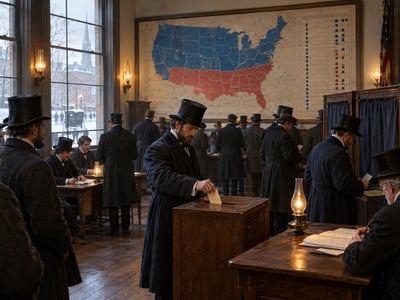
When ballots were cast on November 6, Lincoln benefited from a map transformed by sectional politics. He won enough Northern states to secure a majority in the Electoral College even though he carried no slaveholding state. In the certified result, he received 180 electoral votes, ahead of Breckinridge, Bell, and Douglas. His popular vote total was not a national majority, but under the constitutional system it did not need to be. The distribution of support mattered more than its total share. A candidate with concentrated strength in the more populous free states could win the presidency without broad support in the South.
180 electoral votes and no slaveholding state
That feature of the election made Lincoln's victory especially alarming to many white Southerners who already believed their political influence was weakening within the Union. To them, the result suggested that a sectional president could now govern without their consent. Those fears were tied directly to slavery, which underpinned the economy and social order of the slaveholding states. Although Lincoln repeatedly stated that he would not interfere with slavery where it already existed, many Southern leaders regarded the Republican program against its expansion as a threat to slavery's long-term future and therefore to their political and economic system.
In Springfield, Illinois, Lincoln received the news of his election as president-elect, while in Washington, D.C., officeholders and politicians began to reckon with the consequences. The period between election and inauguration was especially dangerous. Lincoln would not take office until March 1861, leaving months in which a lame-duck administration faced a mounting constitutional crisis. During that winter, arguments over union, state sovereignty, federal authority, and the future of slavery moved from speeches and party platforms toward acts of secession.
The months before the oath
The first decisive break came quickly. On December 20, 1860, a convention in Charleston adopted South Carolina's Ordinance of Secession. Other slaveholding states would follow. The election itself did not create the sectional conflict from nothing; that conflict had been building for decades through disputes over slavery, territorial expansion, congressional balance, and the meaning of the Constitution. But the election converted those tensions into an immediate test of whether the Union's political framework could survive a result that one section accepted and another increasingly rejected.
It is important to see the election both as a contest of rules and as a crisis of legitimacy. The rules functioned: parties nominated candidates, voters cast ballots, states appointed electors, and a winner emerged. Yet constitutional procedure alone could not guarantee political consent. Lincoln's victory demonstrated that a candidate could gain the presidency through lawful means while still facing outright resistance from states and elites unwilling to accept what that result implied.
Why it still matters
The election of 1860 remains a central example of how democratic systems can intensify regional divisions instead of softening them. Electoral rules translated a fractured national vote into a clear presidential victory, but they did not resolve the underlying conflict that had organized the campaign. For historians, the episode is a reminder that institutions may function formally even while public trust across major sections of a country is collapsing.
It also matters because it sits at the intersection of election law, constitutional government, and the origins of the American Civil War. The months after November 1860 show how a lawful transfer of executive power can be endangered when political actors deny the legitimacy of the outcome. Studying this election helps explain not only Lincoln's rise, but also how secession emerged from a crisis in which slavery was the central issue and the presidency became the immediate trigger.
Lincoln's election did not settle the nation's argument. Instead, it exposed how little common ground remained between rival sections of the United States. That is why November 6, 1860, is remembered not only as an election day, but as the opening of the secession winter that led to civil war.
Timeline
- Republicans nominate Lincoln in Chicago
- Democratic Party convention
- Abraham Lincoln wins the presidential election
- South Carolina adopts an ordinance of secession
- Lincoln's first inauguration
What you uncovered
When Victory Was Not Enough
You didn't just… reconstruct an election result; you traced a moment when constitutional procedure continued even as political consent across the country was breaking down.
Lincoln's victory was legally clear, but legality alone did not settle whether the result would be accepted across rival sections of the country. The 1860 election shows how electoral systems can convert regional strength into national power while leaving deep parts of the electorate feeling unrepresented. That gap between formal rules and shared political legitimacy helps explain why an ordinary constitutional process was followed by disunion rather than stability.
Lincoln received 180 electoral votes in the certified 1860 result, while John C. Breckinridge, John Bell, and Stephen A. Douglas finished behind him.
FAQ
What happened in the United States on 1860-11-06?
On 1860-11-06, the United States held its presidential election, and Abraham Lincoln was chosen as president. He was the Republican nominee in a four-way contest marked by deep sectional divisions over slavery.
Why was Abraham Lincoln's 1860 victory unusual?
Lincoln won the presidency with 180 electoral votes even though he carried no slaveholding state. The certified result came from a split field that included Stephen A. Douglas, John C. Breckinridge, and John Bell.
Why was the 1860 election split among four major candidates?
The Democratic Party split in 1860, with Stephen A. Douglas nominated in Baltimore in June and John C. Breckinridge later nominated by Southern Democrats. The campaign was shaped by disagreements over slavery in the territories.
What happened after Lincoln was elected president?
Within weeks, South Carolina acted on secession. On 1860-12-20, a convention in Charleston adopted an Ordinance of Secession.