
About this story
On 4 September 476 at Ravenna, Odoacer deposed Romulus Augustus, the western emperor raised only months earlier by his father Orestes. Later writers often treat the date as the end of the Western Roman Empire, yet Julius Nepos still claimed the western title from Dalmatia and the eastern emperor Zeno remained at Constantinople. The event marked a real shift in Italy more than a single tidy collapse.
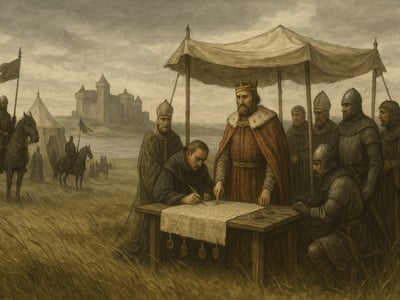
Transfer of power at Ravenna in 476, when Odoacer deposed Romulus Augustus.
On September 4, 476, at Ravenna in Italy, Odoacer removed Romulus Augustus from the western imperial position. Later generations would often treat that date as the end of the Western Roman Empire. Yet even at the time, the meaning of the event was less simple than a single dramatic fall, because imperial authority in the late fifth century was already divided by rival claims, military power, and regional realities.
A short-lived emperor in a shrinking West
Romulus Augustus had come to office only months earlier. On October 31, 475, he was elevated as western emperor by his father Orestes. That alone says much about the condition of western rule. Emperors in this period were often made and unmade by military commanders, and formal legitimacy depended not only on ceremony or title but also on whether armies, officials, and other rulers accepted a claimant's position. In the western provinces, central authority had weakened over decades, and Italy itself had become the core of a shrinking imperial structure.
Ravenna, the city where Romulus Augustus was deposed, had long served as an imperial capital in the West. Its defensible position had made it a practical seat of government, but by 476 the old image of Roman command no longer matched political reality. The western court still used Roman institutions and titles, yet its ability to control events had narrowed. Power depended heavily on armed forces in Italy, including federate troops whose expectations for reward and settlement could not easily be ignored.
Orestes falls at Placentia
The immediate crisis grew out of that military situation. Orestes, the dominant figure behind his son's rule, faced pressure from troops in Italy. Out of this unrest emerged Odoacer, a military leader who became the focus of revolt. On August 28, 476, he defeated and killed Orestes at Placentia. That victory removed the man who had placed Romulus Augustus on the throne and left the young emperor exposed.
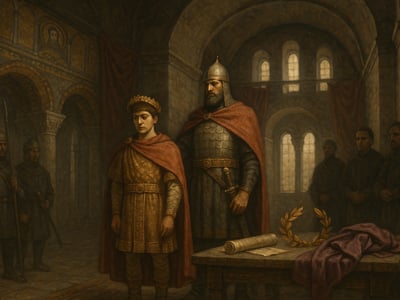
A week later, Odoacer entered Ravenna and deposed Romulus Augustus. Sources do not present the episode primarily as a grand sack or final destruction of Roman institutions. Instead, it was a transfer of power within a world where imperial office had already become unstable. Odoacer chose not to maintain the existing western imperial arrangement under Romulus Augustus. That decision mattered because it shifted the political framework in Italy away from having a separate western emperor in Ravenna.
Deposition at Ravenna, not a sudden vanishing
The deposition also did not settle every question of legitimacy. In 476, the eastern emperor Zeno remained the recognized senior Roman emperor at Constantinople. Meanwhile Julius Nepos, who had earlier held the western imperial title, continued to claim that office from Dalmatia after September 4, 476, and did so until 480. That meant the western empire did not simply vanish in legal terms on one afternoon at Ravenna. There was still an emperor in the East, and there was still a western claimant acknowledged in some contexts.
This is one reason historians handle the date with both confidence and caution. Confidence comes from its usefulness. September 4, 476 offers a clear marker for a major political change: after the deposition of Romulus Augustus, Italy was ruled by Odoacer without a resident western emperor at Ravenna. Caution comes from the overlap of institutions and claims. Roman law, Roman titles, and Roman administrative habits did not disappear overnight. Nor did contemporaries all agree that one neat boundary had been crossed.
Nepos, Zeno, and the problem of a single end-date
Odoacer's position after the deposition illustrates that complexity. He ruled Italy, but not as a self-proclaimed replacement emperor in the western line. His authority rested on military success and practical control, while the broader Roman world still included the court at Constantinople. The political map of late antiquity was being reorganized, but it was reorganized through adaptation as much as through abrupt collapse.
The fame of Romulus Augustus also owes something to symbolism. His name linked the legendary founder of Rome, Romulus, with Augustus, the title of the first Roman emperor. That coincidence made later writers especially willing to treat his removal as a fitting endpoint for the western imperial story. But symbolism should not obscure chronology. Romulus Augustus himself had ruled only briefly, and the larger transformation of the Roman world had been underway for a long time before his deposition.
Why it still matters
The date remains important because it gives historians and students a shared point of reference. In textbooks and survey histories, 476 often serves as a conventional boundary between the ancient Roman world and the political formations that followed in western Europe. Such boundaries are useful, even when reality is more gradual than the date suggests.
The event also helps explain how late Roman politics worked. Legitimacy, military command, and territorial rule did not always line up neatly. A boy could be emperor because his father had the army. A military leader could depose that emperor without claiming the same title. An eastern emperor at Constantinople could remain the senior Roman ruler while a western claimant, Julius Nepos, continued to assert his rights elsewhere. The system was not simply ending; it was fragmenting and being reconfigured.
Finally, the deposition is a reminder that historical period labels are tools, not natural laws. Calling 476 the end of the Western Roman Empire is not wrong, but it is a simplification. It captures one decisive shift in Italy while leaving out the continued life of Roman institutions and the unresolved question of western legitimacy after Romulus Augustus was removed.
That is why September 4, 476 has endured in historical memory. It marks a real turning point at Ravenna, but also invites a more careful view of how empires change: not always in one moment, and rarely in a way that fits perfectly into a single date.
Timeline
- Orestes elevates Romulus Augustus as western emperor
- Odoacer defeats and kills Orestes at Placentia
- Odoacer deposes Romulus Augustus at Ravenna
- Julius Nepos continues a western claim from Dalmatia until 480
What you uncovered
A Date and a Transition
You didn't just… complete a puzzle; you traced a moment that later historians turned into a clear boundary even though power and legitimacy remained contested after it.
476 is memorable partly because it gives history a clean dividing line, but the politics of the time were less tidy. Romulus Augustus was removed, yet imperial authority did not simply vanish in a single stroke, because other claims and Roman structures persisted. That is why the date works so well in surveys: it marks a shift in how rule in the West was organized, even if the legal and political reality remained layered.
After Romulus Augustus was deposed, Julius Nepos continued to claim the western imperial title from Dalmatia until 480.
FAQ
What happened on 4 September 476 in Ravenna?
On 4 September 476, Odoacer deposed Romulus Augustus at Ravenna in Italy. Romulus Augustus had been the western emperor, and the event took place in the former Western Roman imperial capital.
Who was Romulus Augustus?
Romulus Augustus was the western Roman emperor in a period of competing claims to imperial authority. He had been elevated by his father Orestes on 31 October 475.
Who was Odoacer in this event?
Odoacer was the military leader who defeated and killed Orestes at Placentia on 28 August 476 and then deposed Romulus Augustus at Ravenna. He took power in Italy after the deposition.
Why is 476 often treated as the end of the Western Roman Empire?
The date is commonly used as the endpoint of the Western Roman Empire because Romulus Augustus was removed from office at Ravenna. It remains a conventional historical marker, even though Julius Nepos continued to claim the western imperial title afterward.
Did the Roman Empire continue after Romulus Augustus was deposed?
Yes. In 476, the eastern emperor Zeno remained the recognized senior Roman emperor at Constantinople. Julius Nepos also continued to claim the western imperial title from Dalmatia until 480.