
About this story
On 4 November 1922, Howard Carter’s team uncovered a cut step in the Valley of the Kings, the first sign of Tutankhamun’s tomb. Carter wired Lord Carnarvon the next day. The sealed doorway, a first look into the antechamber, and the burial chamber followed over the next months, as a recorded dig rather than one sudden reveal.
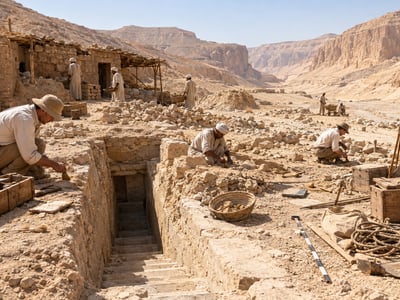
Valley of the Kings excavation linked to the first step found above Tutankhamun’s tomb in 1922.
On 4 November 1922, a work team led by Howard Carter uncovered a cut step in the Valley of the Kings near Luxor, Egypt. It was not yet the opening of a glittering treasure chamber, nor even certain proof of an intact royal burial. But the step, cut into the rock and buried beneath debris and the remains of old workmen’s huts, pointed to something archaeologists had long hoped for and often failed to find: a tomb entrance that had escaped full detection in one of the most intensively searched royal cemeteries in the world.
A step under the workmen’s huts
The discovery took place in a landscape already dense with history. The Valley of the Kings, on the west bank of the Nile opposite modern Luxor, had served as a burial ground for New Kingdom pharaohs and elites. By the early twentieth century, many of its major tombs were known, and some archaeologists believed little of importance remained to be found there. Carter, however, was convinced that the tomb of Tutankhamun, a relatively obscure pharaoh of the late Eighteenth Dynasty, had not yet been properly identified.
Carter did not work alone. His excavation seasons were financed by George Herbert, the 5th Earl of Carnarvon, whose support made it possible to continue searching after years of uncertain results. The work also depended on Egyptian labor and on the administrative framework governing antiquities and excavation permits in Egypt. By 1922, Carter had already spent several seasons pursuing evidence in the valley, narrowing his search to areas others had overlooked or considered exhausted.
That context helps explain why the first step mattered so much. The obstacle was not only physical, in the form of rubble and older structures, but also intellectual. The valley had been excavated repeatedly. Any remaining find would likely be hidden in plain sight, masked by later activity and by assumptions about where a tomb could still be. When Carter’s team began to clear the area on 4 November, they revealed the top of a stairway descending into the ground. It was enough to justify caution, but not enough to settle the matter.
A sponsor, a permit, and a telegram
Carter chose not to force a dramatic opening. Instead, he continued careful clearing and moved toward formal notification. On 5 November 1922, he sent a telegram to Lord Carnarvon reporting the discovery of what he described as a sealed tomb. That decision is an important part of the story. Popular memory often compresses archaeological finds into a single instant of revelation, but Carter’s actions show a slower sequence: identify, clear, inspect seals, wait for the excavation’s sponsor, and proceed under observation.
Over the following weeks, the team cleared the stairway further. On 24 November 1922, they uncovered the sealed doorway at its foot. The doorway bore signs linking it to a royal necropolis, though there were also indications that the tomb had been entered in antiquity and resealed. That raised a new uncertainty. Even if the tomb belonged to Tutankhamun, would anything remain inside? Tomb robbery had affected many burials in the valley, and a sealed entrance did not guarantee an untouched interior.
Doorways, resealing, and a first look
Carnarvon came to Egypt, accompanied by his daughter, Lady Evelyn Herbert. With the sponsor present, Carter continued the formal process of access. On 26 November 1922, he made a small opening through a second sealed doorway leading into the tomb’s antechamber. This was the moment later made famous by his first view into the darkness beyond. Yet even here, the event was less a single triumph than the beginning of a longer task. The chamber contained a dense assemblage of objects that had to be recorded, protected, and eventually removed with great care.
The tomb later identified as Tutankhamun’s proved extraordinary not because it had remained perfectly untouched, but because of the scale and condition of what survived. Furniture, chariots, ritual objects, containers, and other grave goods offered an unusually rich record of royal burial equipment from ancient Egypt. The find quickly drew international attention, and press coverage turned Tutankhamun into one of the most recognizable names in archaeology.
Months between the step and the burial chamber
Still, the process did not end with Carter’s first look into the antechamber. The burial chamber itself was formally opened only on 16 February 1923, more than three months after the first step had been found. That gap is historically important. It reminds us that excavation is not simply discovery but also clearance, documentation, conservation, and negotiation with institutions responsible for antiquities. The tomb’s contents could not be understood in a single glance. They had to be mapped, photographed, catalogued, stabilized, and interpreted.
This slower chronology also keeps attention on the wider system around the excavation. Egyptian authorities regulated access to ancient sites, and the administration of antiquities shaped what foreign-led excavations could do. Modern discussion of Tutankhamun’s tomb often includes questions of ownership, control, and representation in colonial-era archaeology. Those questions do not erase the importance of the 1922 discovery, but they do place it in a fuller historical setting that includes Egyptian institutions and workers as well as famous European names.
Why it still matters
The discovery of the entrance to Tutankhamun’s tomb remains one of the best-known archaeological moments in modern history, but its importance goes beyond fame. It is a reference point for how archaeologists think about excavation as a staged and documented process. From the first cut step to the formal opening of the burial chamber, the sequence shows the importance of patience, recording, and conservation rather than hurried extraction.
It also shaped public understanding of ancient Egypt. Museum exhibitions, popular books, photography, and later film and television all drew on the visual power of the tomb and its contents. For many people around the world, Tutankhamun became an entry point into Egyptology and into broader interest in ancient material culture.
At the same time, the discovery is used today to examine the structures of archaeology in the early twentieth century: who financed excavations, who granted permits, who performed the labor, and who controlled the movement and interpretation of objects. In that sense, 4 November 1922 is remembered not only because something remarkable was found, but because the find still helps explain how archaeology works, how it was once organized, and why its methods and institutions continue to be debated.
What began as a single cut step in the dust of the Valley of the Kings became a long historical record in its own right. The entrance to Tutankhamun’s tomb was not merely uncovered; it was observed, cleared, documented, and gradually opened. That sequence is part of why the event endures: it reveals discovery not as a flash of certainty, but as careful work carried out over time.
Timeline
- First cut step found in the Valley of the Kings
- Carter telegrams Lord Carnarvon about the sealed tomb
- Sealed doorway uncovered after clearing
- Small opening made into the second doorway
- Burial chamber formally opened
What you uncovered
More Than a Single Discovery
You didn't just… complete a puzzle about a famous tomb discovery; you retraced the first step in a long process of clearing, checking, and documenting what lay behind it.
Tutankhamun’s tomb is often remembered as a sudden breakthrough, but the timeline shows something slower and more procedural. Between the first cut step and the later chamber openings came clearance, inspection, communication, and formal access. That sequence helps explain why the discovery still matters to archaeology: not only for what was found, but for how excavation, record-keeping, and authority shaped the find. It also reminds us that archaeology in 1920s Egypt depended on permits, funding, and institutions as much as on dramatic moments in the field.
Howard Carter sent Lord Carnarvon a telegram on 5 November 1922 to report that a sealed tomb had been found.
FAQ
What was discovered on 4 November 1922 in the Valley of the Kings?
Howard Carter’s team found the first cut step of a stairway buried in the Valley of the Kings near Luxor, Egypt. It indicated the entrance to a tomb later identified as Tutankhamun’s.
Who financed Howard Carter’s excavation?
The excavation was funded by George Herbert, 5th Earl of Carnarvon. His support made Carter’s work in the Valley of the Kings possible.
When did Howard Carter first look inside Tutankhamun’s tomb?
On 26 November 1922, Howard Carter made a small opening through the second sealed doorway and looked into the antechamber. The burial chamber itself was formally opened later, on 16 February 1923.
Why did the discovery become so widely known?
The find led to a documented sequence of clearing, sealing inspection, and chamber entry, and it revealed a largely intact royal burial. It became a major reference point for archaeology and public interest in ancient Egypt.