
About this story
On 1 August 1834, the Slavery Abolition Act 1833 took effect in most British slave colonies, ending slavery as a legal status for many people. Emancipation arrived with apprenticeship rules and compensation for owners, not simple immediate freedom.
1 August 1834: the Slavery Abolition Act took effect across many British colonies
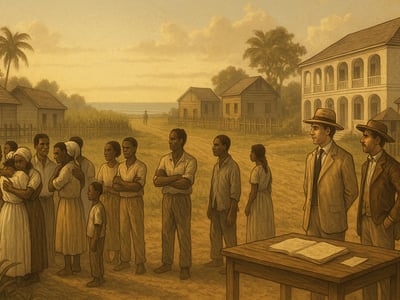
On August 1, 1834, one of the most consequential laws in the history of the British Empire moved from statute to lived reality. The Slavery Abolition Act 1833 came into force in most British slave colonies, especially in the Caribbean, as well as in Mauritius and the Cape. For many enslaved people, that date marked the end of slavery as a legal status. Yet it did not bring simple or immediate freedom. Instead, emancipation was introduced through a system shaped by compromise, colonial administration, and continued labor control.
From statute to force
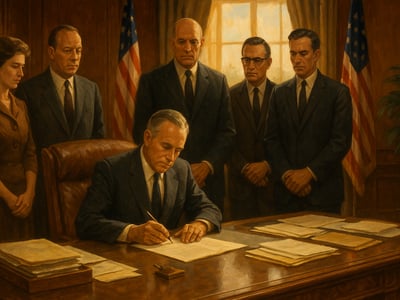
The act had been passed by Parliament on August 28, 1833, and received royal assent during the reign of King William IV. It represented a major shift in British law. For decades, abolitionists had pressed the British state to move beyond the 1807 abolition of the slave trade and confront slavery itself. Campaigners including William Wilberforce and Thomas Fowell Buxton were central to that political effort, which unfolded alongside resistance by enslaved people in the colonies and growing public debate in Britain.
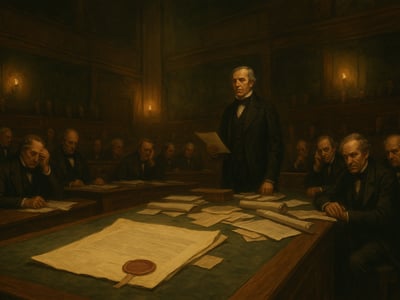
By the early 1830s, it had become harder for the imperial government to maintain a distinction between condemning the trade in enslaved people and preserving slavery in the colonies. Events in the Caribbean, including the Baptist War in Jamaica in 1831–1832, underscored the instability and violence of the slave system. At Westminster, lawmakers faced pressure to legislate, but they did so through a framework designed not only to end legal slavery but also to preserve order, protect property claims recognized by the state, and manage the transition of labor.
Apprenticeship, not free labor
That framework mattered greatly. The 1833 act did not simply declare universal and immediate equality. It paired emancipation with a large compensation scheme for slave owners, acknowledging their financial claims while offering no direct compensation to the formerly enslaved for lifetimes of forced labor. It also created the apprenticeship system, which would shape daily life after August 1, 1834 for many of those who had just been legally emancipated.
Under apprenticeship, many formerly enslaved people were required to continue working for their former owners for a set portion of their time. In theory, the system was presented as a transitional measure between slavery and full freedom. In practice, it preserved many coercive features of plantation life. Work discipline remained strict, movement could still be constrained, and disputes were often judged within colonial systems that had long favored planter authority. Questions that freedom might have settled—where a person could go, how they could use their labor, whether families could control their own time—remained contested.
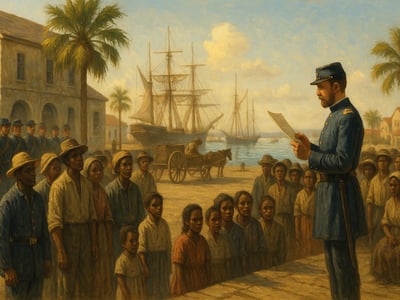
This made August 1 a day of both legal transformation and uncertainty. In colonies such as Jamaica, Barbados, British Guiana, and Trinidad, emancipation was filtered through local officials, magistrates, and plantation managers. The experience of the law therefore varied from place to place. Some people marked the moment with religious services, gatherings, and public expressions of relief or hope. But the meaning of legal freedom depended on how rules were enforced on the ground, and on whether colonial power would permit real independence in work and family life.
Uneven imperial geography
The structure of the act also revealed the uneven geography of imperial reform. Not all parts of the British Empire were included in the implementation of August 1, 1834. Territories administered by the East India Company, along with Ceylon and Saint Helena, were excluded from that initial application. That fact is important because it shows that abolition in the empire was not a single, uniform event. It was a legal process with exceptions, delays, and different administrative pathways.
The tension at the center of the act was therefore clear. Parliament had ended slavery in law across much of the empire, but it had done so in a way that sought to reassure colonial interests and regulate the labor of the newly freed. The state presented emancipation as a moral and political achievement, yet the terms of that achievement were shaped by compromise. The result was a major legal break with slavery, but not a clean break from coercion.
Pressure against apprenticeship
Over the next several years, criticism of apprenticeship grew. Formerly enslaved people challenged its restrictions, and observers increasingly questioned whether a system that compelled labor under threat of punishment could truly be separated from slavery. In the British colonies, apprenticeship ended in 1838, earlier than the full transition originally contemplated by the law. That later change helped clarify what many had already understood in 1834: ending the legal category of slavery was only one stage in a much longer struggle over labor, rights, and power.
Why it still matters
The events of August 1, 1834 remain important because they show that abolition was not just a moral declaration but an administrative and political process. The British state used legislation to end slavery, but it also used law to shape the conditions under which freedom would be lived. Compensation, colonial enforcement, and apprenticeship were not side issues; they were built into emancipation itself.
This history also helps explain why formal legal change does not automatically produce equal conditions in everyday life. In the British Empire, the end of slavery required decisions about labor, movement, wages, punishment, and family autonomy. Those decisions were made within institutions that had long upheld enslavement. Studying the act and its implementation therefore sheds light on the limits of legal reform when old power structures remain in place.
For historians, the start of emancipation in 1834 is a central moment in the study of empire, citizenship, and labor transition. For the public, it remains a reminder that the meaning of freedom is shaped not only by laws passed in capitals such as London, but also by the local systems that enforce, narrow, or expand those laws in practice.
Timeline
- Abolition of the slave trade in the British Empire
- Baptist War in Jamaica
- Slavery Abolition Act 1833 receives royal assent
- Slavery Abolition Act takes effect in most British colonies
- End of apprenticeship in British colonies
What you uncovered
Freedom Within Constraint
You didn't just… complete a puzzle; you traced a moment when legal emancipation arrived, but many newly freed people were still bound by rules that shaped their work, movement, and daily choices.
This is part of why 1 August 1834 is both a landmark and a limit in the history of abolition. The law ended slavery's legal status for many people, yet the apprenticeship system shows how imperial governments tried to manage freedom without surrendering control over labor. That tension still matters because it helps explain why formal legal change does not always transform lived conditions at the same speed. It also shows how states can present reform as decisive while preserving older hierarchies through administration and work discipline.
The apprenticeship system imposed under the 1833 act was ended in British colonies in 1838.
FAQ
What happened on 1 August 1834?
On 1 August 1834, the Slavery Abolition Act 1833 came into force in many British slave colonies, especially in the Caribbean, Mauritius, and the Cape. It ended the legal status of slavery for many enslaved people there.
Where did the 1834 emancipation apply?
It applied across most of the British Caribbean, Mauritius, and the Cape. Territories under the East India Company, along with Ceylon and Saint Helena, were not included in that initial implementation.
What was the apprenticeship system after 1834?
The act provided for apprenticeship for many formerly enslaved people after 1 August 1834. This meant legal emancipation did not immediately bring full labor autonomy for everyone affected.
Why did British abolition include compensation for slave owners?
The 1833 act paired emancipation with financial compensation for slave owners. This was part of the compromise lawmakers used when ending slavery in law.
When did apprenticeship end in the British colonies?
Apprenticeship ended in 1838 in British colonies. That date marked the end of the system that had followed the 1834 implementation of emancipation.