

About this story
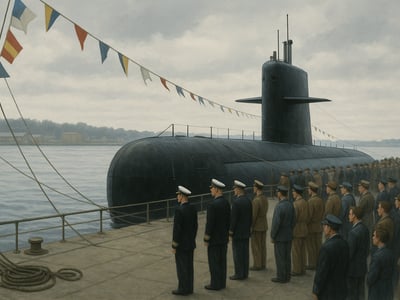
On 30 September 1954 the United States Navy commissioned USS Nautilus (SSN-571) at Groton, Connecticut, the first submarine built around a naval nuclear reactor. Electric Boat built the hull; Hyman G. Rickover drove the reactor program. Launched on 21 January 1954, the boat signaled “Underway on nuclear power” on 17 January 1955 and in 1958 passed submerged beneath the North Pole.
USS Nautilus entered U.S. Navy service at Groton in 1954 as a nuclear-powered submarine.
On September 30, 1954, the United States Navy commissioned USS *Nautilus* (SSN-571) at Groton, Connecticut, formally bringing into service a submarine unlike any it had operated before. Built at the Electric Boat shipyard and powered by a naval nuclear reactor developed through work involving Westinghouse and the U.S. Atomic Energy Commission, *Nautilus* represented more than a new hull or a faster engine. It marked the Navy's decision to accept, in operational form, a fundamentally different way of moving beneath the sea.
The limits of diesel-electric boats
For decades, submarines had been limited by the logic of diesel-electric propulsion. They could travel underwater on battery power, but only for limited periods before needing to surface or snorkel in order to recharge. That cycle shaped nearly every aspect of submarine use: patrol duration, speed, concealment, and tactical planning. Commanders could not simply imagine a submarine disappearing below the surface indefinitely. Engineering realities kept bringing it back into contact with air, fuel, and vulnerability.
The promise of nuclear propulsion was that it might break that pattern. A reactor-generated power plant offered the possibility of sustained underwater movement without dependence on the old battery cycle. That idea had attracted attention in the postwar years, but turning it into a fleet submarine required more than theory. It meant solving problems of reactor design, shielding, heat transfer, crew training, ship construction, maintenance, and command confidence. The commissioning of *Nautilus* was therefore not just ceremonial. It was an institutional step: the Navy was declaring that this technology was ready to leave the realm of development and enter regular service.
Rickover and a new kind of power
One of the central figures behind that transition was Hyman G. Rickover, whose role in naval reactor development became closely associated with the project. Rickover was not the only person involved, nor was the submarine the work of one office alone. The program depended on coordination between naval leadership, civilian atomic-energy authorities, engineers, industrial contractors, and shipyard workers. But Rickover's influence helps explain why *Nautilus* was treated from the beginning as both a technical experiment and a discipline-building program. If nuclear propulsion was going to work at sea, it would require exacting standards not only in design but in operation.
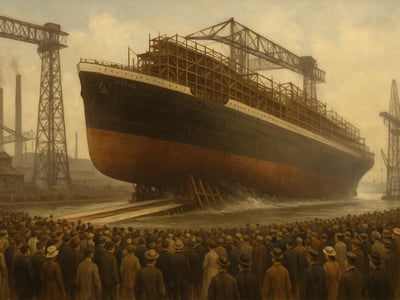
Earlier that same year, on January 21, 1954, *Nautilus* had been launched at Groton, with Mamie Eisenhower serving as sponsor. Launching a vessel, however, is not the same as commissioning it. Launch marks a ship's entry into the water; commissioning marks its entry into naval service. Between those moments lay the difficult work of fitting out, testing, and integrating a machinery system that had no true predecessor in the fleet. By September, the question was whether the Navy would treat nuclear propulsion as an interesting prototype or as a practical capability worth organizing around.
Launch, then commissioning
That decision carried risks. If the reactor plant proved unreliable, if shipboard integration failed under operational conditions, or if the training burden turned out to be too difficult, the entire case for nuclear submarines could have weakened. Cost and safety concerns were not abstract matters. A propulsion system powerful enough to transform naval operations also imposed responsibilities that extended far beyond a single voyage. Crews had to be prepared to operate and monitor the reactor correctly. Maintenance practices had to be defined. Oversight had to be continuous. A submarine could not become useful merely by possessing advanced machinery; it had to fit into a working institution.
The months after commissioning quickly showed why the event mattered. On January 17, 1955, after getting under way from New London, Connecticut, *Nautilus* sent the now-famous signal: "Underway on nuclear power." The phrase was brief, but its significance was large. It announced that the concept accepted in September had begun to function at sea. The submarine was no longer only a symbol of technical ambition. It was demonstrating that nuclear propulsion could support actual operations.
Underway on nuclear power
What followed over the next several years reinforced that impression. *Nautilus* helped show that a submarine no longer needed to think about the sea in the same stop-and-start rhythm imposed by diesel-electric endurance. Sustained submerged travel changed not only engineering expectations but strategic ones. A submarine that could remain underwater longer and operate over greater distances with fewer interruptions offered naval planners new possibilities during the Cold War, when stealth, endurance, and mobility mattered greatly.
Its most widely remembered later achievement came on August 3, 1958, when *Nautilus* completed a submerged transit beneath the North Pole during Operation Sunshine. That voyage did not create the importance of the submarine, but it made visible to a broad audience what nuclear propulsion had made possible. Regions that had once posed severe navigational and endurance challenges could now be approached in new ways. The under-ice Arctic, in particular, took on new military and geographic significance.
Why it still matters
The commissioning of *Nautilus* still matters because it was the point at which nuclear propulsion moved from development program to accepted fleet capability. New technology often receives attention at the moment of invention or public unveiling, but institutional history turns on a different question: when does an organization decide that a tool is ready to trust, staff, regulate, and build upon? On September 30, 1954, the U.S. Navy answered that question for the nuclear submarine.
That choice had consequences far beyond one vessel. The success of *Nautilus* helped validate a broader model built around reactor-trained personnel, specialized industrial support, and closely managed technical oversight. Those systems became essential to the larger nuclear navy that followed. In that sense, the submarine was not simply a ship with a new engine. It was an early test of whether a complex military organization could absorb nuclear technology into daily practice.
It also marked a durable shift in submarine operations. The move from diesel-electric boats to nuclear-powered fleets changed patrol patterns, strategic planning, and assumptions about what submarines could do. During the Cold War, that mattered in practical terms, not just symbolic ones. Endurance underwater was no longer a narrow engineering measure; it became a defining operational advantage.
Seen from the distance of decades, the commissioning at Groton stands as a hinge moment in naval history. The ceremony itself was brief, but what it accepted into service was a new operating model for submarines—one that would influence ship design, training, and maritime strategy long after 1954.
Timeline
- USS Nautilus is launched at Groton
- USS Nautilus is commissioned
- Nautilus signals underway on nuclear power
- Nautilus completes a submerged transit of the North Pole
What you uncovered
When a Prototype Became a System
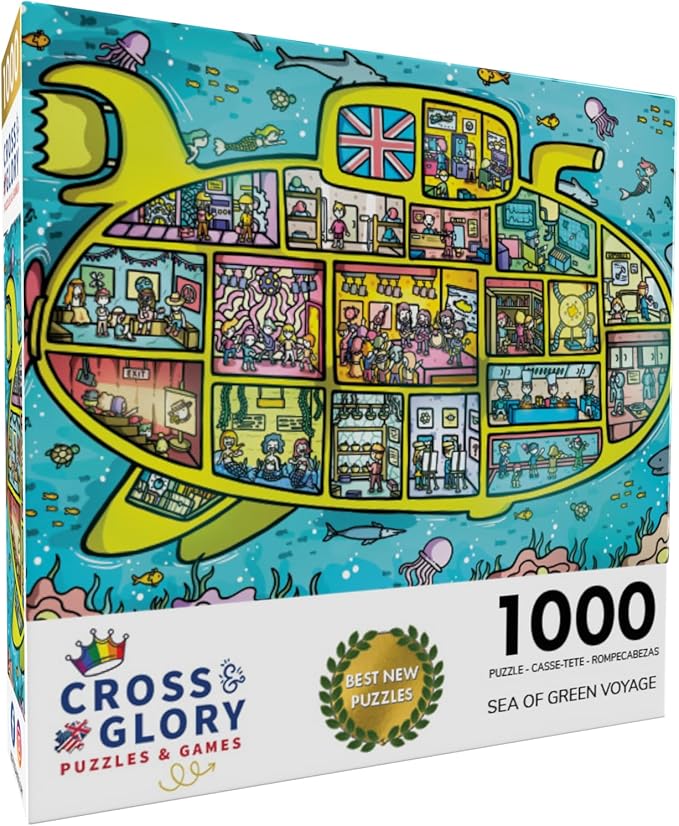
You didn't just… finish a puzzle; you traced the moment the Navy committed itself to making nuclear propulsion work in everyday service, not only in design and testing.
Commissioning Nautilus mattered because it turned an engineering project into an institutional obligation. From that point on, the question was no longer whether a reactor could power one submarine, but whether training, maintenance, oversight, and command procedures could reliably support a new kind of fleet. That wider system, not the vessel alone, is what made nuclear propulsion durable in naval operations.
On 17 January 1955, Nautilus sent the signal "Underway on nuclear power" after departing New London, Connecticut.
FAQ
When was USS Nautilus commissioned into the U.S. Navy?
USS Nautilus (SSN-571) was commissioned on 30 September 1954 at Groton, Connecticut. That marked its entry into service with the United States Navy.
Where was the USS Nautilus commissioning held?
The commissioning took place at Groton, Connecticut. The submarine had been built by the Electric Boat Division of General Dynamics there.
What made USS Nautilus different from earlier submarines?
USS Nautilus used an S2W pressurized-water reactor for propulsion. It introduced sustained underwater operation without depending on diesel-electric battery cycles.
What did 'Underway on nuclear power' mean?
On 17 January 1955, Nautilus sent that signal after getting under way from New London, Connecticut. It indicated that the submarine was operating on nuclear power.
Why is the commissioning of USS Nautilus historically important?
Its commissioning marked the point when nuclear propulsion moved from development into accepted fleet service. It helped validate the Navy's new nuclear submarine operating model.