
About this story
On 18 October 1860 British forces under Lord Elgin began burning the Yuanmingyuan, the Old Summer Palace, northwest of Beijing. The fire came at the end of the Second Opium War, after the detention of Harry Smith Parkes near Tongzhou and after looting of the complex. The Convention of Peking followed later that month. The ruins remain a reference point for wartime destruction of cultural property.
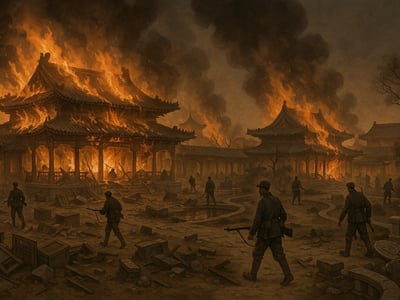
Yuanmingyuan near Beijing after British forces ordered its destruction in October 1860
On October 18, 1860, British forces acting under the authority of Lord Elgin began burning the Yuanmingyuan, known in English as the Old Summer Palace, northwest of Beijing. The destruction came in the final phase of the Second Opium War, after Anglo-French troops had advanced toward the Qing capital and after the detention and mistreatment of foreign prisoners near Tongzhou had sharpened demands for reprisal. What was destroyed was not a single building but a vast imperial complex of palaces, gardens, libraries, and storehouses closely tied to the Qing court.
More than one palace
The event is often remembered through the image of flames consuming a palace, but the Yuanmingyuan was much larger and more complex than that image suggests. It was an extensive landscape of architecture and designed gardens used by Qing emperors as a political and residential center outside the Forbidden City. For the Qing court, it was both a working seat of imperial life and a place that concentrated art, archives, and objects gathered over generations. Its loss therefore carried symbolic, administrative, and cultural weight at the same time.
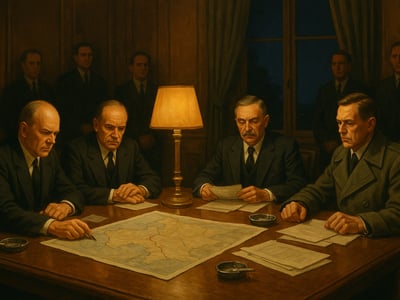
The broader setting was the Second Opium War, a conflict in which Britain and France pressed the Qing state through both military force and diplomacy. The war had begun earlier in the decade, and in 1860 Anglo-French forces renewed their campaign, moving from the Tianjin area toward Beijing. Negotiation and armed advance were closely entangled. Diplomats and military commanders were trying to force new concessions while also calculating how far pressure on the Qing government should go.
The campaign reaches Beijing
One of the key episodes in that advance came near Tongzhou in September 1860, when the British envoy Harry Smith Parkes and others were detained by Qing forces during negotiations. Prisoners taken in this episode were mistreated, and some died. News of their treatment had a powerful effect on British decision-making. It turned a military campaign that was already coercive into one in which punishment became an explicit question: how could the Qing court be made to feel the consequences of these actions in a way that would be unmistakable, but that would not create even wider political fallout?
By October, Anglo-French forces had entered the Beijing area after the Qing court had withdrawn from the capital region. The Xianfeng Emperor was away, and Prince Gong became the key Qing negotiator dealing with the foreign powers. Before the order to burn the Yuanmingyuan was carried out, troops had already looted parts of the complex. This matters because the destruction did not occur in isolation. Removal of objects and deliberate burning formed part of the same moment of occupation, even if different units and chains of command were involved.
A punitive fire, not a battle
Lord Elgin faced a decision that he later framed as punitive rather than purely military. A direct strike on the Forbidden City would have carried obvious risks, including a deeper insult to the Qing dynasty and possibly greater complications for the negotiations still underway. The Yuanmingyuan, by contrast, was an imperial site of great importance but not the formal core of dynastic rule in the same way. Ordering its destruction was meant to send a severe message to the Qing court while stopping short of an attack on the central ceremonial heart of Beijing.
That calculation did not make the decision simple. The Yuanmingyuan was not a battlefield target in the ordinary sense. Burning it meant accepting the destruction of buildings, collections, and records that could not be replaced. Even within the logic of nineteenth-century imperial warfare, it was a choice that linked punishment to cultural loss. Some later accounts have treated the act chiefly as retaliation for the treatment of prisoners; others emphasize how closely it reflected the coercive habits of the age, when military victory, treaty pressure, and symbolic destruction could be used together.
Flames, then a treaty
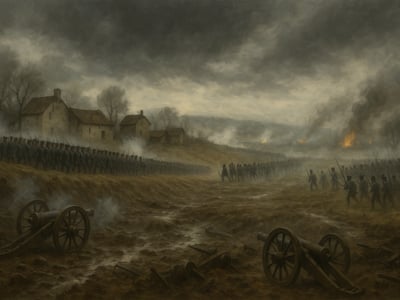
The burning began on October 18 and continued over subsequent days. Reports by participants and later observers differ in detail, but there is broad agreement on the main sequence: looting had already taken place, British forces then set fire to major parts of the complex, and the result was catastrophic damage to one of the Qing empire's most important imperial landscapes. The site that survived in partial ruins became, over time, a powerful monument to loss.
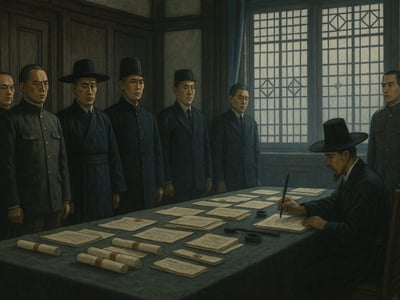
The destruction also occurred just before the formal settlement of the campaign. In late October 1860, the Convention of Peking was concluded with Prince Gong on behalf of the Qing government. In this sense, the burning of the Yuanmingyuan was not an isolated outburst at the margin of war. It took place alongside the final imposition of treaty terms. That combination helps explain why the event has remained so important in historical memory: it showed how violence against people, pressure on governments, and damage to cultural sites could all be folded into a single episode of imperial negotiation.
Why it still matters
The burning of the Old Summer Palace remains important for several connected reasons. One is the question of cultural property in wartime. Although the legal frameworks now associated with protecting cultural heritage were developed later, the destruction of the Yuanmingyuan is often cited in discussions about what armies should not do to sites of artistic, archival, and historical significance. It stands as a clear example of how punishment directed at a government can become irreversible damage to a society's cultural record.
Another reason is the long afterlife of the objects removed from the complex. Items associated with the Yuanmingyuan entered collections, markets, and later museums in several countries. As a result, the events of 1860 continue to shape debates about provenance, ownership, and restitution. These debates do not concern only art history. They also concern how institutions explain the circumstances under which objects left their original setting and what obligations follow from that history.
The event also helps historians understand nineteenth-century imperial conflict more broadly. In the campaign around Beijing, warfare and negotiation were not separate tracks. Military force was used to shape the terms of diplomacy, and symbolic destruction was used to communicate political power. The burning of the Yuanmingyuan is therefore remembered not only because of what was lost at the site itself, but because it reveals how coercion operated in an age of unequal treaties and expanding imperial reach.
Today the ruins of the Old Summer Palace carry meanings that extend beyond the immediate events of October 1860. They are part of the history of the Qing court, part of the history of foreign intervention in China, and part of a wider international conversation about memory and heritage. The fire that began on October 18 did not just end a set of buildings. It left a historical reference point that still shapes how war, diplomacy, and cultural destruction are understood.
Timeline
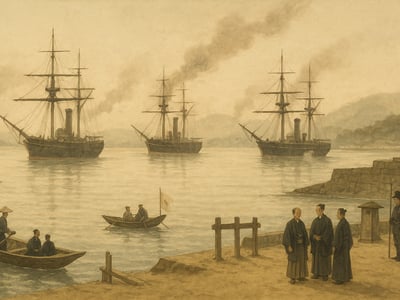
- Arrow Incident
- Detention of Harry Smith Parkes near Tongzhou
- Looting of the Yuanmingyuan
- Burning of the Yuanmingyuan begins
- Convention of Peking
What you uncovered
Punishment Through Ruins
You didn't just complete a puzzle—you traced how military power was expressed through the deliberate destruction of a place tied to imperial authority and cultural memory.
The burning of the Yuanmingyuan was framed by British leadership as a reprisal, but it also shows how punishment in imperial war could be staged through symbolic targets rather than purely military ones. Choosing an imperial cultural complex instead of the Forbidden City sent a message to the Qing court while limiting some immediate political risks. That combination of coercion, negotiation, and cultural loss helps explain why the event still matters in debates about wartime conduct and historical responsibility.
Before the burning began, Anglo-French troops had already looted parts of the Yuanmingyuan complex.
FAQ
What happened on 18 October 1860 at the Yuanmingyuan?
On 18 October 1860, Lord Elgin ordered the burning of the Yuanmingyuan near Beijing during the Second Opium War. The destruction began that day and continued over subsequent days.
Who ordered the destruction of the Old Summer Palace?
The order came from James Bruce, 8th Earl of Elgin, acting as British commander in the campaign around Beijing. Anglo-French forces were in the area after entering Beijing in October 1860.
Why was the Yuanmingyuan targeted instead of the Forbidden City?
The destruction was intended as a punitive response to the detention and mistreatment of foreign prisoners, including Harry Smith Parkes, near Tongzhou. British commanders wanted a strong signal to the Qing court without directly striking the Forbidden City.
Did the burning of the Yuanmingyuan happen in one day?
No. The destruction is commonly described as beginning on 18 October 1860 and continuing over the following days. Before the burning, Anglo-French troops had already looted parts of the complex.
What happened after the destruction of the Yuanmingyuan?
In late October 1860, the Convention of Peking was concluded with Prince Gong on behalf of the Qing government. The event later became a major reference point in debates about cultural loss, war, and restitution.