
About this story
On 8 September 1966 NBC aired The Man Trap, the first network episode of Star Trek, created by Gene Roddenberry and produced by Desilu. The series had already needed two pilots before it reached a weekly slot. The broadcast put Kirk, Spock, and the Enterprise on national television, but it was still an uncertain science-fiction bet against more familiar prime-time formulas.
NBC's 1966 launch of Star Trek began with "The Man Trap" in the United States.
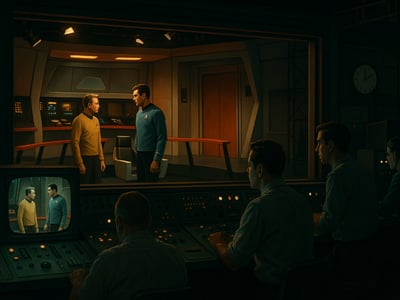
On September 8, 1966, NBC aired *The Man Trap* as the first broadcast episode of *Star Trek* in the United States. With that telecast, a new one-hour science-fiction series created by Gene Roddenberry entered the national network schedule. Produced by Desilu Productions, the program introduced viewers to the starship Enterprise and to the central screen partnership that would define its early identity: William Shatner as Captain James T. Kirk and Leonard Nimoy as Mr. Spock.
A risky hour in the network schedule
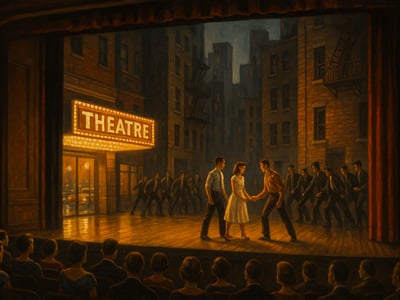
At the moment of its debut, however, *Star Trek* did not arrive as an obvious cultural institution. It was a risky prime-time project in a television environment more reliably shaped by westerns, crime dramas, variety programs, and situation comedies. Science fiction existed on television before 1966, but it was not a standard formula for network success. For NBC and for the producers behind the series, the question was whether an ambitious program about space travel, diplomacy, danger, and exploration could hold a broad weekly audience.
The path to that first broadcast had already been unusual. Before the September premiere, NBC had ordered *Star Trek* only after the production of two separate pilot episodes. The first, *The Cage*, was not accepted for broadcast as the series opener. Rather than ending the project there, the network took the uncommon step of commissioning a second pilot, *Where No Man Has Gone Before*. That decision kept the concept alive long enough to become a full series. It also showed that the program had to be reshaped and justified before it could claim a place on the schedule.
Two pilots before a public start
This development history matters because it reveals how uncertain the series still was in 1966. Many television projects never move beyond a pilot. Others receive a limited chance and disappear quickly if ratings disappoint. *Star Trek* faced both kinds of risk: first in development, then in the transition from pilot to regular broadcast. The September 8 premiere was therefore not simply a creative milestone. It was also the point at which investment in scripts, sets, cast, and production had to meet the practical test of audience attention.
Desilu Productions played a central role in getting the series to air. The studio, led by Lucille Ball when *Star Trek* reached television, backed the project through development and delivered it for network broadcast. Herb Solow, a Desilu executive associated with the series' launch period, was part of the management structure that helped shepherd it from concept to screen. In industrial terms, *Star Trek* was not just an idea from a creator. It was the result of studio support, executive decisions, and network willingness to continue with a demanding production.
The Man Trap, Kirk, and Spock
The first episode that audiences actually saw on NBC was *The Man Trap*, not *The Cage*. That distinction remains important in television history because the earliest pilot and the first aired episode are often confused. *The Cage* came first in production but was not the program's initial network broadcast. *The Man Trap* was the beginning of *Star Trek* as a public weekly series. For viewers in 1966, that was the first point of contact with the world of the Enterprise.
The launch also established the public faces of the program. Shatner's Kirk provided the commanding lead, while Nimoy's Spock offered a distinct on-screen presence that quickly became central to the series' identity. Together, their characters helped give the show a recognizable dramatic structure. Even for viewers unfamiliar with the production history, the combination of command decisions, interpersonal tension, and speculative storytelling marked *Star Trek* as something different from more familiar network fare.
Opportunity without permanence
Yet there was nothing inevitable about what followed. A series premiere creates opportunity, not permanence. In 1966, *Star Trek* still had to survive scheduling pressures, ratings scrutiny, and the high demands of weekly television production. The fact that the show later became a major franchise can make its first night look more secure than it really was. At the time, it was a new program testing whether its premise could sustain a network run.
Why it still matters
The premiere of *Star Trek* remains significant because it shows how network television could become the starting point for long-running franchise culture. What began as a single fall-season launch grew, over time, into a durable body of television series, films, syndication, licensed products, and fan gatherings. That later expansion was not visible in full on September 8, 1966, but the broadcast created the public opening from which it became possible.
The story also illustrates how much television history depends on development choices that are easy to overlook later. NBC's decision to proceed after *The Cage*, the commissioning of a second pilot, and Desilu's continued support all shaped the outcome. These were not abstract creative gestures; they were practical decisions about money, scheduling, and confidence in an uncertain format. The series' later prominence makes those earlier choices easier to study.
Finally, the 1966 debut remains a useful point of reference in media history because it links industrial process with cultural memory. The first broadcast episode was a routine network event in one sense, listed in schedules and subject to ordinary ratings pressure. But it also marked the arrival of a fictional setting and cast that would remain widely recognizable for decades. That combination of ordinary launch and long afterlife is what gives the premiere its lasting place in television history.
Timeline
- NBC rejects The Cage as the series opener
- The Man Trap airs as Star Trek’s first network episode
- Second-season run begins on NBC
- Original series ends with Turnabout Intruder
What you uncovered
An Uncertain First Voyage
You didn't just… complete a puzzle; you traced the moment a network experiment first reached viewers before anyone knew it would outlast its original broadcast run.
What stands out about this premiere is the gap between its modest starting point and its later staying power. Star Trek did not arrive as an obvious media certainty; it emerged through pilot revisions, network approval, and ordinary scheduling decisions that often determine which ideas survive. Its long afterlife helps show how television history is shaped not only by debut nights, but by the industrial systems that keep a series circulating.
Before the series premiered, NBC ordered Star Trek only after two pilot episodes had been produced: "The Cage" and "Where No Man Has Gone Before."
FAQ
What first aired for Star Trek on September 8, 1966?
NBC aired "The Man Trap" as the first broadcast episode of Star Trek in the United States on September 8, 1966.
Who created Star Trek and appeared in its first broadcast?
Gene Roddenberry is credited as the creator of Star Trek. William Shatner appeared as Captain James T. Kirk and Leonard Nimoy as Mr. Spock in the 1966 NBC launch.
Was "The Man Trap" the original Star Trek pilot?
No. "The Man Trap" was the first episode broadcast on television, but the earlier pilots were "The Cage" and "Where No Man Has Gone Before."
Which company produced Star Trek for NBC in 1966?
Star Trek was produced by Desilu Productions, the studio company led by Lucille Ball when the series reached air in 1966.
Why did NBC order a second pilot before Star Trek premiered?
NBC ordered a second pilot after the production of "The Cage." That decision helped move the series toward network broadcast in 1966.