

About this story
On 12 August 2008 Michal Martikán of Slovakia won the men's C1 canoe slalom gold at the Beijing Olympics at Shunyi Olympic Rowing-Canoeing Park. Four days after the Games opened, his clean, timed run under gate penalties confirmed a career already marked by Olympic success since Atlanta 1996.
Michal Martikán won Olympic gold in men's C1 canoe slalom in Beijing on 12 August 2008.
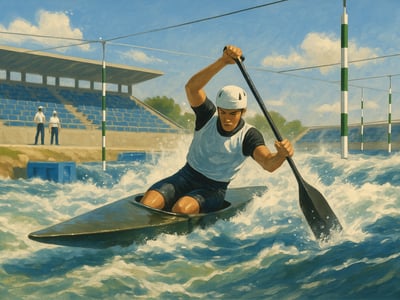
On 12 August 2008, Michal Martikán of Slovakia won the men's C1 canoe slalom event at the Beijing Olympic Games, adding another Olympic title to a career already closely associated with the sport. The race took place at the Shunyi Olympic Rowing-Canoeing Park in Beijing, a purpose-built venue where whitewater, gates, and the clock combined to turn each run into a precise technical test. In canoe slalom, medals are not decided by head-to-head contact or by a single dramatic move, but by a sequence of small decisions made under pressure, each one carrying the possibility of gaining or losing precious time.
Gold on the Shunyi whitewater course
The Beijing Games had officially opened just four days earlier, on 8 August 2008, and the Olympic program was moving quickly across venues built to showcase different sports. At Shunyi, the setting was very different from the stadium events that often dominate Olympic memory. Canoe slalom asks athletes to guide narrow boats through a whitewater course marked by hanging gates, some taken downstream and others upstream. Competitors race individually against the clock, but the final standings depend on more than raw speed. Touching a gate adds a time penalty, and missing one carries an even greater cost, so a run that looks fast can quickly slip down the order.
That basic structure gave the men's C1 event its tension. Every paddler faced the same course, but not in the same way. Water changes from moment to moment, and the athlete must read the current while controlling angle, rhythm, and balance. In C1, a single paddler kneels in the boat and uses a single-bladed paddle, which places unusual importance on timing and boat placement. Progress through the course depends on judging how much risk to accept: push hard for speed, and a gate touch may follow; paddle too safely, and the lost momentum may be just as costly.
Gates, penalties, and racing the clock
Martikán arrived in Beijing as one of the best-known names in Olympic canoe slalom. His earlier Olympic title at Atlanta 1996 had already established him at the highest level, and his continued presence among medal contenders showed unusual longevity in a demanding technical sport. That background mattered, but it did not remove the uncertainty of a single Olympic final. In slalom, reputation does not cancel penalties, and previous medals do not simplify a difficult line through whitewater. Each run still has to be executed cleanly.
On 12 August, Martikán's performance depended on exactly those details. The official results for the men's Canadian Singles, or C1, recorded him in first place when times and penalties were finalized. Behind that result was the kind of run the discipline rewards most: quick enough to lead the field, but controlled enough to avoid the small errors that often decide the medal order. His choices through the course had to balance attack with restraint, using speed where the channel allowed it and preserving accuracy where a rushed approach could turn into penalty time.
Experience under a single Olympic final
The margin mattered because the competition behind him was strong. David Florence of Great Britain finished second and took the silver medal, confirming that the event was decided in a tightly competitive field rather than by a distant advantage. In canoe slalom, even when the standings appear clear on paper, the difference between gold and silver is often rooted in moments so brief that spectators may miss them in real time: the entry to an upstream gate, the exit from a turn, a slightly cleaner line through disturbed water.
The venue itself was part of the story. Shunyi Olympic Rowing-Canoeing Park had been developed to host rowing, sprint canoe, and slalom events for the Beijing Games, reflecting the scale of Olympic preparation in 2008. For slalom athletes, however, a modern venue is only a framework. What matters inside it is how the artificial whitewater behaves and how well a paddler can adapt. The course offers a standard set of demands to all competitors, yet every athlete experiences those demands differently according to style, judgment, and confidence.
A measurable Slovak Olympic landmark
Martikán's victory also stood out in the context of Slovakia's Olympic history after independence. Success in a technical individual event carries a particular visibility because there are no teammates to distribute responsibility and no tactical substitutions once the run begins. The athlete, the boat, the current, and the clock are all bound together in a performance that can be measured exactly. That clarity helps explain why official Olympic result pages and archived records remain such important anchors for the event: the order is determined by a visible scoring system of elapsed time and penalties.
Why it still matters
Martikán's win remains part of Slovakia's Olympic record in a sport that rewards repeatable technical excellence rather than one-off spectacle. It is a useful example of how canoe slalom works at the highest level: course design creates problems, penalty rules punish imprecision, and athletes succeed by making many correct decisions in rapid succession. For viewers unfamiliar with the discipline, the Beijing result offers a clear case study in how an event can be both measurable and deeply dependent on judgment.
It also matters because Olympic canoe slalom provides a long-term benchmark for elite performance. Times can be compared only within the conditions of a given course, but medals across multiple Games show something broader: the ability to sustain world-class execution over many years. Martikán's place at the top in Beijing linked experience with performance, showing that mastery in slalom is not simply about strength or daring. It is about reading water, controlling risk, and repeating difficult actions with precision when the stakes are highest.
When the official records of Beijing 2008 list Michal Martikán as the gold medalist in men's C1 canoe slalom, they preserve more than a final ranking. They capture a sport in which outcomes turn on technique measured in seconds and errors counted in penalties. On that August day in Beijing, Martikán put those elements together better than anyone else in the field, and that is why his run still holds its place in Olympic history.
Timeline
- Martikán wins Olympic C1 gold at Atlanta
- Beijing Summer Olympics open
- Martikán wins men's C1 gold at Shunyi
- David Florence of Great Britain takes silver
What you uncovered
Margins on Whitewater
You didn't just… complete a sports puzzle; you reconstructed a race where control, timing, and a few small decisions could separate gold from silver.
Martikán's Beijing result is a good example of how canoe slalom often rewards repeatable judgment more than any single dramatic move. On a timed whitewater course, athletes are constantly weighing rhythm, entry angle, and how much risk to take at each gate, knowing that a slight correction or penalty can outweigh raw speed. That is why experienced paddlers can remain competitive across Olympic cycles: the event measures technical decision-making as much as physical execution.
David Florence of Great Britain finished second behind Martikán in the men's C1 canoe slalom final in Beijing on 12 August 2008.
FAQ
What did Michal Martikán win at Beijing 2008?
On 12 August 2008, Michal Martikán won the men's C1 canoe slalom final at the Beijing Olympic Games. He finished first in the official results.
Where was the men's C1 canoe slalom held?
The event took place at Shunyi Olympic Rowing-Canoeing Park in Beijing, China. That was the venue for the Olympic canoe slalom competition in 2008.
Who finished second behind Michal Martikán?
David Florence of Great Britain finished second in the men's C1 event at Beijing 2008. He took the silver medal behind Martikán.
What made the canoe slalom course challenging?
Athletes raced individually against the clock on a whitewater course where gate penalties affected final times. A touched or missed gate could change the standings.