
About this story
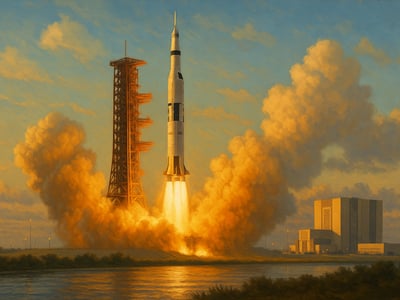
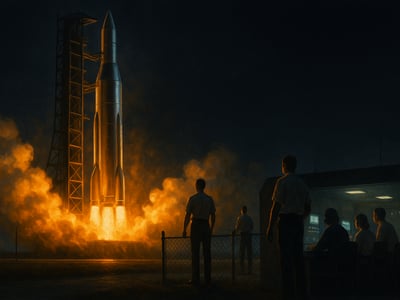
On 20 August 1977 Voyager 2 lifted off from Cape Canaveral in Florida aboard a Titan IIIE-Centaur, beginning a NASA mission to the outer planets. The launch put it on a path that later enabled flybys of Jupiter, Saturn, Uranus, and Neptune — the only mission to visit all four giant planets.
Voyager 2 at Cape Canaveral before its 20 August 1977 launch toward the outer planets.
On August 20, 1977, Voyager 2 lifted off from Launch Complex 41 at Cape Canaveral Air Force Station in Florida aboard a Titan IIIE-Centaur rocket, beginning one of NASA’s most consequential deep-space missions. At the moment of launch, however, its future significance was still uncertain. The spacecraft had to survive ascent, separate correctly from its launch vehicle, and be placed on a precise path away from Earth and toward the outer planets. A small error at the start could have ended the mission before it reached its first destination.
Lift-off from Florida and early uncertainty
Voyager 2 was part of NASA’s outer-planet exploration program, developed with major work at the Jet Propulsion Laboratory in Pasadena, California. Mission planners were working within a rare opportunity: the outer planets were positioned in a way that made a multi-planet mission possible through carefully planned gravity assists. That did not make the task simple. It meant that launch timing, navigation, and later course corrections all mattered greatly. Engineers and managers, including project manager John R. Casani and scientist Ed Stone, were helping guide a mission that would have to function not for days or weeks, but for years and eventually decades.
The spacecraft launched before Voyager 1, even though its name suggested otherwise. The two missions were related but not identical. They were sent on separate trajectories, designed to meet different encounter conditions and scientific priorities. Voyager 1 followed on September 5, 1977, also from Cape Canaveral, but Voyager 2’s earlier departure placed it on the path that would eventually allow visits to all four giant planets: Jupiter, Saturn, Uranus, and Neptune.
A rare alignment of the outer planets
At launch, none of those later successes were guaranteed. A mission to the outer solar system depended on repeated technical success over very long distances. After the launch vehicle did its work, the spacecraft had to remain healthy in deep space, communicate with Earth across expanding gaps, and execute commands with limited opportunity for immediate intervention. The challenge was not only getting off the ground, but preserving a working observatory through years of flight in an environment no repair crew could reach.
Voyager 2’s first major planetary encounter came at Jupiter. On July 9, 1979, it made its closest approach to the giant planet, beginning the series of flybys that would define the mission. Jupiter was more than a target on a map. It was a test of whether the spacecraft, its instruments, and the mission team could carry out the kind of long-range planetary science the program had promised. The encounter also prepared the team for the increasingly demanding sequence of later flybys.
From Jupiter to Neptune
The next key milestone came at Saturn, where Voyager 2 made its closest approach on August 25, 1981. By then the mission had already proven its durability, but Saturn was also a turning point. A spacecraft sent only to Jupiter and Saturn would already have been a major achievement. Voyager 2, however, continued outward. Its trajectory and surviving systems allowed the mission to go beyond the earlier expectations attached to many planetary probes of the era.
That continuing outward path led to Uranus in 1986 and then to Neptune. On August 25, 1989, Voyager 2 made its closest approach to Neptune, completing a sequence unmatched by any other spacecraft: flybys of all four giant planets. This was the result not of a single dramatic moment, but of a chain of decisions and successful operations stretching back to the launch in Florida twelve years earlier. The mission’s scale can make that easy to forget. The famous planetary images and measurements depended first on the ordinary but unforgiving demands of launch, guidance, power, and communication.
Why the mission still shapes exploration
Seen from the ground on launch day, the mission was still mostly a plan backed by engineering confidence. The Titan IIIE-Centaur had to deliver the spacecraft onto the correct interplanetary trajectory, and then the burden shifted to the spacecraft and the teams supporting it from Earth. Those teams had to think in long intervals, preparing not for one arrival but for a succession of encounters, each separated by years. Deep-space navigation required patience as much as precision.
Voyager 2 also stood at the meeting point of two kinds of ambition. One was technical: building a machine that could keep operating at extraordinary distance. The other was scientific: using a single mission to compare worlds across the outer solar system. By the end of the 1980s, those ambitions had produced a mission record unlike any other in planetary exploration.
Why it still matters
Voyager 2 remains important because it showed that a spacecraft launched in a narrow opportunity could support a mission lasting far beyond its original first encounters. It became a reference point for long-duration spacecraft operations, from power management to instrument planning to deep-space communications. Later missions have benefited from experience gained in keeping a robotic explorer productive over immense distances and long periods.
Its flybys also provided comparative data across four giant planets, something no other single mission has matched. Studying Jupiter, Saturn, Uranus, and Neptune within one broad program gave planetary scientists a way to compare atmospheres, magnetospheres, moons, and ring systems across very different environments. That comparative view has influenced both scientific interpretation and mission design.
Just as importantly, Voyager 2 is a clear example of how launch windows and gravity assists shape exploration beyond Earth. Interplanetary missions are not planned only around what scientists want to see; they are also shaped by orbital mechanics and timing. The launch from Cape Canaveral on August 20, 1977, was therefore not just a departure. It was the opening step in a mission built around rare alignment, careful calculation, and sustained operation over many years.
The enduring image of Voyager 2 is often of a spacecraft far from Earth, but its history begins with a much more immediate test: leaving Earth correctly. Everything that followed Jupiter, Saturn, Uranus, and Neptune depended on that successful start at Cape Canaveral. The launch was only the first event in the mission, yet it made all the later milestones possible.
Timeline
- Voyager 2 launch
- Voyager 1 launch
- Voyager 2 Jupiter flyby
- Voyager 2 Saturn flyby
- Voyager 2 Neptune flyby
What you uncovered
Timing the Outer Planets
You didn't just… complete a puzzle; you retraced the start of a mission that depended on exact timing, precise navigation, and years of planned encounters far from Earth.
Voyager 2's launch mattered not only because of where it was going, but because when it left shaped what became possible. A rare alignment of the outer planets made a multi-planet route practical through gravity assists, turning one launch window into a broader exploration strategy. That also helps explain the naming oddity: Voyager 2 launched first because its trajectory and schedule fit the available opportunity, while Voyager 1 followed on a different path designed to reach key targets sooner.
Voyager 2 remains the only spacecraft to have flown by Uranus and Neptune.
FAQ
When did Voyager 2 launch?
Voyager 2 launched on 20 August 1977. It was one of two Voyager launches that year.
Where was Voyager 2 launched from?
It launched from Launch Complex 41 at Cape Canaveral Air Force Station in Florida, United States.
What rocket launched Voyager 2?
Voyager 2 was launched aboard a Titan IIIE-Centaur launch vehicle.
How did Voyager 2 visit the giant planets?
After launch, Voyager 2 followed an outer-planet trajectory and later made flybys of Jupiter, Saturn, Uranus, and Neptune.